Melasma
How to Get Rid of Dark Spots on the Face: Types, Ingredients and Realistic Timelines
How do dark spots on the face go away? The short answer
Most dark spots on the face can be lightened, but not with a single cream and not in a few weeks. Three things decide the result: the type of spot, whether you protect your skin from the sun every day, and whether you use the right active ingredient for long enough. According to the American Academy of Dermatology (AAD), care for dark spots starts with sunscreen; lightening ingredients only work on top of that foundation.
A spot left behind by a pimple often fades on its own within months once its cause is gone. A sun spot does not disappear by itself, but it can be lightened with ingredients and clinic procedures. Melasma is a condition that can be brought under control and may return in summer.
Practical rule: First work out which type of spot you have. Every morning, apply a broad-spectrum sunscreen, ideally a tinted one with iron oxides. In the evening, choose one ingredient with evidence and use it consistently for at least 8-12 weeks. If a spot changes in shape, color or size, bleeds, or is new, show it to a dermatologist before trying any cream.
What causes dark spots on the face? Same melanin, different trigger
Your skin gets its color from melanin, which is made by cells called melanocytes in the base layer of the top layer of skin (the epidermis). Melanocytes produce melanin with the enzyme tyrosinase and pass it on in small packages (melanosomes) to the surrounding skin cells. A spot forms when this production or transfer increases in one area.
This detail matters because ingredients act on different steps: azelaic acid, vitamin C, kojic acid and isobutylamido thiazolyl resorcinol target tyrosinase, while niacinamide slows the transfer of pigment to skin cells.
The main triggers listed by the AAD are sun, a healing pimple or wound, an irritating product, certain medications, and hormonal changes such as pregnancy. The depth of the pigment also shapes the outcome: according to DermNet, pigment in the upper layer (epidermal) responds better to ingredients, while pigment in the lower layer (dermal) lightens much more slowly.
You can read how melanin is made from tyrosine, and why skin colour differs from person to person, in our guide to melanin and melanocytes.
How to tell your spot type: four common types
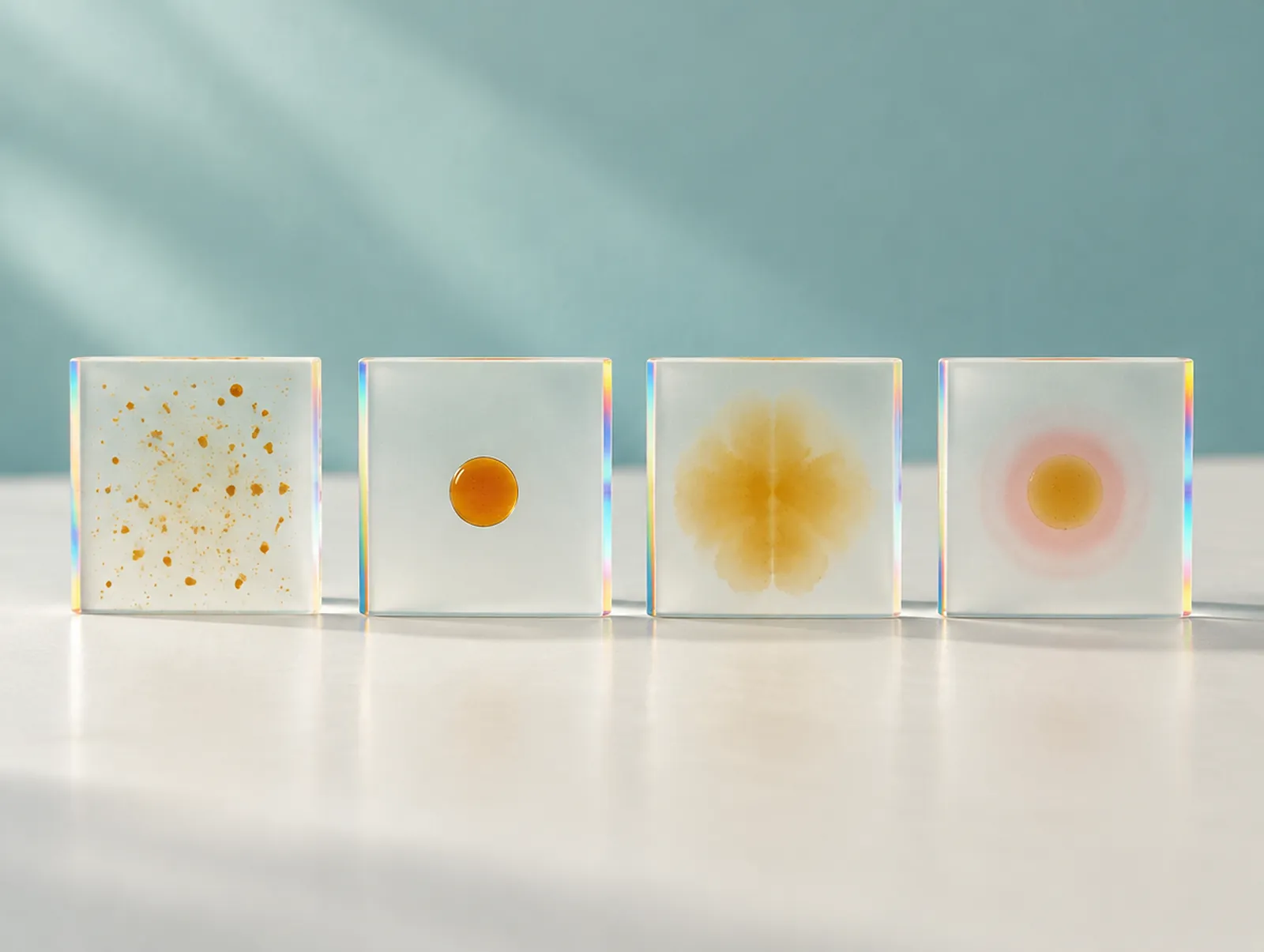
A definitive distinction is made by a dermatologist; according to the AAD, they look at the depth of the pigment with a dermatoscope or a Wood's lamp when needed. The clues below can still point you in the right direction.
Sun spots (solar lentigo)
According to DermNet, sun spots are the result of ultraviolet (UV) exposure that builds up over the years, and they appear most often in middle age and later. They are well-defined spots with an even color inside, ranging from a few millimeters to a few centimeters. They do not disappear in winter; in summer they may only darken slightly.
Melasma
Melasma shows up as irregular brown patches placed symmetrically on both cheeks, the forehead, the nose or the upper lip. According to DermNet, it is most common in women aged 20-40 and in skin that tans easily. When it appears during pregnancy, it is popularly called the pregnancy mask.
Post-inflammatory hyperpigmentation
These are spots, from light brown to black, that stay in the exact place of a pimple, eczema, burn or cut after it has healed. According to DermNet, they can occur on any skin tone, but in darker skin they are more frequent, more intense and longer lasting. They darken with sun exposure.
Freckles
Freckles are small brown dots that appear on the nose and cheeks from early childhood. According to DermNet, they become more visible in summer, fade largely in winter and usually become fewer in adulthood. They are common in fair-skinned and red-haired people and are hereditary.
| Type | Typical look | Where it appears | Seasonal change | Distinguishing clue |
|---|---|---|---|---|
| Sun spot | Sharp edge, one color, single spots | Face, backs of the hands, sun-exposed areas | Does not disappear in winter | Number grows with age and sun |
| Melasma | Symmetrical patch with irregular edges on both sides | Cheeks, forehead, nose, upper lip | Darkens in summer | Pregnancy, hormonal medication, melasma in the family |
| Post-inflammatory hyperpigmentation | Exactly where a former pimple or wound was | Any area | Darkens with sun | Preceded by a pimple, wound or irritation |
| Freckles | Small, scattered dots | Nose and cheeks | Visible in summer, fade in winter | Present since childhood |
What is melasma, what causes it and why does it come back?
Melasma is a long-term pigment disorder. NCBI StatPearls describes melasma as a chronic condition that often recurs; without lasting sun protection and maintenance care, the improvement achieved is often temporary. DermNet also stresses that even in people with good results, pigment can reappear with summer sun.
What causes it? The exact cause is unknown. According to DermNet, 60% of those affected report melasma in their family. Pregnancy and contraceptives containing estrogen or progesterone are seen as the trigger in one in four affected women. The sun's UV rays and visible light increase melanin production; the AAD also lists stress among possible triggers.
What is the role of heat? The evidence is weak, but not weak enough to ignore. According to the 2022 review by Espósito and colleagues, the role of the infrared component of sunlight, felt as heat, in melasma has not been systematically studied; one survey did find a link between workplace heat and disease severity. Handel and colleagues, in their 2014 review, also note that they observed melasma to be hard to control in people working with oven heat. If you have melasma, limiting long steam sessions, saunas and heat applied to the face is a reasonable precaution; we have collected the details in our guide to hot applications on the face and thermal therapy.
Why does it come back? In melasma, pigment sits sometimes in the upper layer, sometimes in the lower layer and often in both. According to StatPearls, sun-related skin changes and increased blood vessel growth keep stimulating melanocytes and increase resistance to treatment. That is why the goal in melasma is not to erase but to lighten and keep it light.
Why is sunscreen the first step? The role of iron oxides in melasma
According to the AAD, sunlight pushes skin to make more pigment; it darkens an existing spot and causes new ones. The academy says that the right sunscreen for dark spots is SPF 30 or higher, broad-spectrum, water-resistant and contains iron oxides. Iron oxide protects against visible light, not UV; that is why it appears on the ingredient list not as an active ingredient but among the other ingredients, under the name "iron oxides". The academy also recommends reapplying every two hours when outdoors and after swimming or sweating, and wearing a wide-brimmed hat.
Why does visible light matter? According to the 2022 review by Morgado-Carrasco and colleagues, high-energy visible light can cause both immediate and lasting darkening in skin that tans easily (phototype III-IV); it does not in very fair skin (phototype I-II). StatPearls also reports that pigmentation caused by visible light can be more intense and lasting than that caused by UV.
What did the studies show? The double-blind study by Castanedo-Cazares and colleagues, done in Mexico in 2014, included 68 patients with melasma. Everyone used 4% hydroquinone, and only the sunscreens differed. After eight weeks, the improvement in the melasma severity score (MASI) was 15% greater in the group using the product with iron oxides.
In the 2015 study by Boukari and colleagues at Nice University Hospital, 40 patients used one of two sunscreens for 6 months through spring and summer; the UV protection was the same, and only one contained iron oxides. The MASI score rose by a median of 0.45 in the iron oxide group and 2.43 in the untinted group. One of the authors was an employee of a sunscreen manufacturer. We explain what SPF, UVA protection and the amount applied mean in our guide to repairing skin after pollution and UV damage.
The four ingredients with the strongest evidence for home use
The evidence for these ingredients comes mostly from melasma studies that compare them with hydroquinone. The 2022 systematic review by Pennitz and colleagues examined 36 randomized studies evaluating at-home melasma products and found 20 of them at high risk of bias. Read the results below with that caution.
Azelaic acid (15-20%)
Azelaic acid suppresses tyrosinase and reduces free radicals involved in melanin production. In the 1991 double-blind study by Baliña and Graupe, 329 women used 20% azelaic acid or 4% hydroquinone together with sunscreen for 24 weeks. The rate of good or very good results was 65% for azelaic acid and 73% for hydroquinone, and the difference was not significant. No allergic sensitization or ochronosis was seen with azelaic acid; the most common side effect is itching. The authors were affiliated with a pharmaceutical company.
Tranexamic acid (2-5%)
Tranexamic acid is actually a drug that reduces bleeding. It is thought to reduce the signals that stimulate melanin production by suppressing the plasminogen-plasmin pathway. In two studies covering 160 patients in Pennitz's review, 5% tranexamic acid cream gave results similar to 2% and 3% hydroquinone, with fewer side effects. The 2026 meta-analysis by Pessotti and colleagues, however, found the lightening effect versus placebo to be small or negligible in 32 studies covering all routes of administration. The results are mixed.
Vitamin C and its stable derivatives
L-ascorbic acid slows melanin production by binding to the copper in the active site of tyrosinase. According to the 2017 review by Al-Niaimi and Chiang, its pure form is unstable; it is more stable and penetrates the skin better below pH 3.5. For a meaningful effect the concentration must be above 8%; most products sit in the 10-20% range, and above 20% adds no benefit and may increase irritation. In the 2004 study by Espinal-Pérez and colleagues, 16 patients applied 5% vitamin C to one half of the face and 4% hydroquinone to the other. 62.5% of patients reported a good or very good result on the vitamin C side; hydroquinone worked faster, but irritation was 6.25% with vitamin C and 68.75% with hydroquinone.
3-O-ethyl ascorbic acid is a stable derivative developed to overcome the oxidation problem of pure vitamin C. The 2019 laboratory study by Iliopoulos and colleagues showed that it can pass through pig skin in suitable solvents; its clinical evidence on spots is thinner than that of pure vitamin C. The main active ingredient of Longos Brightening Serum is also stabilized 3-O-Ethyl Ascorbic Acid, formulated for the appearance of dark spots and uneven skin tone. We have collected common mistakes in our guide explaining what a vitamin C serum does.
Niacinamide (4-5%)
Niacinamide does not suppress tyrosinase; it slows the transfer of pigment to skin cells. In the 2002 study by Hakozaki and colleagues, this transfer fell by 35-68% in cell culture; in 18 Japanese women, 5% niacinamide reduced spots significantly more than the carrier cream in 4 weeks. Most of the researchers worked at a consumer products company. In the 2011 double-blind study by Navarrete-Solís and colleagues, in 27 patients, 4% niacinamide reduced MASI by 62% and 4% hydroquinone by 70% in 8 weeks; the difference was not significant. You can find the details in our article on the brightening effect of niacinamide serum.
Retinoids, arbutin, kojic acid and thiazolyl resorcinol: where is the evidence strong and where thin?
Retinoids. In the 1992 study by Rafal and colleagues, 58 people used 0.1% tretinoin or an inactive cream for 10 months. Sun spots on the face lightened in 83% of the tretinoin group and 29% of the other group; spots that disappeared completely did not return during 6 months of follow-up. In melasma, 0.1% tretinoin was found effective in a 40-week study; the improvement was noticeable only around week 24. Tretinoin is banned in cosmetics under Turkish regulations and is used as a medicine under a doctor's supervision. In the reviews we examined, we did not find a study showing the effect of retinol alone in melasma.
Arbutin. In 2023, the EU's Scientific Committee on Consumer Safety (SCCS) found alpha arbutin safe in face creams at up to 2% and beta arbutin at up to 7%. According to the committee, skin bacteria can convert alpha arbutin into hydroquinone; in the manufacturer's volunteer study this remained below 0.1%. Clinical evidence is limited.
Kojic acid. A substance obtained from fungi that suppresses tyrosinase. According to the SCCS it is safe up to 1%, but it is a concern when the barrier is weakened, such as after a peel. The most common side effect is irritation.
Isobutylamido thiazolyl resorcinol. A thiazolyl resorcinol derivative. In a study that screened 50,000 compounds against human tyrosinase, it emerged as one of the strongest candidates. In the 12-week 2019 study by Arrowitz and colleagues, 79% of participants improved on the face half treated with 0.2% isobutylamido thiazolyl resorcinol and 61% on the 2% hydroquinone side. A 2024 review found positive results in all 14 studies but considered the evidence limited; researchers from the company that developed the compound took part in a significant share of these studies.
| Ingredient | Concentration in studies | Pathway | State of evidence | Caution |
|---|---|---|---|---|
| Azelaic acid | 15-20% | Tyrosinase | Moderate, a large but old study | Itching, mild irritation |
| Tranexamic acid (cream) | 2-5% | Plasmin pathway | Mixed | Oral use is a doctor's decision |
| L-ascorbic acid | 10-20%, below pH 3.5 | Tyrosinase | Moderate, small studies | Oxidizes, irritates at high concentration |
| 3-O-ethyl ascorbic acid | Varies by product | Tyrosinase | Mostly laboratory data | Stable derivative |
| Niacinamide | 4-5% | Pigment transfer | Moderate, small studies | Generally well tolerated |
| Tretinoin | 0.05-0.1% | Cell renewal | Strong | A medicine, not used in pregnancy |
| Alpha arbutin | Up to 2% in face cream | Tyrosinase | Limited | May release hydroquinone |
| Kojic acid | Up to 1% | Tyrosinase | Limited | Do not use after a peel |
| Isobutylamido thiazolyl resorcinol | 0.1-0.2% | Human tyrosinase | Promising, manufacturer-sourced | Few independent studies |
Why is hydroquinone prescription-only? The situation in Turkey and the EU
Hydroquinone is a powerful tyrosinase suppressor that has long been considered the gold standard in melasma. According to DermNet, a triple cream combining hydroquinone, tretinoin and a moderate-strength corticosteroid clears or markedly reduces the spots in 60-80% of patients. But this is a medicine.
European Union. Hydroquinone is on the list of prohibited substances of the EU Cosmetics Regulation (Annex II, entry 1339). The only exception is artificial nail systems used by professionals only. So in the EU, a spot cream cannot contain hydroquinone as a cosmetic; hydroquinone can only be used as a medicine.
Turkey. The Cosmetic Products Regulation is prepared in line with the EU regulation, and hydroquinone is also on its Annex II prohibited list. The borderline products guideline of the Turkish Medicines and Medical Devices Agency (TITCK), updated in 2024, states clearly that skin lighteners containing hydroquinone are not cosmetics; it also places products intended to treat melasma, chloasma and lentigo outside the scope of cosmetics. According to the 2022 review by Tezel and colleagues from Hacettepe University, medicines containing hydroquinone are sold by prescription in Turkey.
Why so strict? According to the 2011 review by Bozzo and colleagues, 35-45% of hydroquinone applied to the skin passes into the blood. According to González-Molina and colleagues, at concentrations of 4% and above, irritation can reach 70% of patients, and with long use a blue-black discoloration of the skin (exogenous ochronosis) may occur. The AAD also reminds that some spot creams from abroad contain steroids or mercury that are not listed on the label. Stay away from "very strong" creams with unclear contents.
Morning and evening routine for dark spots, step by step
- Gentle cleansing. Avoid harsh, gritty or stinging cleansers; according to the AAD, an irritating product can cause a new dark spot on its own.
- Morning antioxidant. A vitamin C serum is not a substitute for sunscreen, but it adds support against the free radicals created by UV.
- Moisturizer. For skin prone to spots, the AAD recommends gentle products labeled "for sensitive skin" or fragrance-free.
- Tinted sunscreen. Apply plenty of an SPF 30 or higher product with iron oxides and reapply during the day.
- One lightener in the evening. Choose one of azelaic acid, niacinamide or tranexamic acid. If you use a retinoid, put it on separate evenings; layering many actives on the same night raises the risk of irritation and new spots.
- Do not scrape or pick. According to the AAD, post-inflammatory spots fade over time unless the wound is injured again.
- A photo every four weeks. Take it in front of the same window, at the same time, without makeup. A photo shows changes you do not notice in the mirror.
If you have melasma, do not use the heating modes of home devices on your face without your dermatologist's approval. If you are thinking of adding a device to your routine, our guide comparing home devices for uneven skin tone explains what each technology does to a spot.
How long do dark spots take to fade? A realistic timeline
Post-inflammatory hyperpigmentation. According to the AAD, once the cause is gone, a spot a few shades darker than your skin usually fades in 6-12 months. Deep spots that look gray-blue can take years to fade. Care can shorten this time.
Melasma. According to the AAD, when a treatment plan is followed, it usually takes 3-12 months to see results; if melasma has been present for a long time, even longer. This is why DermNet recommends year-round and lifelong sun protection.
Sun spots. According to DermNet, an untreated sun spot is usually permanent; strict sun protection can only lighten existing spots slightly. In Rafal's study, the first lightening with tretinoin was seen in the first month; in those whose spots disappeared completely, this took 8 months on average.
The durations of the studies draw the same picture: the iron oxide study lasted 8 weeks, the tranexamic acid and thiazolyl resorcinol studies 12 weeks, and the azelaic acid study 24 weeks. Give an ingredient at least 8-12 weeks before deciding; changing products every two weeks stops you from seeing whether any of them works.
What is done in the clinic? Peels, lasers and caution in melasma
Sun spots and freckles. For sun spots, DermNet lists freezing (cryotherapy), pigment-targeting lasers, intense pulsed light (IPL) and chemical peels; the highest clearance rates are seen when several methods are used together. However, methods that destroy tissue can leave temporary or permanent light or dark spots. For freckles, according to DermNet, a pigment laser gives a temporary lightening.
Peels. Surface pigment can be peeled off with alpha hydroxy acids such as glycolic acid, or with salicylic acid. In a study reported by González-Molina, a 20-30% glycolic acid peel every two weeks gave a slight added benefit to 4% hydroquinone; the risk of post-inflammatory hyperpigmentation in darker skin is real. According to the TITCK guideline, alpha hydroxy acid in cosmetics for general use must not exceed 10% and the pH must not fall below 3.5; for professional products the limit is 30% and pH 3.
Lasers and IPL in melasma. According to DermNet, microneedling, IPL and lasers including Q-switched Nd:YAG carry a high risk of recurrence in melasma and can make the condition more resistant to treatment; they should be done only in experienced hands and after preparing with a tyrosinase suppressor. The AAD also says that laser has helped in some studies only as an addition to medication and sun protection.
Oral tranexamic acid. According to the AAD, for resistant melasma a dermatologist may recommend a pill taken twice a day. If you have had a clotting problem before, be sure to say so.
Does the pregnancy mask go away? What can and cannot be used in pregnancy?
According to the American College of Obstetricians and Gynecologists (ACOG), brown patches on the face are common in pregnancy and most fade on their own after birth, but in some women they can last for years. A daily sunscreen and a wide-brimmed hat are recommended to prevent worsening.
In the 2007 study by Lakhdar and colleagues in Morocco, 200 pregnant women used an SPF 50+ product; of the 185 who completed the study, only 5 (2.7%) developed melasma. In the same team's earlier observation, the rate was 53%. There was no concurrent control group, and the authors included manufacturer employees.
What can be used. ACOG states that azelaic acid, glycolic acid and salicylic acid can be used in over-the-counter products during pregnancy. According to the review by Bozzo and colleagues, most of the skin care products examined act locally and very little passes into the blood.
What to avoid. ACOG recommends avoiding retinoids. Bozzo and colleagues also ask for exposure to hydroquinone to be minimized because of its high absorption. According to its manual, Longos Sense is also not used during pregnancy and breastfeeding. Talk with your dermatologist about leaving peels, lasers and prescription options until after birth and breastfeeding.
Which spot must be shown to a doctor? The ABCDE rule
Not every brown spot is harmless. According to DermNet, a sun spot can be mistaken for an early-stage melanoma (melanoma in situ), and sun spots are an independent risk factor for melanoma. According to the AAD's ABCDE rule, see a dermatologist right away if you have any of these features:
- A, asymmetry: One half of the spot does not match the other.
- B, border: The edge is irregular, notched or blurred.
- C, color: Brown, black, white, red or blue shades appear together.
- D, diameter: Melanoma is often larger than 6 millimeters, but it can be smaller.
- E, evolving: It is changing in size, shape or color; it looks different from the others.
A spot that is new, itchy or bleeding also needs an examination. A dermatologist's opinion also saves time in these cases: if you have symmetrical patches on both cheeks that darken in summer, if there is no lightening at all despite 3 months of regular care, or if spots appeared after a new medication. The AAD advises not stopping a medicine on your own and asking the prescribing doctor first.
Where to start this week?
This week, do two things: match your spot to the table above, and add a tinted sunscreen with iron oxides and SPF 30 or higher to your morning routine. For the evening, choose a single lightener and do not change it for 12 weeks.
If you would rather track the change by measurement than by guesswork, run the AI skin analysis in the Longos Sense app once on clean, product-free skin; the analysis scores pigmentation and skin tone evenness, and the look of pimples and spots, from 0 to 100. Repeat it once a month in the same light. The analysis does not diagnose; it is a care guide, not medical advice. For a spot that changes or is new, your first stop should be a dermatologist.
Frequently Asked Questions
What causes dark spots on the face?
Dark spots on the face form when melanin production, or the transfer of melanin to skin cells, increases in one area. According to the American Academy of Dermatology, the main triggers are sun, a healing pimple or wound, products that irritate the skin, certain medications and hormonal changes such as pregnancy. Depending on the trigger, four common types appear: sun spots, melasma, post-inflammatory spots and freckles. Knowing which type you have is the first step in choosing the right care.
Which cream works for dark spots on the face?
Look at the active ingredient, not the name of the cream. In spot and melasma studies, the most data exist for 15-20% azelaic acid, 10-20% L-ascorbic acid (vitamin C), 4-5% niacinamide and 2-5% tranexamic acid; the evidence for tretinoin is strong, but it is a medicine used under a doctor's supervision. None of them works well without sun protection: the American Academy of Dermatology recommends a broad-spectrum tinted sunscreen with iron oxides and SPF 30 or higher. Before judging an ingredient, use it regularly for at least 8-12 weeks.
Do sun spots go away?
Sun spots do not go away on their own; according to DermNet, they are usually permanent if untreated and may grow and darken over time. Strict sun protection only lightens an existing spot slightly. In a 1992 study, 0.1% tretinoin lightened sun spots on the face in 83% of patients over 10 months. In the clinic, freezing, pigment lasers and IPL can give a more visible result, but they may leave temporary or permanent light or dark marks. Show a spot that changes shape or color to a dermatologist first.
What is melasma and what causes it?
Melasma is a set of brown patches with irregular edges that appear symmetrically on both cheeks, the forehead, the nose or the upper lip. According to DermNet, it is most common in women aged 20-40, and 60% of those affected also have melasma in the family. The sun's UV rays and visible light, pregnancy and hormonal contraceptives are the main triggers; the role of heat is less well understood. Melasma is chronic and recurrent, so year-round sun protection is needed even after it lightens.
Does the pregnancy mask go away?
According to the American College of Obstetricians and Gynecologists (ACOG), melasma that appears in pregnancy often fades on its own after birth, but in some women it can last for years. A daily sunscreen and a wide-brimmed hat are recommended throughout pregnancy. ACOG states that azelaic acid, glycolic acid and salicylic acid can be used in pregnancy; it recommends avoiding retinoids and minimizing exposure to hydroquinone, which is highly absorbed. If the spot remains after birth, talk about the options with your dermatologist.
How long do dark spots take to fade?
The time depends on the type of spot. According to the American Academy of Dermatology, a spot left by a pimple or wound that is a few shades darker than your skin usually fades in 6-12 months after the cause is gone; deep gray-blue spots can take years. In melasma, seeing results with a treatment plan usually takes 3-12 months, and the spot may return in summer. A sun spot does not go away on its own. Whichever ingredient you choose, use it regularly for at least 8-12 weeks before deciding.
Clinical evidence