
Acne marks
How Do Acne Marks Go Away? Separate Paths for Red Marks, Brown Marks and Pitted Scars
How do acne marks go away? The short answer: know your mark type first
How acne marks fade depends on the type of mark. A flat red or brown mark is usually not a true scar: with daily sunscreen and the right actives it fades over months. A depressed (pitted) scar rarely disappears on its own. No cream lifts it, and results come from clinic procedures.
According to the American Academy of Dermatology (AAD), the flat, colored area left behind once a pimple clears is usually not a scar but post-inflammatory discoloration. The same organization notes that true acne scars may lighten in color over time, but the scar itself rarely disappears completely.
So what you call a "scar" can be one of four different things, and each has its own path. The first job is to work out which one you are looking at in the mirror. The second is to stop new marks: as long as acne stays active, every new pimple is a candidate for a new mark.
One word, four different situations: red marks, brown marks, pitted and raised scars
According to Bae-Harboe and Graber (2013), acne can leave three kinds of marks: red marks, brown marks, or true scars that change the texture of the skin. The authors stress that most people have a mix of these and that each needs its own approach. A fourth group, less common, is raised scars.
Red or pink marks: post-inflammatory erythema
This is the flat pink, red or purplish mark left after a pimple heals. Its source is not pigment but the small blood vessels that widen during inflammation. According to the same paper, it is more common in lighter skin tones and tends to fade over time.
Brown marks: post-inflammatory hyperpigmentation
Inflammation stimulates the pigment cells, leaving a flat mark that ranges from light to dark brown. According to DermNet, this can occur in every skin tone, but it is more frequent, more intense and longer lasting in darker skin. In a study cited in the 2010 review by Davis and Callender, acne-related brown marks developed in 65.3% of African American patients, 52.7% of Hispanic patients and 47.4% of Asian patients.
The shade of the mark reveals its depth. According to the same review, pigment at the surface looks brown. Pigment deeper down takes on a blue-gray tone, fades much more slowly and can sometimes be permanent.
Depressed scars: ice pick, boxcar and rolling
Most true acne scars are sunken; the medical term is atrophic scar. The 2001 classification by Jacob and colleagues describes three types. As DermNet describes them:
- Ice pick: Narrow, V-shaped scars that are deeper than they are wide. They make up 60-70% of atrophic scars.
- Boxcar: Wider, round or oval depressions with sharp edges.
- Rolling: Broad depressions with gently sloping edges; they may flatten when the skin is stretched.
Raised scars: hypertrophic scars and keloids
According to DermNet, a hypertrophic scar stays the same size as the pimple that caused it, while a keloid often grows beyond that boundary. Both most often appear along the jawline, on the chest and on the upper back; keloids are more common in darker skin. In the 1994 study by Layton and colleagues, hypertrophic and keloid scars on the trunk were significantly more common in men.
Which mark do you have? Three simple checks you can do at home
Only a dermatologist can make the definitive distinction. Still, three checks you can do in daylight on a clean face will show you which direction to look in.
The press test. Press the bottom of a clear drinking glass or a clean fingertip on the mark for a few seconds. If the redness fades, it is a vascular red mark; if the color stays the same, it is pigment. Parraga and Mayo (2025) also describe redness blanching under pressure while hyperpigmentation keeps its color: in one it is blood in the vessels that gives the color, in the other it is melanin.
The side-light test. Hold your phone's flashlight to your cheek from the side, almost parallel to the skin. Flat marks cast no shadow. Depressions cast tiny shadows and become more obvious as you move the light.
The stretch test. Gently stretch the skin on either side of the mark with your fingers. According to DermNet, rolling scars can flatten when stretched. Narrow, deep ice pick scars stay where they are.
| What do you see? | On pressing | To the touch | Most likely |
|---|---|---|---|
| Flat pink, red or purple mark | Fades | Flat | Red mark (erythema) |
| Flat light or dark brown mark | No change | Flat | Brown mark (hyperpigmentation) |
| Flat blue-gray mark | No change | Flat | Deep pigment |
| Narrow, deep pinpoint pit | No change | Pit | Ice pick |
| Round pit with sharp edges | No change | Pit | Boxcar |
| Wavy depression that flattens when stretched | No change | Soft depression | Rolling |
| Firm, raised or growing mark | No change | Raised | Hypertrophic scar or keloid |
A single mark can have more than one component, for example redness at the bottom of a pit or a brown halo around it. The 2017 review by Connolly and colleagues recommends targeting the redness first and the pit second in the clinic as well.
Why do marks stay? First stop the active acne
The risk of scarring depends largely on how deep the inflammation goes and how long it lasts. The AAD lists deep, painful pimples, a parent or sibling with acne scars, and picking, squeezing or scratching pimples as the main risk factors. DermNet also links smoking to more severe scarring.
Starting treatment late makes a measurable difference. In the 1994 study of 185 patients by Layton and colleagues, some degree of facial scarring was seen in 95% of patients, and a delay of up to three years between the onset of acne and adequate treatment was associated with the final grade of scarring. In the 2017 study by Tan and colleagues, which evaluated 1,972 acne patients seen by dermatologists, 43% had scars. Of those with scars, 69% had mild or moderate acne at the time: scarring is not unique to severe acne.
According to the AAD's page on scar treatment, scar care generally begins once the acne is under control. The organization's 2024 acne guideline recommends treating acne that leaves scars like severe acne and considering isotretinoin. If you are seeing new scars, that is a reason to see a doctor, not to wait.
Topical treatments play a part too. In the 2017 split-face study by Dréno and colleagues with 31 participants, a combination of adapalene 0.1% and benzoyl peroxide 2.5% was applied to one half of the face for six months. On that side the number of scars stayed constant, while on the other side it rose by about 25%. The study was small and was supported by the product's manufacturer.
One of the actives used in mild acne is salicylic acid; you can find the strengths and correct use in our guide to how salicylic acid enters the pore. The main active ingredient of Quantum Orbit Labs' Anti-Acne Serum, developed for acne-prone skin, is natural salicylates from Salix Purpurea (purple willow). This is a cosmetic care step; it does not replace a dermatologist for deep, painful or scarring acne.
Why is sunscreen the base of every plan?
Brown marks darken in the sun. For this reason DermNet recommends a broad-spectrum SPF 50+ sunscreen every day. The AAD recommends at least SPF 30, broad-spectrum and water-resistant, reapplied every two hours and after swimming or sweating.
For darker skin tones the AAD goes one step further and recommends a tinted sunscreen containing iron oxide. According to the organization, iron oxide also protects against visible light, which is one of the causes of dark marks.
Sunscreen alone does not erase a mark. But it is the ground every active is built on: a spot serum used without protection is racing against a mark that darkens again every day. Davis and Callender also consider sun protection an integral part of treatment.
First options for brown marks: azelaic acid and niacinamide
Creams and serums work best on pigment at the surface. According to Davis and Callender, deep pigment does not respond well to these products; the data below is therefore for brown marks.
Azelaic acid (15-20%). The AAD's 2024 acne guideline finds azelaic acid particularly useful in sensitive skin and darker skin tones because of its effect on uneven skin color. In the 1998 study by Lowe and colleagues, a 20% azelaic acid cream lightened facial marks more than the vehicle cream after 24 weeks in people with dark skin; burning and stinging were slightly more common.
In the 2024 placebo-controlled study by Shucheng and colleagues, 72 acne patients used either a 15% gel or an inactive gel twice a day for 12 weeks. Azelaic acid reduced red marks more than placebo and lowered the amount of melanin in brown marks. The look of the brown marks also improved in the placebo group. Time works too; the active supports that process.
Niacinamide (5%). According to the 2002 study by Hakozaki and colleagues, niacinamide blocked the transfer of pigment from the cells that produce it to surrounding cells by 35-68% in a laboratory model. In 18 people with marks, a 5% moisturizer reduced the marks more than the vehicle cream in four weeks. The study was run by researchers from a cosmetics manufacturer and the group was small. The details of the mechanism are in our article on the brightening and pore effects of niacinamide serum.
The two actives can be used together, but irritation can create a new mark on its own; Davis and Callender stress this risk in particular. Make sure you tolerate one first, then add the second.
Vitamin C, retinoids and tranexamic acid: what does the evidence say?
Vitamin C: the formula matters as much as the percentage
Pure vitamin C, that is L-ascorbic acid, does not enter the skin easily. According to the 2001 pig skin study by Pinnell and colleagues, it is absorbed only when formulated below pH 3.5, and absorption is best at a 20% concentration. Some derivatives tested in the same study did not raise ascorbic acid levels in the skin.
Human data on marks is limited. In the 2004 split-face study by Espinal-Perez and colleagues with 16 women with melasma, 5% ascorbic acid gave a weaker subjective result than 4% hydroquinone (a good or very good response in 62.5% versus 93%). Color measurement showed no difference, and side effects were much fewer. This is a melasma study, and its result cannot be applied directly to acne marks.
The main active ingredient of Quantum Orbit Labs' Brightening Serum is 3-O-Ethyl Ascorbic Acid, a stable derivative of vitamin C; the serum is formulated for uneven skin tone and the look of dark marks. Most of the publications we found on this derivative were cell culture studies. Think of the serum as a care step that supports the look of brown marks, not as a product that erases a mark. We explain the difference between the forms in our guide to the scientific evidence and common mistakes of vitamin C serum.
Retinoids: the longest-running evidence
In the 40-week study by Bulengo-Ransby and colleagues (1993), 0.1% tretinoin cream lightened post-inflammatory marks by 40% on color measurement in 54 people with black skin, against 18% for the vehicle cream. The first improvement was noticed in week four. But irritation developed in half of those using tretinoin, which is why it makes sense to start a retinoid in a small amount and not often.
According to the AAD, mild pitted scars can also look less noticeable with a retinoid or salicylic acid. Whether a strong retinoid such as tretinoin needs a prescription varies by country. If you are pregnant or planning a pregnancy, talk to your doctor before using a retinoid.
Tranexamic acid: promising, but little data for acne marks
Most of the data on tranexamic acid for marks comes from melasma. In the 2024 meta-analysis by Panchal and colleagues covering 28 randomized trials, the oral form showed a significant difference, while the topical form did not differ significantly from the comparison treatments at weeks 8 and 12. Studies on red marks were mostly done with in-clinic injections and small groups. In the 2025 study by Gheisari and colleagues with 33 patients, adding an injection to light therapy gave no significant extra benefit.
For this reason, think of topical tranexamic acid as a second-line option. Oral use is entirely a doctor's decision.
Why are red marks so stubborn? Time, a calm routine and vascular laser
Because the source of a red mark is a blood vessel, most pigment-lightening actives do not target it. The good news: according to Bae-Harboe and Graber, red marks tend to fade over time. DermNet also notes that post-inflammatory color changes resolve, but that this can take months or longer.
There are few options with evidence at home. The 15% azelaic acid study above showed an advantage over placebo for red marks; this is the most concrete data for a home routine. And remember one more thing: preventing a new pimple means preventing a new red mark.
In the clinic, light that targets the vessel is used. Bae-Harboe and Graber published two cases treated with a 595 nm pulsed dye laser (PDL); this is a case report, not a controlled study. Intense pulsed light (IPL) and Nd:YAG lasers are also tried. The 2026 systematic review by Alhussain and colleagues examined nine randomized trials with 301 participants; because of the small samples and short follow-up, no single preferred treatment could be identified.
We collected what home LED devices can and cannot do at each wavelength in our guide to at-home LED light therapy. We did not come across a solid home-device study showing that it fades red acne marks.
A home routine for acne marks: simple, consistent and non-irritating
The home routine for red marks and brown marks is short. The real work is keeping the same steps going for months without changing them.
- Cleanse gently in the morning, then apply the one active you chose for marks (azelaic acid, niacinamide or vitamin C) in a thin layer.
- Apply sunscreen every morning: at least SPF 30, broad-spectrum, and a tinted iron oxide formula on dark skin. Reapply every two hours if you are outdoors.
- In the evening, apply the product that keeps your acne under control. If you use a retinoid, start with a few nights a week.
- Do not skip the moisturizer. On dark skin, irritation means a risk of new marks.
- Take a photo once a month in the same light. Marks change slowly; looking in the mirror every day misleads.
- Do not change the product for at least 12 weeks unless there is clear irritation. Most of the studies above measured results at 12 weeks or longer.
Some habits set you back. According to the AAD, pimples should never be squeezed, picked or scratched; these increase inflammation and raise the risk of scarring and discoloration. DermNet explains that some plant extracts, such as lime juice, can cause a skin reaction when combined with sun and leave a mark that can last for years. The AAD also advises never putting bleach on the skin and staying away from imported lightening products of unclear content, which may contain steroids or mercury. If a product you apply burns or stings, stop using it.
Do pitted scars improve with cream? The honest answer
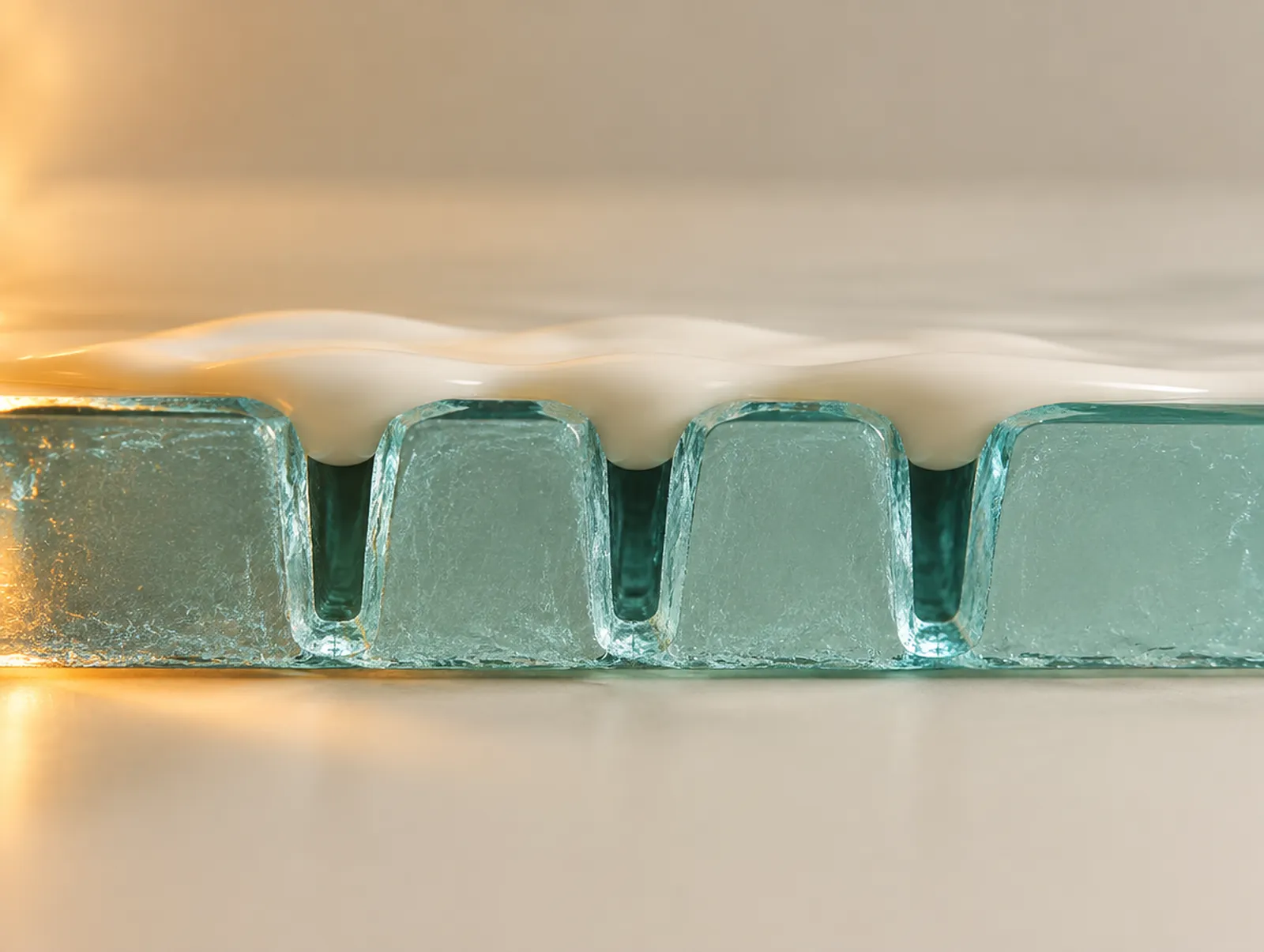
No. Creams and serums work on the surface; they do not replace the lost tissue under an ice pick, boxcar or rolling scar, and they do not lift the pit. Tan and colleagues also write that no treatment yet removes acne scars completely, which is why prevention and early treatment are the core strategy.
Creams contribute in two places. The first is prevention: as active acne comes under control, no new pits form. The second is improving the surroundings: as the redness or brown halo around a pit fades, the scar draws less attention. The AAD describes this contribution of retinoids only for mild scars; the options it lists for deep pits are clinic procedures.
A home needle roller or pen does not close this gap. According to the AAD, products used at home are not designed to puncture the skin; if they do, there is a risk of infection and scarring, and viruses such as those that cause warts and cold sores can spread across the skin.
What is done in the clinic for which scar? Microneedling, laser, subcision and peels
First, let us set expectations correctly. According to the review by Connolly and colleagues, complete disappearance of acne scars is the exception, not the rule. The 2016 Cochrane review by Abdel Hay and colleagues examined 24 randomized trials with 789 participants: most of the evidence was of very low quality, moderate-quality evidence existed only for filler injections, and no method was supported well enough to be recommended first. This does not mean the methods do not work; it is simply not yet clear which works better for whom. That is why dermatologists often combine methods.
| Scar type | Commonly used methods | Data and cautions |
|---|---|---|
| Ice pick, deep boxcar | TCA CROSS, punch techniques | In TCA CROSS, 65-100% trichloroacetic acid is applied only to the base of the scar; in a 2026 review, improvement was 50-80%. Never tried at home |
| Scars spread over a wide area | Fractional laser, microneedling, peeling | According to Connolly and colleagues, laser and resurfacing are the main option for wide areas |
| Rolling | Subcision, filler | Subcision cuts the fibrous band that pulls the scar down; about 50% improvement was reported in a study of 40 patients |
| Hypertrophic scar, keloid | Corticosteroid injection, silicone gel or tape, laser | May come back even after successful treatment |
| Red mark | Pulsed dye laser, IPL | Evidence is based on small studies |
Microneedling. According to the AAD, acne scars generally need 3-5 sessions, and it takes several months to see the full result. In the 2014 randomized split-face study by Alam and colleagues, after three sessions two weeks apart, the scar score on the treated side fell significantly at month six. 15 of the 20 participants completed the study.
Peeling and laser. The AAD says a light peel may need 3-5 sessions 2-4 weeks apart, and that collagen and elastin are produced in skin that heals after laser. In darker skin the risk of a brown mark after the procedure is higher. The method can make a difference too: in a small comparison in the Cochrane review, hyperpigmentation was seen in 6 of 12 people who had a peel and in none of the 15 who had microneedling. At the 2024 AAD meeting, dermatologist Valerie Callender recommended doing a test patch and preparing the skin with lightening agents before the procedure to reduce this risk.
Fillers. According to the AAD, the effect of most fillers lasts between 3 months and 2 years, and repeat treatment is needed.
If you have taken isotretinoin. The 2017 consensus report by Spring and colleagues found insufficient evidence to support delaying superficial peels and fractional laser during or right after isotretinoin; mechanical dermabrasion and fully ablative laser are not recommended in this period. For microneedling, the AAD asks for at least one month since the last dose. Set the timing together with your doctor.
How long do acne marks take to go away? A realistic timeline by mark type
Red marks: months. According to DermNet, post-inflammatory color changes resolve over time, but this can take months or longer. We did not find a solid source giving an exact duration.
Brown marks: 6-12 months or longer. According to the AAD, a mark a few shades darker than your skin usually fades in 6-12 months. Deep, blue-gray or very dark pigment can last years. Seeing a first difference with actives takes weeks: the niacinamide study lasted 4 weeks, the azelaic acid studies 12 and 24, and the tretinoin study 40 weeks.
Depressed scars: they do not go away on their own. According to the AAD, the color may lighten, but the scar itself remains. With clinic procedures too, improvement builds up across sessions and settles over months.
Raised scars: they can come back. According to DermNet, hypertrophic scars and keloids tend to return even after treatment that seemed successful; silicone gel or tape can be worn for months, 24 hours a day.
When should you see a dermatologist about acne marks?
Do not wait if any of the following applies to you:
- You have deep, painful, swollen pimples, or your pimples leave marks.
- A parent or sibling has acne scars; the AAD considers early treatment especially important in this case.
- You have pitted or raised scars; home care alone is not enough for these.
- A raised scar is growing.
- Your mark looks blue-gray, or it has not lightened within months despite regular care.
- You have dark skin and are considering laser or a peel.
If your acne started in adulthood or flares with your menstrual cycle, our guide to the causes and treatment options of hormonal acne can help you prepare the questions to ask your doctor.
Where to start this week?
This evening, do the three checks in daylight and note each mark as red, brown or pitted. For red and brown marks, choose a single active and keep it going for 12 weeks together with morning sunscreen. For pitted or raised scars, book a dermatologist appointment; for these marks, what makes the difference is a procedure, not a cream.
If you want to track progress by measurement rather than guesswork, the AI skin analysis in the Longos Sense app scores the "acne / blemishes" and "pigmentation and skin tone evenness" parameters on a 0-100 scale from a photo taken on clean skin. Repeating the analysis once a month in the same light lets you see how your marks change under the same conditions. This is a cosmetic tool for tracking appearance; it does not determine the scar type and does not diagnose, and diagnosis and treatment decisions belong to your dermatologist.
Frequently Asked Questions
How do acne marks go away?
It depends on the type of mark. Flat red marks and brown marks are not true scars; with daily sunscreen and actives such as azelaic acid, niacinamide, vitamin C or a retinoid, they fade over months. Pitted scars (ice pick, boxcar, rolling) rarely disappear on their own and do not lift with cream; they need clinic procedures such as microneedling, fractional laser, subcision or TCA CROSS. In every case the first step is to bring active acne under control and not to squeeze pimples.
What helps acne marks at home?
At home, the most benefit is seen with brown marks and red marks. The core step is a broad-spectrum sunscreen of at least SPF 30 every morning; on dark skin, a tinted formula with iron oxide is recommended. Add a single active on top: the studies used 15-20% azelaic acid, 5% niacinamide, low-pH vitamin C and retinoids. Judge the result after at least 12 weeks. Lime juice combined with sun can leave marks, and a needle roller at home carries a risk of infection and scarring.
How do red acne marks go away?
A red mark comes from the small blood vessels that widen during inflammation, and it fades when you press on it. It often shrinks on its own within months, though this can take longer. The most concrete home data comes from 15% azelaic acid: in a placebo-controlled study of 72 patients it reduced red marks more than placebo in 12 weeks. For long-lasting redness, a dermatologist may suggest vessel-targeting methods such as a pulsed dye laser or intense pulsed light (IPL); the evidence for these also rests on small studies.
Which serum works for acne marks?
For brown acne marks, the ingredients with evidence are azelaic acid (15-20%), niacinamide (5%), vitamin C and retinoids. Pure vitamin C enters the skin only below pH 3.5, and absorption is best at 20%; human data on marks is more limited for stable derivatives. The data on topical tranexamic acid mostly comes from melasma and is mixed. Whichever serum you choose, marks darken again without daily sunscreen. Deep, blue-gray marks respond poorly to serums.
Do pitted acne scars go away with cream or laser?
Pitted scars do not go away with cream; creams and serums do not replace the lost tissue under the scar. Mild scars may look slightly less noticeable with a retinoid, but for deep scars this difference is small. In the clinic, fractional laser, microneedling, subcision, TCA CROSS, fillers and peels are used in combination according to scar type. These procedures aim to reduce the scar noticeably rather than erase it completely; a 2016 Cochrane review also reported that most of the evidence in this area is of low quality.
How many months do acne marks take to go away?
According to the American Academy of Dermatology, a brown mark a few shades darker than your skin usually fades in 6-12 months; deep, blue-gray pigment can last years. Red marks also often shrink within months, but the time varies from person to person. Pitted scars do not go away on their own; microneedling generally needs 3-5 sessions, and it takes several months to see the full result. Use a spot serum regularly for at least 12 weeks before judging it.
Clinical evidence

