Microcurrent
How to tighten sagging facial skin at home: why it happens, what works and how long it takes

Why does the face sag? Sagging does not start in a single layer
When you look in the mirror, what you notice is your cheeks sitting a little lower, your jawline softening or the lines at the corners of your mouth becoming more defined. Most of us sum this up as "my skin has gone loose." In reality, sagging forms when four different layers stacked beneath the skin change at the same time. Knowing how much each layer contributes tells you from the outset what you can improve at home and what you cannot.
Bone sits at the very bottom. According to a 2013 review by Farkas and colleagues, whose authors include plastic surgeons Rod Rohrich and Joel Pessa, the facial skeleton keeps remodeling throughout life. A review by Coleman and Grover describes how the eye sockets widen with age while the upper jawbone shrinks. As this bony scaffold recedes, the tissues resting on it lose their support.
Fat compartments lie on top of the bone. Facial fat is not one single piece; it is divided into superficial and deep compartments. With age, some compartments lose volume while others slide downward and forward. Coleman and Grover write that the fat pad over the cheekbone gradually moves forward and down, deepening the nasolabial fold that runs from the side of the nose to the corner of the mouth.
Ligaments hold this fat in place. Retaining ligaments that run from the cheekbone and the lower jaw to the skin carry the fat compartments like a hammock. As these ligaments loosen, the tissues descend; this is the origin of what we see as bags under the eyes, a "double chin" below the jawline or jowls along the edge of the jaw.
Skin sits on top. As collagen and elastin decline, the skin thins, loses its elasticity and can no longer hide the changes underneath. Here is an interesting detail: according to a magnetic resonance study cited in the same review, the muscles of facial expression do not lose volume or length with age. In other words, the main culprit behind sagging is not the muscles but the quartet of bone, fat, ligaments and skin.
Where does sagging show, and what does it look like? Four zones from under the eyes to the neck
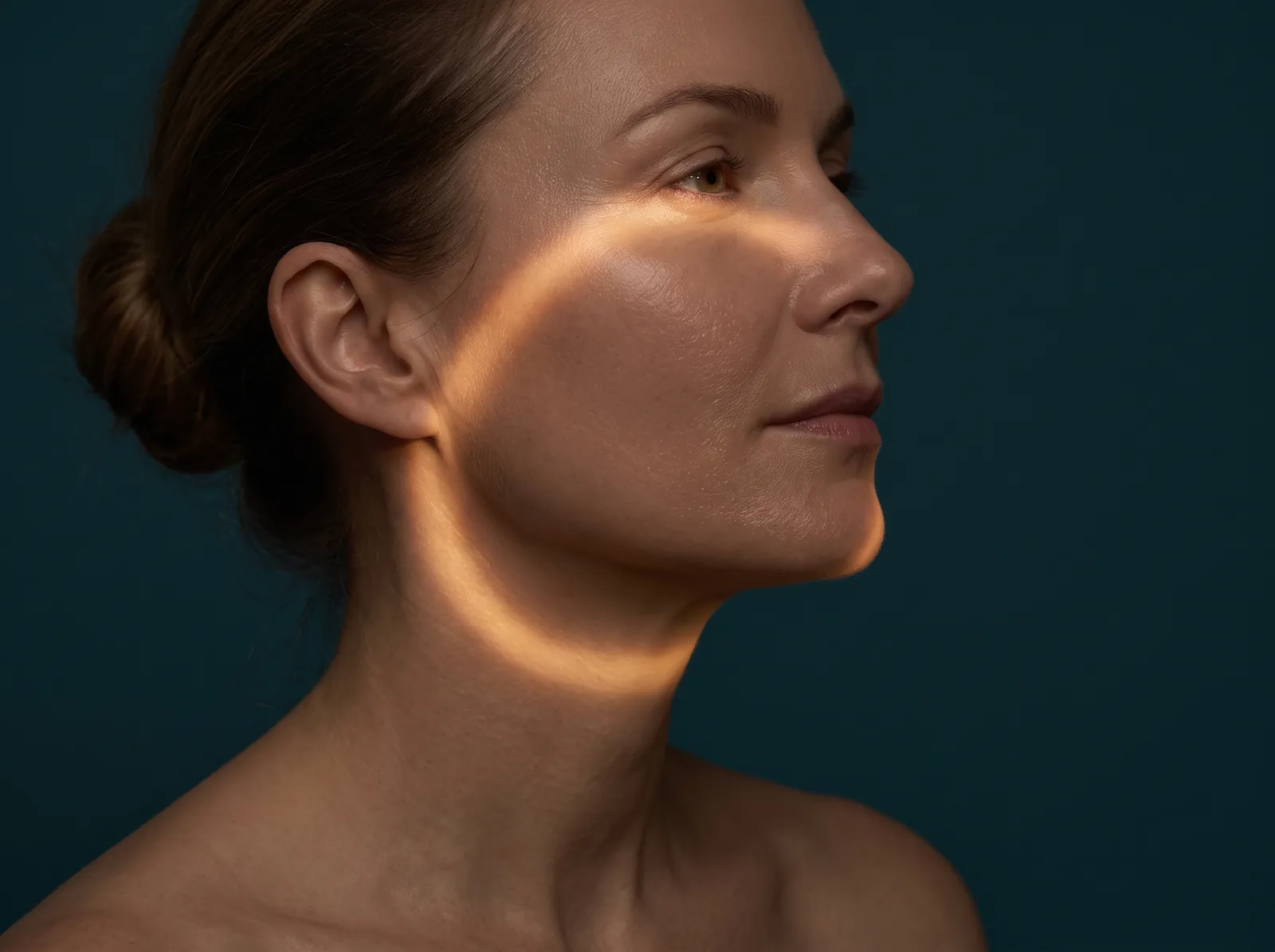
The face does not age at the same pace everywhere. Coleman and Grover's review paints a surprising picture: while the temples, the area around the eyes, the cheekbones and the area around the lips lose volume over time, the fat pockets under the chin, along the jaw and under the eyes stay as they are or even grow. So the face deflates and, in certain spots, fills out at the same time. Noticing which area has changed in the mirror is the first step toward setting the right expectations.
Under the eyes. As the retaining ligament around the eye loosens, the fat beneath it pushes forward and becomes more visible; Farkas and colleagues' review links the tear trough and the bags above the cheekbones to this change. Because the change here is structural, a cream improves how the skin looks but does not remove the bag itself. Puffiness that is more noticeable in the morning, on the other hand, is usually caused by fluid and eases as the day goes on.
Cheeks and the side of the nose. As the fat pad on the cheekbone slides down and forward, the fold running from the side of the nose to the corner of the mouth deepens. The good news: in the randomized at-home RF study we describe in detail below, this fold was among the areas that improved significantly with 12 weeks of regular use.
Jawline and double chin. As the retaining ligament along the jaw loosens, cheek tissue descends and a sharp jawline takes on a wavy outline. Under the chin, fat build-up accompanies the sagging. In a 12-week study with an at-home RF device, experts reported a significant improvement in jawline firmness.
Neck. Neck skin is thinner than facial skin and is often forgotten when sunscreen goes on. It is also where the evidence is weakest: in the same randomized study, neck sagging showed no difference between the side treated with the device and the side without it. Give your neck the same sun protection and regular care as your face, but keep your expectations there more modest than for your face.
Sun or time? What speeds up sagging the most?
We all know that the sun ages the skin. The Flament study, carried out in France with 298 women aged 30-78, puts a number on it: according to the researchers, UV rays appear to be responsible for about 80% of the visible signs of aging on the face. Yet the same study paints a different picture for sagging. When women who love the sun were compared with women who avoid it, there was a clear difference in dark spots at every age and in wrinkles after age 50, but no difference between the two groups in the signs of sagging. The researchers' interpretation is clear: sagging is largely the work of time, in other words, chronological aging.
That does not make sun protection unnecessary. In a randomized study of 903 adults under 55 in Australia (Hughes and colleagues, Annals of Internal Medicine), the group that used a broad-spectrum sunscreen every day showed no measurable increase in skin aging over 4.5 years. Skin aging in this group was 24% less than in those who used sunscreen only when they felt like it.
Put the two studies side by side and the practical takeaway is this: sunscreen protects the quality of your skin and its collagen, and it delays dark spots and wrinkles. But on its own it does not firm up sagging that has already begun. For sagging, you need a routine that supports collagen and nourishes the tissue. Smoking, alcohol and unprotected sun exposure are also listed in Farkas and colleagues' review among the factors that speed up facial aging.
What works at home and what doesn't? An honest table based on the evidence
The methods you come across when looking for an at-home solution for facial sagging are not all equal: some are backed by controlled studies, while others leave nothing more than a feeling that lasts a few hours. The honest answer to "what helps a sagging face?" depends on which layer each method reaches. The table below shows which layer each method works on and how strong the evidence is.
| Method | Layer it reaches | Level of evidence | What to expect |
|---|---|---|---|
| Daily sunscreen | Skin (collagen protection) | Randomized study of 903 people | Slows aging, does not lift existing sagging |
| At-home radiofrequency (RF) device | Deep layer of the skin (dermis) | Small randomized and controlled studies | Modest tightening with regular use, over 8-12 weeks |
| Serums with retinoids and peptides | Skin | Many clinical studies on retinoids | Slow improvement in skin texture and fine lines |
| Facial exercise | Muscle | Pilot study with no control group, completed by 16 people | Possible, modest difference in cheek fullness |
| Massage and ice | Surface puffiness | No solid data on lasting effects | A firmer look for a few hours |
| Home masks such as egg white or lemon | Surface | No clinical data | A temporary feeling of tightness from the drying film |
Perhaps the most important row in the table is the last one. When egg white dries, it forms a thin protein film on the skin and creates a feeling of tightness; once you wash your face, that feeling goes too. Lemon juice, meanwhile, can irritate the skin and, if you go out in the sun afterwards, may leave dark spots in some people. It is wiser to spend the time you devote to sagging on methods whose effects have actually been measured.
At-home radiofrequency: what do the studies actually show?
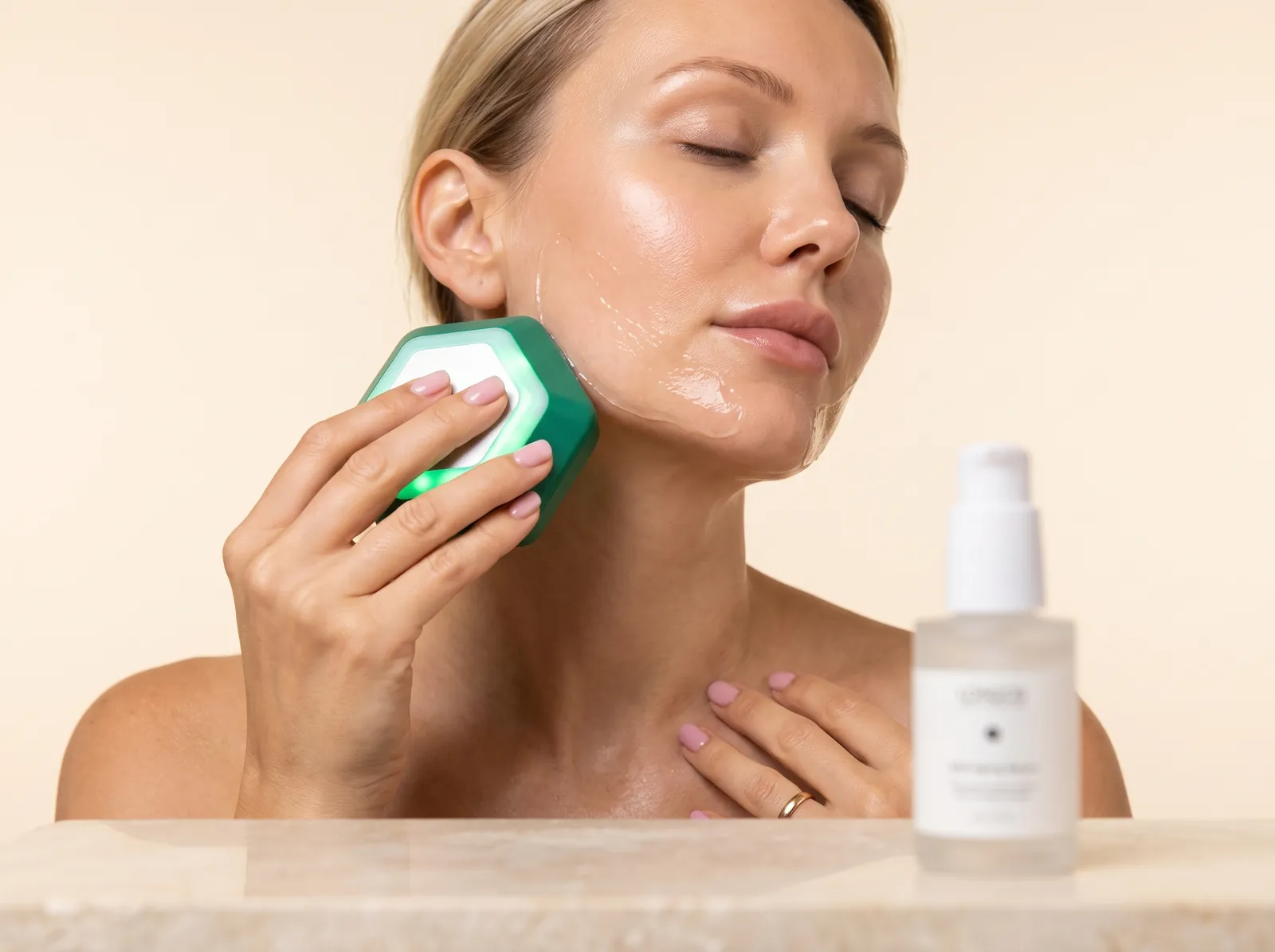
Radiofrequency (RF) is a type of energy that heats the deep layer of the skin in a controlled way. A review examining radiofrequency in aesthetic surgery explains that the effect arrives in two stages. First, the heat breaks the hydrogen bonds in the collagen helix, shortening and thickening the fibers and creating a slight, immediate firming. The skin then reads the heat as a repair signal and produces new collagen over the following 3-4 months. According to the same review, the best results come when the skin surface is kept within the 38-42°C range.
So do the much gentler home versions of powerful clinic devices actually work? Controlled studies give a modest but consistent "yes":
- Randomized split-face study (Shu and colleagues, 2022): In 33 women aged 35-60, one half of the face was treated for 12 weeks with an at-home RF device (1 MHz RF and 630 nm red light), while the other half received only an anti-aging cosmetic product. The device was used five days a week, 6 minutes a day, for the first two months, and three times a week in the third month. At week 12, the device side was significantly better than the cosmetic side for forehead lines, crow's feet, nasolabial folds, pores and lower-face sagging. For neck sagging, however, there was no difference between the two sides. Note too that this device combines RF with red light; we explain in detail how light affects the skin in our guide to at-home LED light therapy.
- 8-week open-label study (Ai and colleagues, 2023): A group of 22 women aged 25-55 used the device three times a week. Wrinkle scores improved significantly at weeks 4 and 8, and skin thickness measured by ultrasound increased at week 8. Only one participant had mild redness, which cleared within two days.
- 12-week study (Sadick and Harth, 2016): Of 47 participants, 45 completed the study. The device was used three times a week for the first four weeks and twice a week for the following eight weeks. In the expert assessment, significant improvement was reported in the lifting of the jawline and face, in the marionette lines that run from the corners of the mouth down to the chin, and in firmness and elasticity measured with an instrument.
A 2021 systematic review of home devices (Cohen and colleagues) gives at-home RF devices a level B recommendation for wrinkles on the basis of this evidence. In short, RF is one of the best-supported methods you can use against sagging at home. But it is no miracle: what a clinic treatment delivers in a few sessions, a home device delivers over weeks and more modestly.
Do the results last? What happens when you stop using the device?
This is the question people ask least when buying a home device, yet it is the most important one. In a study of 20 women aged 37-52 in Japan (Omi, 2018), participants used an at-home RF device every other day for four weeks. In their own assessments, the sagging improvement score rose from 1.99 to 5.60. Just two weeks after they stopped using the device, the score fell back to 4.53.
What this result tells us is that at-home RF is not a one-off course but a rhythm. Like the muscle you build at the gym, the result holds while you keep at it and slowly fades when you stop. The schedule used in most studies is built around this: first a few weeks of intensive use, then maintenance with two to three sessions a week.
It also pays to know the limits of the evidence. In a 2024 review of at-home facial rejuvenation devices, only 5 of the 18 studies examined were randomized controlled trials, only 3 had more than 50 participants, and the longest follow-up was 12 weeks. So the data we have are promising, but there are no large studies yet showing results over several years. For powerful in-clinic RF, Cleveland Clinic states that results appear within 2-6 months and can last 1-3 years with good skincare.
Can face yoga and massage firm up sagging skin?
Facial exercises are the most commonly recommended home method, and they have at least one serious study behind them. In a pilot study published in JAMA Dermatology (Alam and colleagues, 2018), women aged 40-65 were taught 32 facial exercises. Participants exercised for 30 minutes every day for the first eight weeks, then every other day until week 20. Experts who assessed their photos saw significant improvement in upper and lower cheek fullness, and the participants' estimated age fell on average from 50.8 to 48.1.
Two notes complete the picture. Of the 27 people who started the study, only 16 completed the 20 weeks, and there was no control group. What is more, 30 minutes a day is a commitment most people cannot keep up for long. The researchers think the effect may come from cheek muscles that grow with exercise and add volume to the face. This fits with what we covered in the first section: sagging does not stem from muscle loss, but stronger muscles can make up for part of the lost volume.
Massage and ice do a different job. They reduce morning puffiness and make the face look firmer for a few hours. There is no solid clinical data showing that they have a lasting tightening effect. You can happily make them part of your morning routine, as long as they are not your main plan against sagging.
Creams for facial sagging: which active ingredient does what?
Let us state the limits of creams and serums up front: no cream can lift a fat pad that has slipped down back into place or pull a loosened ligament taut again. A cream works on the skin itself. But the skin is the visible face of sagging; thicker, better-hydrated skin with well-preserved collagen hides the changes beneath it far better.
Retinoids are the most studied active ingredients in this area. According to a review by Mukherjee and colleagues, many retinoids have shown improvement both under the microscope and in the clinic, especially in sun-aged skin. The same review also gives an important warning: strong retinoids can cause burning, peeling and redness and can make the skin more sensitive to the sun in the first weeks. Gentler derivatives such as retinol cause far less irritation. Retinoids should be avoided during pregnancy and while planning a pregnancy.
That is why QOL's Midnight Repair Serum uses Hydroxypinacolone Retinoate, a gentle retinoid ester; the serum targets overnight repair. Our Anti-Aging Serum, developed for firmness and fine lines, pairs Anigozanthos Flavidus extract with Hexapeptide-9. When you choose a serum, look at the active ingredient and the concern it targets, not at the promise on the box.
Humectants such as hyaluronic acid also help fine lines look less noticeable by plumping the skin. This effect comes from hydration, not from collagen production; it lasts with regular use and fades when you stop. Hydration is not a solution for sagging, but it is a good foundation layer.
An at-home care plan by age: your 30s, 40s and 50s
How you firm up a sagging face depends on your age. Sagging does not begin overnight, and each decade has its own priority. The plan below turns the findings from the studies into a daily routine; adapt it to your own skin and lifestyle.
In your 30s: protect and build a foundation
If you are wondering what you can do to prevent facial sagging, this is the most productive time.
- Use a broad-spectrum sunscreen every morning; it is the cheapest and best-proven way to protect your collagen.
- Add a gentle retinoid derivative to your evening routine, starting with two nights a week, and increase the frequency as your skin adjusts.
- Quit smoking and limit alcohol; both are among the factors that speed up facial aging.
In your 40s: actively support collagen
- Add a peptide serum to your sunscreen and retinoid routine.
- If you are considering at-home RF, this is a good time to start. According to the review examining radiofrequency in aesthetic surgery, younger tissue responds better to RF.
- Use RF in a rhythm similar to the studies, with three sessions a week in the first weeks.
In your 50s and beyond: consistency and realistic expectations
- Keep up your RF and serum routine as a care habit; keeping the effect going depends on regular use.
- Track your progress with monthly photos; expect mild tightening, not the result of a facelift.
- If you have pronounced sagging or excess skin along the jawline, consider at-home care alongside an assessment by a specialist.
The same principle applies to both methods: as in our wrinkle guide, where we explain how to address wrinkles at home, consistency does more than intensity here too.
Using at-home RF correctly and safely
At-home RF devices work at much lower energy than clinic devices, and no serious side effects have been reported in the studies. Still, a few rules shape both your safety and your results.
- Start with clean, dry skin. Makeup and oil stop the energy from spreading evenly across the skin.
- Use a conductive gel or serum. The devices in the studies were mostly used with a conductive gel; the gel helps the device glide comfortably over the skin and spreads the heat evenly.
- Keep the device moving. Holding it in one spot concentrates the heat in a single area. That is why the device in the Shu study was fitted with a motion sensor that cuts the energy when the device stays still.
- Stick to the recommended time and frequency. A longer session does not mean faster results. The Cohen review reports every-other-day schedules and courses of one to two months for the home devices it examined.
- Stop if you feel burning. Mild warmth is normal; a stinging or burning sensation means you should move the device away from that area.
As for who should be careful, the review examining radiofrequency in aesthetic surgery lists the following: people with a pacemaker or another implanted electronic device, people with an autoimmune or connective tissue disease, smokers, people taking anti-inflammatory medication that may weaken collagen renewal, and older people with very thin skin. Do not use the device on areas with active inflammation, open wounds or irritated skin. If any of these applies to you, talk to your doctor before you start.
The limits of at-home care: when should you see a specialist?
At-home care is a powerful tool for mild to moderate changes, but not every case of sagging can be solved at home. The review examining radiofrequency in aesthetic surgery says so plainly: RF results are generally modest and do not replace the lift achieved with surgery.
It makes sense to see a dermatologist or a plastic surgeon in these situations:
- You have pronounced sagging and excess skin along the jawline.
- You see no change despite several months of regular at-home care.
- You have noticeable volume loss in your cheeks or temples; no cream or device can bring back lost fat volume.
In the clinic, the options depend on which layer the problem sits in: filler for lost volume, focused ultrasound or microneedling radiofrequency for deeper tightening, and surgery for advanced sagging. An examination, not a photo, decides which one is right for you.
One situation should never be left to wait: a sudden droop on one side of the face is not sagging. It can be a sign of stroke or facial palsy and needs urgent medical care.
Where should you start this week?
Today, take one photo of your face from the front and one from the side, in the same light and at the same angle; this is the only honest measure you will have to compare against in eight weeks. Then lock in three things: sunscreen every morning, a serum whose active ingredient you know in the evening, and three fixed RF days a week in your calendar. If you would rather see your starting point through data than guesswork, run the AI skin analysis in the Longos Sense app once tonight on cleansed skin with no products applied. The analysis also measures your skin's elasticity, and the app then recommends the RF mode that targets tightening, together with a serum suited to that result.
Frequently Asked Questions
At what age does facial sagging start?
Sagging has no single starting age; changes in the bone, fat, ligament and skin layers build up over the years. According to the Flament study, sagging is largely the result of chronological aging. The most productive time for prevention is your 30s: a foundation built on daily broad-spectrum sunscreen and a gentle retinoid derivative makes it easier to actively support collagen in your 40s.
Can facial sagging be fully reversed?
With at-home care, you can expect a modest improvement in mild to moderate sagging, but you should not expect a full reversal. No cream or device can bring back lost fat volume, and radiofrequency results do not replace surgery. The effect also depends on consistency: in one study, the sagging score rose from 1.99 to 5.60 in four weeks and fell back to 4.53 two weeks after the device was stopped.
How often should you use an at-home radiofrequency device?
The schedules used in studies are similar: intensive in the first weeks, then at a maintenance pace. In the randomized study, the device was used five days a week, 6 minutes a day, for the first two months, and three times a week in the third month; in another study, three sessions a week were followed by two sessions a week. Always follow your own device's instructions; a longer session does not mean faster results.
Can face yoga firm up sagging skin?
There is limited but promising evidence. In a pilot study in JAMA Dermatology, women aged 40-65 did facial exercises for 20 weeks; experts saw improvement in upper and lower cheek fullness, and estimated age fell on average from 50.8 to 48.1. However, only 16 people completed the study, there was no control group, and it required 30 minutes of exercise a day.
Do creams work for facial sagging?
A cream works on the skin itself: it cannot lift a fat pad that has slipped down or tighten a loosened ligament. But thicker, hydrated skin with preserved collagen hides the changes beneath it better. Retinoids are the most studied active ingredients in this area and show improvement especially in sun-aged skin, while humectants help fine lines look less noticeable.
Is a sudden droop on one side of the face a sign of sagging?
No. Sagging develops slowly over the years and affects both sides of the face in a similar way. A droop that appears suddenly on one side of the face can be a sign of stroke or facial palsy and needs urgent medical care without delay. In this situation, at-home care or device use is out of the question; seek medical help right away.
Clinical evidence