sphingolipids
How to Get Rid of Dry Hands: Cracked Hands, Hand Eczema and Evidence-Based Care
How to get rid of dry hands: the short answer
Dry hands usually improve with habits, not medication. Wash your hands with lukewarm water, dry them all the way between the fingers and apply cream right after every wash. If your hands are not visibly dirty, use an alcohol hand rub instead of soap; contrary to what most people think, research shows it is gentler on the skin barrier than soap.
Wear gloves for dishes and cleaning, and protect your hands from cold, dry air outdoors. At night, a thick cream or petroleum jelly under cotton gloves buys time for the fingertips that crack most.
One warning first: not every dry patch is just dryness. According to the American Academy of Dermatology (AAD), itchy blisters, deep and painful cracks, oozing, crusts or pus point to hand eczema, and a moisturizer alone is not enough for that. Vitamin supplements do not fix ordinary winter dryness either; we explain why below.
Why do hands dry out? Few oil glands, frequent washing and wet work
Hands are an oil-poor area. According to DermNet, sebaceous glands are found over most of the body, but there are few on the hands and none on the palms. The sebum produced by these glands, which number up to 400-900 per square centimeter on the forehead and chin, reduces water loss from the skin surface. It is no surprise, then, that your hands feel tight in winter while your forehead shines.
The palm is thick, but hard to moisturize. Dermatologist Dawn Davis of Mayo Clinic says, in an AAD explainer, that the thick skin on the palms is protective but also hard to moisturize. The back of the hand is the surface most exposed to wind, sun and water.
Every wash takes away a little oil. Mayo Clinic points out that soaps and detergents are designed to remove oil in the first place. According to DermNet, irritants such as water, soap and detergent strip the oils and the natural moisturizing factor from the outer layer of the skin. Once the barrier loosens, irritants penetrate deeper and inflammation starts. The first sign of this kind of irritation often appears between the fingers. We cover how the barrier holds water in detail in our guide to moisture loss and moisturizing in the skin.
The wet work threshold is lower than you think. A 2022 review by Patel and Nixon defines wet work as follows: hands wet for more than 2 hours a day, waterproof gloves worn for more than 2 hours a day, or more than 20 hand washes a day. Nurses, hairdressers, plumbers, cleaning and kitchen workers are at risk for this reason, and housework counts too. In a 2020 study by Lund and colleagues in Denmark, which reviewed the records of more than 17 thousand patients, the risk of hand eczema was significantly higher even with an average of 30 minutes or less of wet work a day.
How do cold air, indoor heating and wool gloves make dryness worse?
Winter pushes from two sides: cold and wind outdoors, and air dried out by heating indoors. A 2016 review by Engebretsen and colleagues concludes that low humidity and low temperature generally weaken the skin barrier and leave the skin vulnerable to mechanical stress. The same review notes that under these conditions the skin becomes more reactive to irritants and allergens.
The 2022 hand eczema guideline of the European Society of Contact Dermatitis (ESCD) also lists cold, dry air and low indoor humidity among the risk factors. Mayo Clinic adds that heaters, stoves and fireplaces lower indoor humidity.
Gloves protect, but the fabric matters. The AAD recommends wearing gloves against cold, dry air in winter, and the ESCD advises insulated gloves in the cold. Wool cuts both ways: it warms, but according to the AAD, fabrics such as wool and polyester can irritate dry, sensitive skin. The fix is simple: wear a thin cotton glove under your wool glove.
Humidifying the air at home also helps. The AAD recommends a humidifier running at night in the bedroom, and reminds you to clean it regularly so mold does not grow. You can find how the same cold can also redden the cheeks in our guide to the causes of facial redness in sensitive skin and ways to soothe it.
Simple dryness or hand eczema? Tell the signs apart
Hand eczema is not rare. According to the ESCD guideline, its one-year prevalence in the general population is at least 9.1%: 10.5% in women and 6.4% in men. In high-risk occupations the rate can reach 40%. According to the AAD, hand eczema is easily mistaken for ordinary dryness, but unlike dryness it does not clear with a moisturizer alone.
| Condition | Typical appearance | Distinguishing clue |
|---|---|---|
| Simple dryness (xerosis) | Tightness, roughness, fine scaling, superficial cracks | Eases with cream and protection; no blisters, oozing or crusts |
| Irritant contact dermatitis | Redness, burning, painful cracks | Starts between the fingers, the palm is often spared; causes burning and pain more than itching |
| Allergic contact dermatitis | Itchy redness, small blisters | Flares hours or days after a particular task; may stop at a sharp line such as the glove cuff |
| Atopic hand eczema | Itchy patches on the back of the hand and wrists | History of eczema in childhood, eczema elsewhere on the body |
| Psoriasis, fungus or focal peeling | Sharply defined scaly plaques; a scaly-edged patch on one hand; air-filled blisters and peeling on the palm | Fungus is often one-sided; focal palm peeling usually does not itch and gets worse in summer in about half of people |
Irritation is the most common cause. According to DermNet, 80% of work-related hand eczema is irritant and it affects cleaning, hairdressing, food and healthcare workers most. The chronic picture is usually built not by one strong chemical but by repeated small blows from water, soap and detergent.
Allergy is a different mechanism. The immune system recognizes a particular substance and reacts to it on every contact. DermNet's list of common allergens includes nickel, fragrances, the accelerator chemicals in rubber gloves, chromium and p-phenylenediamine in permanent hair dyes. The two pictures can also occur together; the way to tell them apart is the patch test done by a dermatologist.
When dryness and itching come together on the hands, atopic or allergic eczema becomes more likely. According to the AAD, adults who had atopic dermatitis as children have a higher risk of hand eczema.
When should you see a dermatologist?
If dryness does not improve at home, or if you have any of the signs below, do not wait. The list is compiled from the recommendations of the AAD, Mayo Clinic, DermNet and the ESCD:
- Deep, painful or bleeding cracks. According to Mayo Clinic, open cracks let bacteria in.
- Itchy blisters, oozing or crusting. The AAD counts these among the signs of hand eczema, not of ordinary dryness.
- Signs of infection. Pus, yellow crusts, increasing pain and swelling. DermNet notes that bacterial infection of eczematous hands causes pus-filled blisters and crusts; Davis warns that untreated eczema can progress to cellulitis.
- A spreading rash. Redness moving to the forearms, the feet or other parts of the body.
- A scaly-edged patch that starts on one hand. It may be a fungal infection and will not clear with a moisturizer.
- Itching and pain that disturb your sleep or work. Mayo Clinic lists this as a reason to see a doctor too.
- Eczema lasting longer than three months or not responding to treatment. In this case the ESCD recommends a patch test to look for allergy.
Your dermatologist may suggest a short course of a corticosteroid cream, non-steroidal anti-inflammatory creams or a plan to avoid an allergen. According to Davis of the AAD, an allergy can get stronger as long as contact with the allergen continues, which is why finding the cause matters. Do not start these medicines on your own.
How to wash your hands and when to apply cream
Giving up washing is not the answer: washing your hands prevents the spread of germs. The goal is to wash more gently. The recommendations of the AAD and the ESCD complement each other.
Use lukewarm water, not hot. The ESCD guideline recommends lukewarm water. According to the AAD, lather every surface of your hands, between the fingers and around the nails for at least 20 seconds. Some soaps dry the skin more than others, so you may need to try several to find the one that suits you.
Rinse well, do not rub. Davis recommends rinsing thoroughly, especially the cleanser residue that builds up between the fingers, and drying by patting rather than rubbing. The ESCD also advises against cleaning hands with brushes, abrasives or solvents.
Apply cream right away. The AAD recommends applying cream while the skin is still slightly damp and working it into the fingertips and around the nails too. Using a moisturizer after washing does not compromise hand hygiene. According to DermNet, for someone with hand eczema this can mean applying cream 10-20 times a day. This is why it helps to keep one tube by the sink and one in your bag.
Why does regular cream matter? In a 2010 study by Lodén and colleagues, 53 patients with hand eczema that had healed with treatment were split into two groups. In those who used a 5% urea cream regularly, the median time to relapse was 20 days; in those who applied nothing it was 2 days. Even so, eczema came back in 90% of patients within 26 weeks. The study was open-label and the sponsor was a cream manufacturer. Cream delays relapse; it does not remove the trigger.
Alcohol hand rub or soap? What the evidence says about the skin barrier
Most people assume a hand rub dries the hands out more than soap does. The evidence says the opposite. Dermatologists writing on the website of the US Centers for Disease Control and Prevention (CDC) on behalf of the American Contact Dermatitis Society describe this belief as a widespread myth with no scientific support. According to them, an alcohol hand rub removes less of the skin's protective oils than soap and water.
What did the studies show? In a 2005 study by Pedersen and colleagues, a detergent, an alcohol hand rub or the two in alternation were applied to the forearm skin of 17 healthy volunteers for 10 days. The detergent caused both more visible irritation and more barrier damage, measured by transepidermal water loss. In a 2007 study by Löffler and colleagues, 60-100% alcohols were tested in 15 volunteers in each test. The alcohol did not change the barrier or redness, but it lowered skin hydration. In the washing tests, alcohol caused significantly less irritation than detergent; ethanol used after washing even showed a protective effect.
Know the limits too. Both studies were small and were done on forearm skin with patch tests, not on the hands. One of the authors of the Löffler study worked at a hand rub manufacturer. Still, the results are consistent: the ESCD guideline recommends alcohol-based disinfection instead of washing with soap when the hands are not visibly dirty, especially in healthcare and food work. The hand antiseptic formulations recommended by the World Health Organization also contain 1.45% glycerol as a humectant for the skin.
So why does it sting? According to the CDC article, if a hand rub stings, it is because the skin is already cracked; the stinging is not a sign of new damage. If your hands are dirty or greasy, you need soap and water. When choosing a hand rub, pick one with few ingredients that is fragrance-free and contains glycerin or dimethicone. To make up for the drop in hydration Löffler found, apply cream once the rub has dried.
The best cream for dry hands: which ingredients to look for on the label
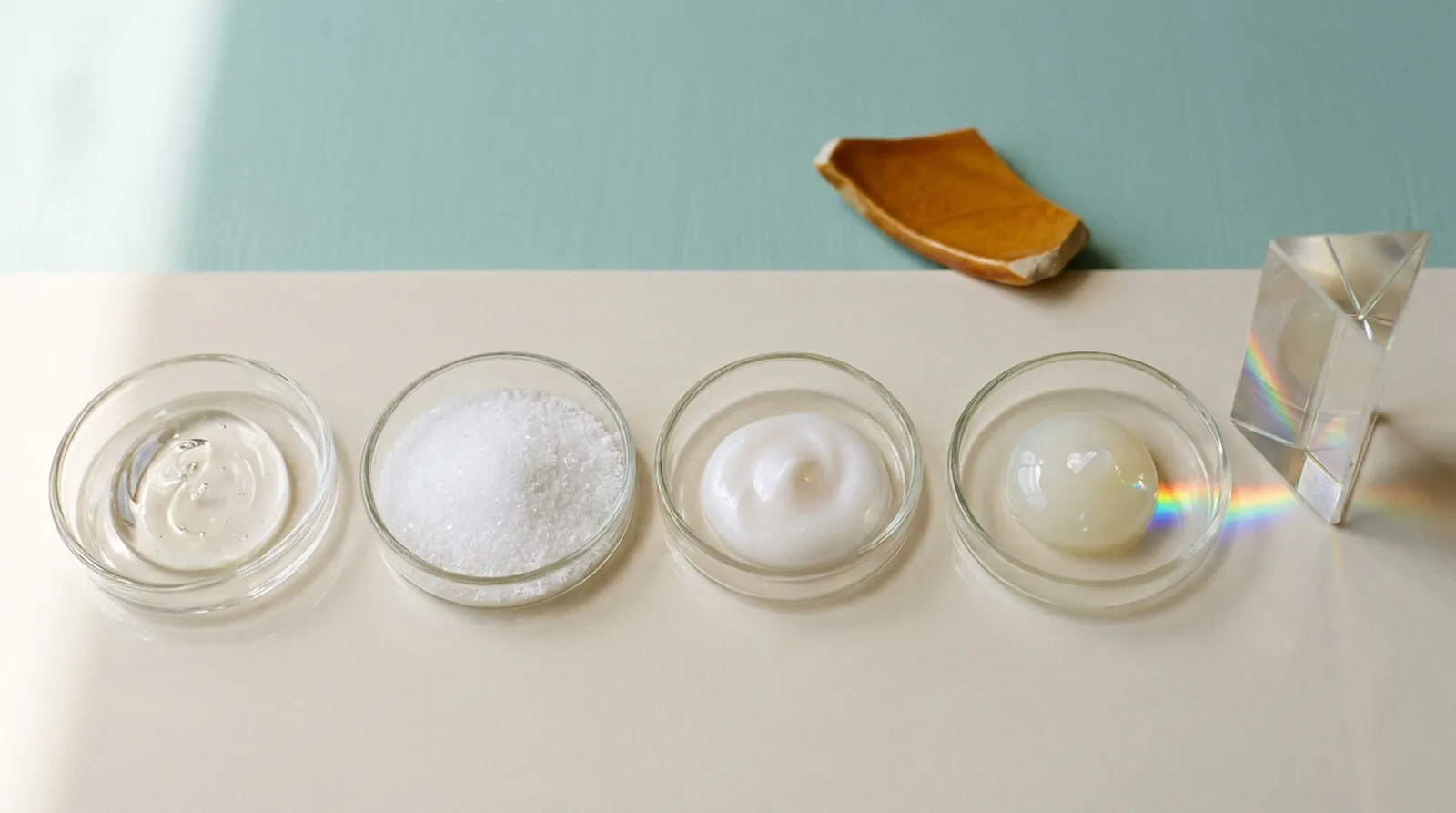
Choose a cream by its ingredient list, not by the promise on the packaging. In its hand care advice, the AAD, through dermatologist Dr. Berson, names three groups of ingredients: lipids such as ceramides, humectants such as glycerin and hyaluronic acid, and occlusives such as mineral oil or petroleum jelly. Creams and ointments that come in a tube work better than the runny lotions in pump bottles. Fragrance-free and dye-free ones sting less on dry, cracked skin.
| Ingredient | What it does | A note on the evidence |
|---|---|---|
| Glycerin | Draws in and holds water | According to a 2008 review by Fluhr and colleagues, it supports hydration, the barrier and resistance to irritation; it is especially important in winter dryness |
| Urea | Part of the natural moisturizing factor; loosens scales at high concentrations | 2-10% is used for moisture and barrier, 10-30% for moisture and scale loosening, 30% and above for thick, hard areas |
| Ceramides | Replenish the lipid mortar between cells | In dry skin, this mortar made of ceramides, cholesterol and fatty acids is weakened |
| Petroleum jelly (petrolatum) | Forms a waterproof layer on the surface | At a concentration of at least 5% it reduces water loss by more than 98% |
| Mineral oil, lanolin, silicones | Form a lighter occlusive layer | Reduce water loss by roughly 20-30%; feel less greasy by day |
| Hyaluronic acid | Draws in water | Works together with an occlusive layer, not alone |
Why both together? According to a 2016 review by Sethi and colleagues, humectants pull water from the deeper layers to the surface, and in dry air that water is easily lost. This is why they are combined with occlusives. A good hand cream puts the pair in a single tube. We explain how hyaluronic acid works differently depending on molecular size in our 8D hyaluronic acid guide.
A note on urea. According to a 2021 review by Piquero-Casals and colleagues, side effects of urea products are mild and occur more often at high concentrations. Starting with a low concentration on cracked hands therefore makes sense. Two of the authors of the review are employees of a dermocosmetics company.
Avoid fragrance. DermNet lists fragrances among the common allergens on the hands. According to Davis, a product labeled "unscented" does not always contain no fragrance; it may contain other chemicals that mask the scent. Look for "fragrance-free" on the label. If you want to compare brands by their technologies and ingredients, see our guide covering 30 skincare brands.
Cotton gloves at night, protective gloves by day
At night: a thick layer and cotton gloves
Night is the longest stretch when hands stay away from water and soap. Dr. Berson recommends soaking your hands briefly in lukewarm water, then applying cream or ointment, then putting on cotton gloves and leaving them until morning. Davis also lists applying petroleum jelly to the affected areas before bed. The ESCD guideline considers a lighter lotion reasonable by day and a more oily, preferably fragrance-free, lipid-rich cream at night.
Cotton gloves keep the cream in place and stop it from rubbing off on the bedding. We did not find a large study that directly measures this method; the advice rests on the practice of dermatology bodies and on the fact that an occlusive layer reduces water loss. You can build your evening steps together with our guide to the night skincare routine.
By day: gloves for wet work and cleaning
The ESCD recommends protective gloves for wet work and contact with chemicals, both at home and at work. The guideline's practical rules are:
- Gloves should be intact, clean and dry inside.
- If you will wear them for more than 10 minutes, wear cotton gloves underneath and change them regularly.
- Wear gloves as long as needed but as briefly as possible; sweating, heat and friction also irritate.
- Use disposable gloves only once, and do not wear rings during wet work.
According to DermNet, vinyl gloves cause fewer allergies than rubber gloves. If a rash stops with a sharp line exactly where the glove cuff ends, talk to your dermatologist about the possibility of an allergy to something in the glove.
What helps dry hands at home? Petrolatum, glycerin and olive oil
Petroleum jelly works. Davis describes petroleum jelly as the ingredient that can be found in moisturizers that reacts least with the skin and is least likely to cause allergy. Its only drawback is the greasy feel, so it works best at night.
Glycerin alone is only half the job. The benefit of glycerin for skin is well known, but because it is a humectant, it needs an occlusive layer on top in dry air. If you use the homemade glycerin and rose water mixture, apply a thin layer of petroleum jelly or cream over it. Scented waters such as rose water may increase the risk of irritation in hands sensitive to fragrances.
Olive oil is not as harmless as it seems. In a 2013 study by Danby and colleagues, 19 adults applied six drops of olive oil to their forearms twice a day. After four weeks the integrity of the outer layer of the skin had decreased and mild redness had developed; sunflower oil applied to the other arm preserved integrity and increased hydration. The study was small, was done on the forearm, not the hands, and tested pure oil, not formulated creams. Even so, it is hard to call pure olive oil a safe first choice for dry hands.
Soak briefly in lukewarm water, then stop right away. The short lukewarm soak Dr. Berson recommends works if cream is applied immediately afterwards. A long, hot soak without cream does the opposite: Mayo Clinic lists long, hot washing among the causes of dryness.
Which vitamin deficiency causes dry hands, and which conditions can they signal?
The honest answer: no single vitamin explains ordinary winter dryness. We found no study showing that a vitamin deficiency causes this dryness in a healthy adult whose hands dry out in winter. The evidence points to washing, wet work, and cold, dry air.
Real deficiencies look different. According to NCBI StatPearls, in pellagra caused by niacin (vitamin B3) deficiency, a burning redness resembling sunburn appears on sun-exposed areas such as the backs of the hands. Over time the skin darkens, thickens and roughens. But this picture is rare in industrialized countries; it is linked to severe malnutrition, alcohol dependence, malabsorption disorders or certain medicines, and findings such as diarrhea, confusion or dementia may accompany it.
What about vitamin D? A 2024 meta-analysis by Nielsen and colleagues reviewed 11 randomized trials covering 686 people with atopic dermatitis. Supplementation reduced eczema severity by a small but significant amount; however, only three of the trials gave a significant result on their own, and most were small. This result applies to atopic eczema, not to ordinary dry hands. Decide on supplements together with your doctor, based on your blood levels.
Which conditions increase dryness? Mayo Clinic lists hypothyroidism, ichthyosis, diabetes and poor nutrition among the conditions that raise the risk of dry skin; dialysis and cancer treatments can also cause dryness. According to the AAD, atopic dermatitis, psoriasis or kidney disease may lie behind dryness that does not go away. According to the NHS, when the thyroid is underactive, dry skin comes with tiredness, feeling cold, weight gain and constipation. If the dryness spreads over the whole body and comes together with these symptoms, the cause should be sought not in the cream jar but in a doctor's examination and a blood test.
Daily hand care plan: from morning to night
- Morning: Wash with lukewarm water, pat dry and apply a thin layer of day cream. If you will spend time outdoors, also put broad-spectrum sunscreen of SPF 30 or higher on your hands, as the AAD recommends.
- During the day: If your hands are not visibly dirty, use a hand rub and apply cream once it has dried. Keep a tube of cream by the sink and in your bag.
- After every wash: Dry between the fingers too, and work the cream into the fingertips and around the nails.
- For dishes and cleaning: Take off your rings, wear protective gloves over inner cotton gloves, and take the gloves off as soon as you finish.
- Outdoors: Wear gloves in the cold and wind; add a thin cotton glove under wool gloves.
- Evening: Hold your hands briefly in lukewarm water, dry them, apply a thick cream or petroleum jelly and go to bed in cotton gloves. You can run a humidifier, kept clean, in the bedroom.
- Weekly check: If you see blisters, oozing, pus or deepening cracks, see a dermatologist instead of stepping up the care.
Where to start this week
This evening, put a fragrance-free hand cream in a tube by the sink and follow a single rule for a week: cream after every wash, while your hands are still slightly damp. For the night, plain petroleum jelly and a pair of cotton gloves are enough; and do not do the dishes without gloves. If you see blisters, pus or deepening cracks, see a dermatologist instead of switching creams.
If the cold also shows up as redness on your face in these same days, the AI skin analysis in the Longos Sense app scores redness on a 0-100 scale for the face; both the analysis and the device are for the face and neck and are not applied to the hands. This is a care guide, not medical advice.
Frequently Asked Questions
Why do hands get dry?
Hands have few oil glands, and the palms have none, so hands lose their oil layer more easily than any other area of skin. Frequent washing, soap and detergent strip these oils and the natural moisturizing factor. Wet hands for more than 2 hours a day, waterproof gloves worn for long periods or more than 20 hand washes a day count as wet work and raise the risk markedly. In winter, cold air, wind and indoor air dried out by heating also weaken the skin barrier.
What helps dry hands at home?
The most effective home remedy is a habit: wash with lukewarm water, pat dry and apply cream right after every wash, while your hands are still slightly damp. At night, apply plain petroleum jelly or a thick cream and sleep in cotton gloves. For dishes and cleaning, wear protective gloves over thin cotton gloves. Glycerin helps but needs an occlusive layer on top. Pure olive oil weakened the skin barrier in one small study, so it should not be your first choice.
Which cream is good for dry hands?
Look for three groups of ingredients on the label: humectants such as glycerin, urea or hyaluronic acid, lipids such as ceramides, and occlusives such as petrolatum or mineral oil. Petrolatum at a concentration of at least 5% reduces water loss by more than 98%. Urea is used at 2-10% for moisture and barrier support and at higher concentrations to loosen scales. Choose fragrance-free, dye-free creams that come in a tube; the ingredient list matters more than where you buy it.
Which vitamin deficiency causes dry hands?
No single vitamin deficiency has been shown to explain ordinary winter dryness in a healthy adult; the evidence points to washing, wet work, and cold, dry air. In pellagra, caused by severe niacin (vitamin B3) deficiency, a burning redness and darkening appear on sun-exposed areas such as the backs of the hands, but this picture is rare and linked to poor nutrition, alcohol or malabsorption. Vitamin D supplements showed a small benefit in atopic eczema; decide on supplements with your doctor based on your blood levels.
Which illness can dry hands be a sign of?
Most dry hands are not a disease but the result of washing and weather. Dryness that does not go away can, however, be linked to hand eczema, atopic dermatitis, psoriasis or a fungal infection. Mayo Clinic lists hypothyroidism, diabetes, ichthyosis and poor nutrition among the conditions that raise the risk of dry skin, and the AAD adds kidney disease. If the dryness spreads over the whole body or comes with tiredness, feeling cold and weight gain, see a doctor.
When should you see a doctor for dry, cracked, itchy hands?
See a dermatologist if you have deep, painful or bleeding cracks, itchy blisters, oozing, yellow crusts, pus, increasing swelling or a rash spreading up the forearms. These point to hand eczema or infection rather than ordinary dryness, and a moisturizer alone will not clear them. A scaly-edged patch that starts on one hand may be a fungus. For hand eczema that lasts longer than three months or does not respond to treatment, a patch test is recommended to look for allergy.
Clinical evidence