How was this guide prepared?
This guide was prepared by Quantum Orbit Labs, the maker of the Longos Sense device and Longos serums. We do not compare the brands below with Longos; we present each one through its own products and in its own words. We read the brand information on 2 November 2026 from the brands' official pages, from statements by the groups they belong to and from FDA records. For two pieces of sales-channel information we relied on interviews that brand executives gave to the press, and we say so in the text. For the clinic treatments we also consulted peer-reviewed reviews and Turkish legislation. We sorted the brands into four groups by what the reader needs, because the first question is often not the brand but the format: a device at home, a serum with active ingredients, a prestige cosmetic or a treatment in a clinic?
We have not listed prices, because they change almost every week with promotions; check the current price through the brand's official channel. We have also not repeated the result percentages of tests the brands commissioned themselves. Most of these are user surveys, and because they are measured with different methods, placing them side by side can mislead. For some products we noted how many people the brand's test involved and how long it lasted. The "Who it may suit" line at the end of each brand and treatment entry rests on how the brand describes the intended user of the product; it is not our quality judgment.
Short answer: which is the best skincare brand, and which group fits which need?
There is no single best skincare brand. The right choice depends on three things: the main concern on your skin, your budget, and whether you want a device, a serum with active ingredients or a treatment in a clinic. The table below goes from need to group. The example names are not a ranking; they were chosen from the brands' own product descriptions.
| Need | Group to look at | Example names in this guide |
|---|---|---|
| Wrinkle and fine line appearance at home | At-home LED or RF device | CurrentBody Skin, Silk'n, TriPollar, NuFACE |
| Facial contour and muscle stimulation at home | At-home microcurrent or EMS device | FOREO (BEAR 2), NuFACE, YA-MAN, Medicube |
| An LED mask or light-emitting attachment at home | At-home LED device | CurrentBody Skin, FOREO (UFO 3), Silk'n, NuFACE |
| Dark spot and uneven tone appearance | Vitamin C, niacinamide or arbutin serum | La Roche-Posay, Vichy, Caudalie, Bioderma, Cream Co. |
| Breakout-prone skin, pore and oiliness appearance | Salicylic acid, azelaic acid or niacinamide serum | Bioderma, SVR, Caudalie, Cosmed, Maruderm, Kiehl's |
| Hydration and barrier support | Hyaluronic acid and ceramide serum | CeraVe, Kiehl's, Vichy, Bioderma, The Ordinary |
| Sensitivity and redness appearance | Soothing serum | Bioderma, The Purest Solutions, Cream Co., Skin401 |
| Starting retinol, or retinol on sensitive skin | Low-strength or micro-dose retinol serum | Kiehl's, La Roche-Posay, SVR, Skin401 |
| Several signs of aging at once | Prestige cosmetic serum | Estée Lauder, Lancôme, Clarins, Shiseido |
| Dermocosmetics sold in pharmacies | Serum brands sold through the pharmacy channel | La Roche-Posay, Vichy, CeraVe, SkinCeuticals, Bioderma, SVR |
| A serum brand founded in Turkey | Turkish skincare brands | The Purest Solutions, Dermoskin, Cosmed, Maruderm, Cream Co., Skin401 |
| Looseness appearance on the brows, under the chin and on the neck | Focused ultrasound in a clinic | Ultherapy PRIME, HIFU |
| A one-session clinic treatment for wrinkles | RF in a clinic | Thermage FLX, needle-free professional RF |
| Surface cleansing and hydration care | Clinic or salon care | Hydrafacial, professional skincare centers |
At-home skincare device brands: 7 brands, their technologies and FDA records
When choosing among skincare device brands, the first thing to look at is the technology. Two devices from the same brand can do entirely different jobs. The technologies in the table are the brands' own wording. The FDA notes were taken from US 510(k) records and are given under the name of the registered device; a record describes only that model.
| Brand | Featured devices | Technologies (in the brand's words) | App | Regulatory note |
|---|---|---|---|---|
| FOREO | BEAR 2, UFO 3, FAQ 102 | Microcurrent (BEAR 2); LED, heat, cooling (UFO 3); RF, LED, EMS (FAQ 102) | FOREO For You | BEAR and BEAR mini (K200803): "over-the-counter cosmetic use" |
| Medicube | AGE-R Booster Pro, Booster Pro X2 | Booster, microcurrent, derma shot, air shot, sonic vibration, LED | AGE-R | The brand lists safety features such as current control and output isolation |
| TriPollar | STOP VX2, STOP VX3 | Multi-RF, DMA muscle activation; LED on the VX3 | Not stated | STOP U (K220322): "mild to moderate facial wrinkles" |
| CurrentBody Skin | LED mask Series 2, RF device | 633, 830 and 1072 nm LED; 1 MHz RF | Not stated | Mask (K250966): "full-face wrinkles"; RF (K232424): "mild to moderate facial wrinkles" |
| NuFACE | TRINITY+ and its attachments | Microcurrent; red, amber and infrared light in the Wrinkle Reducer attachment | NuFACE Smart App | TRINITY+ (K201782): "over-the-counter cosmetic use"; Wrinkle Reducer (K212947): "fine lines and wrinkles" |
| Silk'n | FaceTite, LED masks | Bipolar RF, red LED, infrared heat; LED in the masks | Not stated | Silk'n HST (K162784): "mild to moderate periorbital wrinkles" |
| YA-MAN | Photo PLUS Prestige SP, Medi Lift PLUS | 3 MHz RF, EMS, microcurrent, LED, cooling; EMS only in the Medi Lift | Not stated | Medi Lift PLUS (K220198): "over-the-counter cosmetic use" |
FOREO
FOREO is a Swedish brand founded in 2013 and headquartered in Stockholm; according to the company it is present in more than 80 countries. In Turkey it sells through the Turkish page of foreo.com and the FOREO store at Teknosa. The brand's technologies are spread across three separate devices.
BEAR 2 is a microcurrent device: the brand speaks of four types of microcurrent and T-Sonic vibration. According to the manual, the device must be used with a conductive serum, and the advanced intensity levels are unlocked from the app. According to its manual, UFO 3 applies full-spectrum LED, heat, cooling and T-Sonic massage together with a face mask. FAQ 102 includes heated RF, pulsed LED and EMS. In the FDA record, the wording for BEAR and BEAR mini (K200803) is stimulation of the face and neck and "over-the-counter cosmetic use". The brand shares its own study of BEAR 2, run at Medcin Lab with 40 women aged 25-55 over 30 days.
Who it may suit: According to the brand's description, people who want to work the facial and neck muscles with microcurrent (BEAR 2) and people who want to use LED, heat and cold together with a face mask (UFO 3).
Medicube
Medicube is a Korean brand that APR Corporation started in Seoul in 2016; according to the brand it is sold in more than 30 countries. Its global site lists Amazon, YesStyle, Olive Young and its authorized retailers as sales channels.
The featured device is the AGE-R Booster Pro. The product page lists six functions: booster, MC (microcurrent), derma shot, air shot, sonic vibration and LED. The brand writes that the booster mode increases the absorption of active ingredients and that the MC mode gives a fuller look around the eyes and mouth. The device works together with the skincare products you already use and connects to the AGE-R app. The Booster Pro X2 offers dual heads, seven modes and six intensity levels; the brand states that the artificial intelligence mode here works only for mode suggestions in the app.
Who it may suit: According to the brand's description, people who want to use their existing skincare products together with a device and who want absorption and microcurrent modes in the same device.
TriPollar
TriPollar is the at-home device brand of Pollogen, which was founded in 2006. According to the company, Pollogen is a subsidiary of the medical device maker Lumenis and its products are sold in more than 60 countries.
For the STOP VX2 Gold the brand lists six-frequency multi-RF, third-generation DMA (Dynamic Muscle Activation), Turbo RF, heat mapping and a motion sensor. The STOP VX3 adds multi-spectrum LED to these; for this device the brand speaks of a "V-shape" appearance. The models are used with the brand's preparation gel. The STOP U model is registered with the FDA: the wording of record K220322 is "non-invasive treatment of mild to moderate facial wrinkles" in adults with Fitzpatrick I-IV skin types, for over-the-counter use. An earlier FDA summary of the same model gives an RF frequency of 1 MHz.
Who it may suit: According to the brand's description, people focused on facial contour and a firmer appearance through RF and muscle activation; for the STOP U in the FDA record, adults with Fitzpatrick I-IV skin types who have mild to moderate facial wrinkles.
CurrentBody Skin
CurrentBody Skin is a British device brand launched in 2019 as the company's own label. The group it belongs to, The Beauty Tech Group, began trading on the London Stock Exchange in October 2025. It sells its products through its global store, currentbody.com.
According to the brand's page, the LED Light Therapy Face Mask Series 2 carries 236 LEDs: 110 red (633 nm), 110 near-infrared (830 nm) and 16 deep near-infrared (1072 nm). The recommended use is 10-minute sessions, 3-5 times a week. The separately sold RF device operates at 1 MHz, switches itself off when the skin reaches 40-41°C and is used with the brand's RF gel. In FDA records, the wording for the mask (K250966) is "treatment of full-face wrinkles", and for the RF device (K232424) "mild to moderate facial wrinkles" in adults with Fitzpatrick I-IV skin types. The brand shares a 35-person, 56-day study of the mask run by SGS.
Who it may suit: Based on the wording in the FDA records, people interested in the appearance of full-face wrinkles who want LED in mask form; for the RF device, adults with Fitzpatrick I-IV skin types who have mild to moderate facial wrinkles.
NuFACE
NuFACE is a US brand founded in California in 2005 by the esthetician Carol Cole and her two daughters; it is headquartered in San Diego and, according to the brand, sold in more than 45 countries. Its products are on the brand's own site, mynuface.com.
TRINITY+ is a microcurrent device. The brand lists three adjustable frequencies and intensities, three modes (Instant Lift, Pro Toning, Skin Tightening) and a Boost button. The device is used with the Microcurrent Activator gel, which is applied to the face like a mask, and it connects to the NuFACE Smart App; the brand recommends using it five times a week for the first 60 days, at least five minutes a day. Among the attachments there is also the Wrinkle Reducer, which emits red, amber and infrared light. In FDA records, the wording for TRINITY+ (K201782) is stimulation of the face and neck and "over-the-counter cosmetic use", and for the Wrinkle Reducer (K212947) "reduction of full-face fine lines and wrinkles". The brand shares a single-center, 60-day study of 56 people with the earlier Trinity model.
Who it may suit: According to the brand's description, people who want to build a short daily microcurrent routine for facial contour and the appearance of tone; people who want to use the light attachment for fine lines.
Silk'n
Silk'n was founded in Israel in 2006, according to the brand's regional site; in FDA records the applicant is Home Skinovations Ltd. It sells its products through silkn.com and, in Europe, through silkn.de and silkn.eu.
The face device FaceTite uses a technology the brand calls HT (Home Tightening), which combines three kinds of energy: bipolar RF, red LED and infrared heat. The user manual gives red LED as 630 nm, infrared as 850 nm and RF as 1 MHz; a heat regulator engages when the skin reaches 42-43°C, and RF works only while the device is moving. The recommended plan is two sessions a week for ten weeks with Silk'n Slider Gel, 15 minutes per area. The brand's LED masks offer red, blue and infrared light. In the FDA record, the wording for the Silk'n HST (K162784) is "mild to moderate periorbital wrinkles" in adult women with Fitzpatrick I-IV skin types.
Who it may suit: According to the brand's description, people who want RF, light and heat in the same device for the appearance of wrinkles; for the HST model in the FDA record, adult women with mild to moderate wrinkles around the eyes.
YA-MAN
YA-MAN is a Japanese company founded in 1978 and listed on the Tokyo Stock Exchange. According to the company history, it released its first RF facial device in 2013.
The brand presents the Photo PLUS Prestige SP as a "5-in-1" device and lists its functions as follows: 3 MHz RF, EMS, microcurrent, red, blue and orange LED, RF for the eye area, ion cleansing and cooling. The device, made in Japan, has CLEAN, NEB, EMS UP, EYE CARE and COOL modes; the brand recommends using a serum with some of the modes. The Medi Lift PLUS is a silicone mask worn on the face: it uses only EMS and is applied for 10 minutes a day. In the FDA record, the wording for the Medi Lift PLUS (K220198) is stimulation of the face and "over-the-counter cosmetic use".
Who it may suit: According to the brand's description, people who want to combine cleansing, RF, EMS and cooling in the same routine (Photo PLUS Prestige SP) or who want a hands-free EMS mask for 10 minutes a day (Medi Lift PLUS).
How to read device technologies: LED mask, microcurrent, RF, ultrasound, heat and cold
When you read the page of an at-home device, ask three questions: which energy, at what value and for how long? The notes below are for reading these terms independently of any brand.
LED color and wavelength. The color of an LED tells you the wavelength of the light, and the wavelength tells you how far the light reaches into the skin. A 2025 review defines blue light as 400-470 nm, yellow as 570-590 nm, red as 630-760 nm and near-infrared as 760-1200 nm. According to DermNet, 390-600 nm reaches the superficial layers and 600-1100 nm goes deeper. If an LED mask page says only "red light", look for the nanometer value in the manual; the power of the light (mW/cm²) and the session length also determine the dose. You can find which wavelength is used for what in our guide to at-home LED light therapy.
Microcurrent and EMS. Microcurrent is a very weak electric current at the microampere level; for the FOREO BEAR 2 and the NuFACE TRINITY+, the brands ask for a conductive serum or gel to be used. EMS (electrical muscle stimulation) stimulates the muscles so that they contract. The FDA wording for the registered microcurrent and EMS devices in this guide follows the same pattern: "facial stimulation" and "over-the-counter cosmetic use". If you have an electronic implant such as a pacemaker, read the warnings of every device that uses electricity or RF and consult your doctor.
RF (radiofrequency). RF is a type of energy that heats tissue. The documents of the at-home devices in this guide give values of 1 MHz (CurrentBody Skin, Silk'n FaceTite, TriPollar STOP U) and 3 MHz (YA-MAN Photo PLUS). A monopolar system works with a return pad placed on the body; bipolar and tripolar systems carry the energy between electrodes in the head. In at-home devices, safety is mostly provided by a temperature cutoff: CurrentBody Skin gives 40-41°C and Silk'n 42-43°C.
Ultrasound and sonic vibration. Ultrasound is a high-frequency vibration that the human ear cannot hear; in at-home devices it is there for gentle vibration on the surface and for use together with a serum. "Sonic" vibration is a separate thing: FOREO uses the word "sonic", not "ultrasonic", for T-Sonic. Focused ultrasound (HIFU) in the clinic, on the other hand, gathers the energy at points at specific depths under the skin. You can read about the difference in our article on the ultrasonic skincare device and how it differs from HIFU.
Heat and cold. These modes briefly change the temperature of the skin surface. Look for the value in the manual; for example, the manual of the FOREO UFO 3 gives a range of 5-45°C. What to look for is an automatic cutoff on heat and, on cold, a contact temperature that stays above the freezing point. We have collected what cold actually does to the skin, with measurements, in our guide to rubbing ice on your face and Cryo Therapy.
What does FDA 510(k) tell you, and what doesn't it? 510(k) is a premarket notification submitted to the FDA so that a device can be sold in the US. According to the FDA, the applicant shows that its device is as safe and effective as a similar device on the market; the result is called "clearance", not "approval". What matters is the "indications for use" text in the record: "over-the-counter cosmetic use" means non-prescription cosmetic use and does not describe the treatment of a disease.
A record is specific to a model and is not considered valid for another model from the same brand. An FDA record concerns the US market and on its own says nothing about the status in Turkey. If a device's page has no FDA wording, do not read that as negative information; it only shows that the page does not give this information.
Serum and dermocosmetic brands: pharmacy, Turkish and French skincare brands
When choosing a serum, the active ingredient and its concentration come before the brand name. The table below shows each brand's origin, the ingredients it highlights on its own page and the sales channel the brand itself states for Turkey. If you are looking for pharmacy skincare brands, the last column will guide you; you can tell Turkish and French skincare brands apart in the second column.
| Brand | Origin and group | Featured actives | Sales in Turkey (as stated by the brand) |
|---|---|---|---|
| The Purest Solutions | Turkey, 2020 | 10% ascorbic acid, retinol, niacinamide | Own online store |
| La Roche-Posay | France, L'Oréal | Retinol, niacinamide, hyaluronic acid, Melasyl | Pharmacies |
| Vichy | France, 1931, L'Oréal | 0.2% retinol, 1.5% hyaluronic acid, volcanic water | Authorized pharmacies |
| SkinCeuticals | 1994, L'Oréal | 15% and 10% pure vitamin C, ferulic acid | Authorized pharmacies and clinics |
| The Ordinary | Canada, DECIEM | 10% niacinamide, 2% hyaluronic acid, 2% alpha arbutin | Sephora Turkey |
| Dermoskin | Turkey | 10% niacinamide, 15% liposomal vitamin C | Own online store |
| Cosmed | Turkey, 2009 | 0.5% retinol, 8D hyaluronic acid, 2% salicylic acid | Own online store, pharmacies |
| Maruderm | Turkey, 2021 | 10% niacinamide, 0.3% and 0.5% retinol, 2% BHA | Own store; Watsons, Rossmann, Gratis |
| Bioderma | France, NAOS | Salicylic acid, 2% vitamin C, hyaluronic acid | NAOS Stars, authorized pharmacies and online channels |
| SVR | France, 1962 | 0.3% retinol, 20% stabilized vitamin C, 15% azelaic acid | Authorized pharmacies |
| Caudalie | France, 1995 | Viniferine, salicylic acid, resveratrol | Own online store, pharmacies |
| Kiehl's | USA, 1851, L'Oréal | Retinol, 10.5% vitamin C, 1.5% hyaluronic acid | Own online store and stores |
| CeraVe | USA, 2005, L'Oréal | Hyaluronic acid, ceramides, encapsulated retinol | Authorized pharmacies |
| Cream Co. | Turkey | Vitamin C derivatives, tranexamic acid, hyaluronic acid | Own online store |
| Skin401 | Turkey | 0.3% retinol, 10% vitamin C, 10% niacinamide | Own store and the sellers it lists |
The Purest Solutions
The Purest Solutions is a Turkish brand founded in 2020 by Alim Ozan Evliyaoglu and Hazal Evliyaoglu. According to the company, the products are made at a GMP-standard factory in Turkey. Sales run through the brand's own online store.
The featured serums are these: a vitamin C serum with 10% ascorbic acid and 0.5% ferulic acid, a night serum with retinol, acetyl hexapeptide-8 and ceramide, a hyaluronic acid serum that uses four types of sodium hyaluronate, and a pore serum with zinc PCA and niacinamide. The brand asks that its retinol serum not be used during pregnancy and that it be used together with sunscreen.
Who it may suit: According to the brand's description, people looking for a vitamin C serum for oily, combination and dry skin; people focused on the appearance of pores and blackheads on oily, combination and breakout-prone skin; and people looking for a Cica serum for the appearance of redness on sensitive skin.
La Roche-Posay
La Roche-Posay is a brand of L'Oréal's Dermatological Beauty division; it takes its thermal water from the French town of the same name. Distribution in Turkey runs through L'Oréal Turkey, and the product pages on the site direct visitors to a pharmacy locator.
Retinol B3 Serum combines retinol with niacinamide; the brand's UK page gives the retinol concentration as 0.3%. Hyalu B5 Serum contains four types of hyaluronic acid, panthenol and madecassoside. Mela B3 Serum targets the appearance of dark spots with Melasyl and niacinamide. Effaclar Ultra Concentrated Serum uses glycolic acid, salicylic acid, LHA and niacinamide. For Retinol B3 Serum, the Turkish page reports 8-week assessments with 51 people.
Who it may suit: According to the brand's description, people looking for retinol, including those with sensitive skin (Retinol B3); all skin types interested in the appearance of dark spots (Mela B3); and breakout-prone skin (Effaclar range).
Vichy
Vichy is a French dermocosmetic brand founded by Dr. Haller in 1931 and is an L'Oréal brand. Its Turkish site directs visitors to a pharmacy locator showing authorized pharmacies.
In the Liftactiv range, four serums stand out: a serum with pure vitamin C, the Retinol Specialist with 0.2% pure retinol and 1% probiotic derivative, the Supreme H.A. Epidermic Filler with 1.5% pure hyaluronic acid, and the Pigment Specialist B3, which uses niacinamide and glycolic acid. Mineral 89 Hydrating Serum contains 89% Vichy volcanic water and pure hyaluronic acid. For Retinol Specialist, the brand's page reports a 12-week clinical study with 39 women.
Who it may suit: According to the brand's description, people looking for retinol or hyaluronic acid for the appearance of wrinkles, all skin types interested in the appearance of dark spots (Pigment Specialist B3), and people looking for hydration support, including those with sensitive skin (Mineral 89).
SkinCeuticals
SkinCeuticals is a brand of L'Oréal's Dermatological Beauty division. According to its Turkish site, its history goes back to Dr. Sheldon Pinnell's research, and the brand was founded in 1994. Products are sold in Turkey at authorized pharmacies and clinics.
C E Ferulic is an antioxidant serum containing 15% pure vitamin C. Serum 10, with 10% vitamin C, is described for sensitive skin and for people using an antioxidant serum for the first time. Phloretin CF targets the appearance of dark spots with 10% pure vitamin C, and Silymarin CF targets oily and combination skin with 15% vitamin C, 0.5% silymarin and 0.5% salicylic acid. The brand states that it formulates its antioxidants on the principle of pure vitamin C, high concentration and acidic pH.
Who it may suit: According to the brand's description, people looking for vitamin C for normal, dry and sensitive skin (C E Ferulic), people new to vitamin C and those with sensitive skin (Serum 10), and people with oily and combination skin (Silymarin CF).
The Ordinary
The Ordinary is a brand of DECIEM, which was founded in Toronto in 2013; The Estée Lauder Companies bought the remaining shares in DECIEM in May 2024. According to what DECIEM executives told Marketing Türkiye, the brand has been sold in Turkey at Sephora stores, on sephora.com.tr and in the Sephora app since April 2025.
The product names state the ingredient and concentration directly: Niacinamide 10% + Zinc 1%, Hyaluronic Acid 2% + B5, Alpha Arbutin 2% + HA, Ascorbyl Glucoside Solution 12% and Vitamin C Suspension 23% + HA Spheres 2%. For Niacinamide 10% + Zinc 1%, the brand states that the product is non-comedogenic, based on a study in which 35 people used it twice a day for 8 weeks.
Who it may suit: According to the brand's product pages, all skin types ("All Skin Types"); the product is chosen by the ingredient and concentration written in its name.
Dermoskin
Dermoskin is the brand of a Turkish company whose roots go back to the pharmacy and pharmaceutical wholesale business in the 1970s. According to the company page, it moved into production under its own brand after 2007 and today manufactures under GMP conditions at its facility in Eskisehir. Products are sold in the brand's online store; the founding pharmacist Hatice Sariyer said in 2021 that the brand's sales channel was pharmacies.
The Be Bright range includes the Niacinamide Complex Serum with 10% niacinamide and 1% zinc PCA, the Liposomal Vitamin C Complex Serum with 15% liposomal vitamin C and 0.5% ferulic acid, and the Retinyl Face Serum.
Who it may suit: According to the brand's description, people looking for niacinamide for combination and oily skin, people looking for a vitamin C serum to use in the evening on all skin types, and people looking for a retinyl serum for the appearance of wrinkles and dark spots.
Cosmed
Cosmed is a Turkish dermocosmetic brand founded by Deren Öztürk Mataraci and launched in 2009; the company name is Aegean Kozmetik A.S. Products are available in the brand's online store and at the pharmacy outlets listed on its site.
The Skinologist range includes a renewing serum with 0.5% encapsulated retinol and two patented peptides, and a 10% azelaic acid solution. In the Beauty Squad range, the 8D Hyaluronic Acid serum, which uses hyaluronic acid in eight different molecular structures, and a night serum with 2% salicylic acid, AHA, niacinamide and zinc PCA stand out. Alight Brightening Vitamin C Serum contains stabilized vitamin C (VC-IP).
Who it may suit: According to the brand's description, people looking for retinol for oily, combination, breakout-prone or mature skin, people looking for a daily hydrating serum for all skin types, and people looking for salicylic acid for normal, oily or breakout-prone skin.
Maruderm
Maruderm is a Turkish brand launched in November 2021. According to the brand's page, the formulas are developed in Turkey with dermatologists, and the botanical actives are sourced mostly from France. The brand has its own online store; its niacinamide serum also appears on the pages of Watsons, Rossmann and Gratis.
The serum range includes products with 10% niacinamide, vitamin C in the form of 10% sodium ascorbyl phosphate, 0.3% and 0.5% retinol, 2% hyaluronic acid with 5% hydrolyzed collagen, and 2% salicylic acid (BHA). The catalog also includes serums with azelaic acid, alpha arbutin, tranexamic acid and Centella asiatica.
Who it may suit: According to the brand's description, people looking for niacinamide for sebum balance or BHA for the appearance of pores on oily and combination skin, and people who want to use retinol in their evening routine.
Bioderma
Bioderma is a brand of NAOS, a French company that manufactures in Aix-en-Provence; its first products came out in 1977. In Turkey, the brand's site directs visitors to NAOS Stars, the official online sales site, to authorized pharmacies and to the authorized online channels it lists, such as Trendyol, Hepsiburada and Amazon.
Sébium Serum is described for breakout-prone skin, with salicylic acid and acetyl glucosamine. Pigmentbio C-Concentrate is a night serum with 2% fresh vitamin C plus AHA and BHA. Hydrabio Hyalu+ Serum contains hyaluronic acid and niacinamide. Sensibio AR+ BI-Serum is a two-phase serum containing bakuchiol. For Sébium Serum, the brand's page reports a 4-week clinical study with 33 volunteers under dermatological supervision.
Who it may suit: According to the brand's description, breakout-prone adult skin (Sébium), sensitive skin prone to intense spots (Pigmentbio), skin that lacks moisture (Hydrabio) and sensitive skin prone to redness (Sensibio AR+).
SVR
SVR is a French dermocosmetic brand founded by the pharmacist Simone Véret in 1962; the brand states that it makes all its products at its factory in France. Its official Turkish site is tr.svr.com; according to the brand's frequently asked questions page, products can be bought from authorized pharmacies.
In the Ampoule range, [A] Ampoule Lift contains 0.3% pure retinol and 2% NovoRetin, [C] Ampoule Anti-Ox contains 20% stabilized vitamin C (3-O-ethyl ascorbic acid), and [B3] Ampoule Hydra contains 5% niacinamide and three types of hyaluronic acid. Sebiaclear Ampoule Flash, with 15% azelaic acid, 2% zinc and 2% niacinamide, is for breakout-prone skin. For [A] Ampoule Lift, the brand shares a 56-day self-assessment with 20 volunteers.
Who it may suit: According to the brand's description, people looking for retinol for first wrinkles and a dull appearance ([A] Ampoule Lift), skin that lacks moisture and is sensitive ([B3] Ampoule Hydra), and breakout-prone sensitive skin aged 10 and over (Sebiaclear Ampoule Flash).
Caudalie
Caudalie is a French brand born in the vineyards of Château Smith Haut Lafitte in Bordeaux; it presented its first products to pharmacists in 1995. In Turkey it is sold in its own online store at tr.caudalie.com, in pharmacies and at the brand's spa locations.
The Vinoperfect serum targets the appearance of dark spots with patented Viniferine. According to the brand's description, Vinopure contains a complex with 1.5% BHA and PHA and is for combination and oily skin. VinoHydra contains very low molecular weight hyaluronic acid. Resveratrol-Lift uses resveratrol, micro hyaluronic acids and peptides; the brand positions this serum as an option that can be considered in place of retinol. For Vinoperfect, the brand's page reports a 56-day clinical study with 65 women.
Who it may suit: According to the brand's description, all skin types interested in the appearance of dark spots (Vinoperfect), combination and oily skin interested in the appearance of acne (Vinopure) and people looking for a firmer appearance without using retinol (Resveratrol-Lift).
Kiehl's
Kiehl's is a US brand that began in 1851 as a pharmacy in New York's East Village and has been part of L'Oréal since 2000. According to the brand's frequently asked questions page, products can be bought in Turkey at kiehls.com.tr or at Kiehl's stores.
Retinol Skin-Renewing Daily Micro-Dose Serum contains pure retinol, peptides and ceramide; the brand writes that it is suitable for first-time retinol users and for all skin types, including sensitive skin, and can be used in the daytime or at night. Powerful-Strength Line-Reducing Concentrate contains 10.5% pure vitamin C and 2% ascorbyl glucoside. The Ultra-Pure range offers 1.5% hyaluronic acid and 5% niacinamide options. For the retinol serum, the brand reports a 24-week clinical study with 132 people.
Who it may suit: According to the brand's description, people starting retinol for the first time and those with sensitive skin (Micro-Dose), people looking for hydration on dry and very dry skin (1.5% hyaluronic acid) and people with normal to oily skin (5% niacinamide).
CeraVe
CeraVe is a brand founded in the US in 2005 that states it was developed with dermatologists; L'Oréal bought the brand in 2017. The Turkish site is run by L'Oréal Turkey and shows authorized pharmacies as points of sale.
There are two products in the serum category in Turkey. The Hydrating Hyaluronic Acid Serum is a serum with a gel-cream texture that contains hyaluronic acid, the three essential ceramides (NP, AP, EOP) and vitamin B5; the brand reports hydration of up to 24 hours from a 28-person instrumental test. The Resurfacing Retinol Serum contains encapsulated retinol, licorice root extract, niacinamide and ceramide; the brand asks for sunscreen to be applied during use.
Who it may suit: According to the brand's description, people looking for hydration on skin that tends toward dryness (Hyaluronic Acid Serum) and people looking for retinol for the appearance of marks left by hyperpigmentation on breakout-prone skin (Resurfacing Retinol Serum).
Cream Co.
Cream Co. is a Turkish brand of Cream Co Kozmetik A.S., which is based in Atasehir. According to the brand's page, the products are dermatologically tested both in its own laboratory and in independent laboratories in Europe. Products are sold on the brand's own site.
The three serums on the site contain the following: SOS Serum has two forms of vitamin C (ethyl ascorbic acid and ascorbyl tetraisopalmitate), niacinamide, tranexamic acid, arbutin, five types of hyaluronic acid and two peptides; Hyaluronic Acid & Peptide Serum has five types of hyaluronic acid, niacinamide, two peptides and caffeine; Cloud Milk Serum has eight types of hyaluronic acid, three ceramides and 11 amino acids. The brand recommends that SOS Serum not be used in the same routine as products containing acids, vitamin C and retinol.
Who it may suit: According to the brand, the products are formulated for all skin types; Cloud Milk Serum is described especially for skin with sensitivities such as dryness, flaking and redness.
Skin401
Skin401 is a Turkish brand based in Atasehir; products are available at skin401.com and from the sellers the site lists, such as Watsons, Trendyol, Hepsiburada and Amazon Turkey.
The serums are named by their 30 ml size and active concentrations: an evening serum with 0.3% retinol, squalane, ceramide and peptide; a 10% vitamin C serum in the form of 3-O-ethyl ascorbic acid; a hydration serum with a 2% hyaluronic acid complex of five forms and peptides; a serum with 10% niacinamide and zinc PCA; and a soothing serum with 5% azelaic acid. The brand recommends starting retinol twice a week and, for very sensitive skin, adding the vitamin C serum to the routine gradually.
Who it may suit: According to the brand's description, skin prone to oiliness with visible pores (10% niacinamide), people interested in the appearance of dark spots, redness and blemishes (5% azelaic acid), and people looking for hydration on all skin types (hyaluronic acid and peptide).
How to read a serum label: actives, percentages and the ingredient list
The front of a serum tells you its promise; the back tells you its formula. The notes below are for reading the label yourself, whichever brand you choose.
The order of the ingredient list. Under the Cosmetic Products Regulation, the ingredient list is written in descending order by the weight of each ingredient at the time it was added to the product; ingredients below 1% may be listed in any order after that. An active at the start of the list may be at a high concentration, but the concentration of those near the end cannot be told from the list. Look for the concentration in the product name or on the brand's page; if you see different percentages in the heading and in the text, ask the brand.
What does the percentage tell you? The percentage is the amount of the active in the formula; on its own it is not a measure of tolerance or of results. The percentages of different forms of the same active are not considered equal to each other. When choosing a concentration, take into account your skin's tolerance and the other actives in your routine.
Types of retinoids. Retinoid is the common name for derivatives of vitamin A. On labels the most common is retinol; there are also esters such as retinyl palmitate and retinyl propionate. The words "encapsulated" or "micro-dose" describe how the retinol is carried in the formula. Bakuchiol is not a retinoid; some brands describe it as a "retinol-like" plant-derived ingredient. Many brands in this guide recommend starting a retinoid in the evening or with infrequent use and applying sunscreen.
Forms of vitamin C. Pure vitamin C is L-ascorbic acid, and it appears on labels as Ascorbic Acid. Because it is an unstable molecule, some brands recommend an acidic pH, an anhydrous formula or storage in the refrigerator. 3-O-ethyl ascorbic acid, ascorbyl glucoside, sodium ascorbyl phosphate and the oil-soluble ascorbyl tetraisopalmitate are derivatives developed to be more stable. The percentage of a derivative does not mean exactly the same thing as the percentage of pure ascorbic acid.
Niacinamide and salicylic acid. Niacinamide is vitamin B3; in the serums in this guide it is used at concentrations between 2% and 10% for pores, oiliness, dark spots or the barrier. Salicylic acid is a BHA: because it dissolves in oil it can enter the pore, and in the serums here it appears at between 0.5% and 2%. You can read how it works in our guide to what salicylic acid does in the pore.
The size of hyaluronic acid. Large-molecule hyaluronic acid mostly forms a moisture-holding film on the skin surface; small and hydrolyzed forms can reach the layers just below the surface. On a label you will see it as Sodium Hyaluronate, Hydrolyzed Hyaluronic Acid or Sodium Acetylated Hyaluronate. The phrases "three types", "five types" or "8D" describe how many different sizes are used together; the details are in our article on why molecule size matters in 8D hyaluronic acid.
Read the test type from the footnote. "Self-assessment" or "satisfaction percentage" is the participant's own perception; "clinical grading" is an expert's evaluation, and an "instrumental test" is a measurement with a device. How many people took part and over how many days also matters. Compare phrases on the front such as "fragrance-free" with the Parfum or Fragrance line in the ingredient list, and try a new active on a small area first.
Prestige and large cosmetic brands: 8 brands and their key products
Prestige and large-scale cosmetic brands usually focus not on a single active but on complexes or technology names they developed themselves. The table shows the products the brands highlight on their own pages and how they are sold in Turkey.
| Brand | Origin and group | Featured product | Featured ingredients | Sales in Turkey |
|---|---|---|---|---|
| Estée Lauder | USA, 1946 | Advanced Night Repair | Tripeptide-32, hyaluronic acid | Own online store |
| Lancôme | France, 1935, L'Oréal | Génifique Ultimate, Rénergie | Beta Glucan-CM, vitamin C, niacinamide | Own online store |
| Clarins | France, 1954 | Double Serum | 22 plant extracts, 5 pure molecules | Partner distributor |
| Shiseido | Japan, 1872 | Ultimune, Benefiance | Fermented plant extracts, retinol | Retailers |
| L'Oréal Paris | France, 1909 | Revitalift Filler, Clinical | 1.5% hyaluronic acid, 12% vitamin C | Retailers such as Watsons, Rossmann |
| Olay | 1952, Procter & Gamble | Retinol 24, Vitamin C + Peptide 24 | Retinol, niacinamide, peptide | Global site |
| NIVEA | Germany, 1911, Beiersdorf | Cellular Epigenetics, Luminous630 | Epicelline, Thiamidol | Retailers |
| INO Beauty | Turkey | Catch Glow | Marine collagen | Own online store |
Estée Lauder
Estée Lauder is the brand of The Estée Lauder Companies, which was founded by Estée and Joseph Lauder in 1946 and is headquartered in New York. In Turkey it sells online through esteelauder.com.tr, and its site has a store locator.
Advanced Night Repair contains tripeptide-32, which the brand calls its "special night peptide", sodium hyaluronate and Chronolux Power Signal technology; according to the brand's global frequently asked questions page, it does not contain retinol. The tests on the Turkish page involve between 23 and 543 women and run from a single application to four weeks. Perfectionist Pro Multi-Zone Wrinkle Shot contains niacinamide and chlorella.
Who it may suit: According to the brand's description, people interested in the appearance of several signs of aging; according to the global page, also sensitive skin and skin after procedures.
Lancôme
Lancôme is a French brand founded by the perfumer Armand Petitjean in 1935 and part of L'Oréal since 1964. In Turkey it sells through lancome.com.tr.
Génifique Ultimate contains Beta Glucan-CM, hyaluronic acid, licorice root extract and pre-probiotic fractions; with this serum the brand targets barrier repair, early signs of aging, and the appearance of redness and fine lines. Rénergie H.C.F. Triple Serum offers hyaluronic acid, vitamin C with niacinamide and ferulic acid together in a three-compartment pump; there is also a version with retinol. The brand also sells a device called Rénergie Nano-Resurfacer 400 Booster: a single-use cartridge holds 484 fine needles, each 80 microns long, and it is used three times a week together with a serum.
Who it may suit: According to the brand's description, people looking for a serum for barrier support and early signs of aging (Génifique Ultimate); people who target the appearance of wrinkles and dark spots with a serum and device routine (Rénergie).
Clarins
Clarins is a brand of the French Groupe Clarins, a family company since 1954. According to the group's official page, Clarins operates in Turkey through a partner distributor, and this market is managed from the Dubai regional office.
The ninth generation of Double Serum is a serum made of water and oil phases. The brand speaks of 27 active ingredients, made up of 22 plant extracts and 5 pure active molecules; among them are turmeric, Provence reed and harungana, which the brand calls "nature's retinol". The brand shares 26 studies involving about 700 women for the serum.
Who it may suit: According to the brand's description, people who want to target the appearance of wrinkles, firmness, radiance and pores with the same serum.
Shiseido
Shiseido is the brand of the Japanese company that opened in Tokyo's Ginza district in 1872; the company operates today in about 120 countries and regions. In Turkey it appears on the pages of retailers such as Sephora, Boyner and Beymen.
Ultimune Power Infusing Concentrate uses fermented roselle, heartleaf, reishi mushroom and iris root extracts and the technology the brand calls ImuGeneration RED Technology. Benefiance Wrinkle Smoothing Contour Serum contains encapsulated retinol (Retinol Soft Caps) and KOMBU-Bounce Complex. Vital Perfection Intensive WrinkleSpot Treatment is a dual-function care product that uses pure retinol.
Who it may suit: According to the brand's description, people looking for the appearance of radiance and resilience (Ultimune) and people looking for a retinol serum for the appearance of wrinkles (Benefiance, Vital Perfection).
L'Oréal Paris
L'Oréal Paris is a brand of the L'Oréal Group, which was founded in Paris by Eugène Schueller in 1909. Its Turkish site, lorealparis.com.tr, presents the products; the products are sold at retailers such as Watsons and Rossmann.
Revitalift Filler serum contains 1.5% pure hyaluronic acid; the brand's Australian page splits this into 0.5% macro and 1% micro hyaluronic acid. Revitalift Clinical serum contains 12% pure vitamin C (L-ascorbic acid), vitamin E and salicylic acid. The range also includes the Revitalift Laser Pure Retinol Night Serum. For Filler, the brand's Turkish page reports a 6-week clinical grading with 53 women.
Who it may suit: According to the brand's description, people looking for hyaluronic acid (Filler) or a night retinol (Laser) for the appearance of wrinkles; people focused on the appearance of uneven tone and pores with vitamin C (Clinical).
Olay
According to the brand's own history, Olay was born in 1952 from a care fluid developed by the South African chemist Graham Wulff, and today it is a Procter & Gamble brand. It presents and sells its products through its global site, olay.com.
Retinol 24 Night Smoothing Serum contains retinol, retinyl propionate, niacinamide and Palmitoyl Pentapeptide-4; the brand recommends using it every night for 28 days. Collagen Peptide 24 serum contains peptides and vitamin B3, and Vitamin C + Peptide 24 serum contains 3-O-ethyl ascorbic acid, niacinamide and lactic acid.
Who it may suit: According to the brand's description, people who want a retinoid and niacinamide together in a night routine, and people looking for a peptide for the appearance of firmness or a vitamin C derivative for radiance.
NIVEA
NIVEA is a brand of the Hamburg-based Beiersdorf AG and was born in Hamburg in 1911. The nivea.com.tr product pages in Turkey direct visitors to retailers with "Buy now" links.
Cellular Epigenetics Serum contains Epicelline, which the brand calls its patented Age Clock Technology, and three types of hyaluronic acid; the brand reports a 2024 clinical study with 43 women, which it describes as "independent". Luminous630 Dark Spot Serum targets the appearance of dark spots with patented Thiamidol. Q10 serums focus on the appearance of wrinkles with Q10 and peptides, and Cellular Expert Filler focuses on the appearance of fullness with hyaluronic acid.
Who it may suit: According to the brand's description, people interested in the appearance of dark spots (Luminous630), and people looking for hyaluronic acid, Q10 or peptides for the appearance of wrinkles and fullness.
INO Beauty
INO Beauty is the brand of Ino Kozmetik A.S. in Istanbul, which describes itself as a marine collagen-based cosmetic brand; its catalog has lip and cheek sticks, bronzer and contour sticks, lip balms, the Catch Glow care cream with SPF 15+, a tinted SPF 50+ sunscreen and a drinkable collagen shot. The catalog on the brand's own site has no face serum or device.
Who it may suit: According to the brand's description, people looking for tinted cosmetics with marine collagen, a care cream that gives radiance, or a tinted sunscreen.
Clinic treatments: HIFU or Thermage, and what is Ultherapy?
Clinic treatments are a separate category from devices used at home. They are mostly carried out with higher energy, in one or a few sessions, in the hands of a trained practitioner and subject to medical device regulations. An at-home cosmetic device does not replace these treatments; it works at a different energy level and for a different purpose.
What you need to know in Turkey about who may perform them: under the Regulation on Private Healthcare Establishments Providing Outpatient Diagnosis and Treatment, published in the Official Gazette of Turkey no. 32875 of 19 April 2025, healthcare services for aesthetic and cosmetic purposes can be provided in medical centers, polyclinics and doctors' practices, by physicians, within the competence they have gained through training or certification. None of the Turkish legislative texts we examined, however, names Hydrafacial, Thermage, Ultherapy, HIFU, RF microneedling or LED panels, and none says explicitly whether these can be performed in a beauty salon. So for every treatment, ask two questions: who performs the procedure, and in which licensed setting?
| Treatment | Energy type | Who performs it (by manufacturer or record) | Typical session |
|---|---|---|---|
| Hydrafacial | Mechanical abrasion, vacuum, serum; optional LED | Trained practitioner | According to the manufacturer, many people once a month |
| Thermage FLX | Monopolar RF, 6.78 MHz | Practitioner; the manufacturer recommends consulting a doctor | Usually a single session, 30-60 minutes |
| Ultherapy PRIME | Micro-focused ultrasound with imaging | Licensed physician, according to the manufacturer | Usually a single session, 30-90 minutes |
| HIFU | High-intensity focused ultrasound | Clinic setting; prescription use in the example record | Usually a single session; the protocol is not standardized |
| Professional RF | Monopolar, bipolar or needle RF | Health professional, clinic setting | Usually a single session for needle-free RF |
| Professional LED | Blue, red and near-infrared panel | Trained specialist or clinic staff | In the example record, 4 weeks, 3-4 times a week |
| Professional skincare center | Low-level care devices, vacuum, current | Beauty specialist in a municipality-licensed salon | No official protocol |
Hydrafacial
Hydrafacial is a treatment from Hydrafacial LLC, part of The Beauty Health Company. The company says that with its patented Vortex-Fusion technology it cleanses, exfoliates, extracts the contents of pores and hydrates the skin in a single treatment; higher packages add LED and lymphatic drainage steps. The company's annual report describes the procedure as "non-invasive hydradermabrasion".
In the FDA listing, the Hydrafacial console is a Class I device exempt from 510(k) notification, listed under the name "Brush, Dermabrasion, Powered", so there is no 510(k) indication text to quote. In an imaging study of eight people, the outermost layer of the skin thinned immediately after the procedure and returned to its previous thickness in two weeks. The American Academy of Dermatology (AAD) writes that after microdermabrasion there can be pinkness and mild swelling lasting a day or two.
Who it may suit: According to the manufacturer's description, people who want to cleanse, exfoliate and hydrate the skin surface in a single treatment.
Thermage FLX
Thermage FLX is Solta Medical's monopolar RF system. According to the FDA summary, the device delivers RF energy at a frequency of 6.78 MHz with a maximum average power of 400 W and works by cooling the epidermis; in one mode the FLX also adds vibration. The relevant wording in record K170758 is "non-invasive treatment of wrinkles and rhytids" and "periorbital wrinkles and rhytids", including the upper and lower eyelids. The record's wording is built on wrinkles.
According to the manufacturer, the procedure usually takes a single session of 30-60 minutes; results appear gradually over two to six months and can last 1-2 years. The manufacturer reports short-term redness and swelling and, more rarely, burns and numbness; it is not used in people with electronic implants such as pacemakers.
Who it may suit: According to the wording in the FDA record, people considering a single-session clinic treatment for the appearance of wrinkles on the face and around the eyes.
Ultherapy PRIME
The short answer to the question "what is Ultherapy?": it is Merz Aesthetics' micro-focused ultrasound system, and the manufacturer states that it works together with real-time imaging. According to the FDA summary, focused ultrasound energy is delivered under the skin and creates separate thermal coagulation points; with the DeepSEE head, imaging can be done to a depth of 8 mm. The current record (K260618) lists these uses: lifting the brow, lifting lax tissue under the chin and on the neck, improving lines and wrinkles in the décolleté area, and improving the appearance of laxity on the abdomen, arms and knees.
According to the manufacturer, a session lasts 30-90 minutes depending on the area, most people see a result after a single session and the final result forms over two to three months. A 2025 meta-analysis reported an average pain score of 4.85 out of 10. The manufacturer writes that the treatment is offered only through licensed physicians.
Who it may suit: According to the wording in the FDA record, people considering a clinic treatment for the appearance of laxity on the brow, under the chin and on the neck, or for décolleté lines.
HIFU
HIFU stands for high-intensity focused ultrasound; it is the name of a technology group, not of a single brand. The FDA groups such aesthetic devices under 21 CFR 878.4590, and this category contains other systems besides Ultherapy. For example, SofWave's record K211483 carries the wording "improve facial lines and wrinkles, lift the eyebrow, and lift lax submental (beneath the chin) and neck tissue" for people aged 22 and over, and it is marked as prescription use.
A 2025 review collects studies reporting 18% to 30% improvement in laxity of the lower face, neck and eye area, and stresses that treatment protocols are not standardized. For HIFU devices offered under different names in Turkey, ask which device is used and what its registration is. A note for those looking for an at-home HIFU device: none of the at-home devices in this guide states that it uses focused ultrasound.
Who it may suit: According to the wording in the example FDA record, people aged 22 and over who are considering a clinic treatment for facial lines and the appearance of laxity on the brow, under the chin and on the neck.
Professional RF treatments
Clinic RF treatments fall into two main groups. According to the AAD, in non-invasive RF the dermatologist places the device on the skin and heats the tissue underneath; in the more invasive type, a thin tube or needles enter the skin. In RF microneedling devices, the needles carry RF energy to specific depths.
In FDA records, most professional RF devices are listed as electrosurgical devices, and the wording is mostly limited to coagulation. For example, the record for Morpheus8 (K231790) says "dermatologic procedures where coagulation/contraction of soft tissue or hemostasis is needed" and is marked as prescription use. So the fact that an RF device has an FDA record does not by itself show that it is registered for wrinkles. According to the AAD, needle-free RF is usually applied in a single session, while the needle type has a recovery period of a few days.
Who it may suit: According to the AAD's description, people considering needle-free or needle RF, after a dermatologist's assessment, for the appearance of sagging skin; people who can plan for the recovery period of a few days in the needle procedure.
Professional LED treatments
Professional LED is delivered with large panels that emit light at specific wavelengths without producing heat. The FDA record (K212275) for Dermalux Flex MD, an example professional panel, lists 415 nm blue, 633 nm red and 830 nm near-infrared light. The wording is "mild to moderate inflammatory acne vulgaris" for blue light and "periorbital and full face wrinkles" for red and infrared light; the protocol in the same record is four weeks, 3-4 times a week and at most 30 minutes per session.
An honest note: wavelength alone does not separate professional from at-home LED. What sets them apart is the area the panel covers, the session length, the dose delivered per session and the person running the treatment; the manufacturer writes that it designed this panel for both professional and home use. A review of 31 randomized studies states that the strongest evidence is in acne, herpes and acute wound healing, and that most of the studies were small.
Who it may suit: According to the wording in the example FDA record, people who want a regular, short-session light treatment for mild to moderate inflammatory acne or for the appearance of wrinkles on the face and around the eyes.
Professional skincare centers
The definition of a "beauty center" as a healthcare establishment ended when the 2003 regulation was repealed. Skincare today is performed by beauty specialists in beauty salons licensed by the municipality. According to the list reported in the letter of 8 January 2026 from the Ministry of Environment, Urbanisation and Climate Change, a beauty specialist can perform skin cleansing, skincare, iontophoresis, massage, myo lifting, vacuum and hot and cold applications with cosmetic preparations and devices. The equipment list includes frimator, high-frequency, galvanic and faradic current, ultrasound, soft laser and infrared devices.
The 2018 announcement of the Bartin Provincial Health Directorate, for its part, writes that medical procedures within a physician's authority cannot be performed in a salon, even if someone with a medical degree works there. There is no official source that determines the number or length of sessions.
Who it may suit: According to the list in the legislation, people who want non-medical skincare such as cleansing, care, massage and hot or cold applications.
At-home device or clinic treatment: where is the difference?
The words RF, ultrasound and LED appear on both sides. The difference shows up not in the name but at five points.
Energy. The FDA summary of Thermage FLX gives a maximum average power of 400 W. The documents of the at-home RF devices in this guide, on the other hand, show frequencies of 1-3 MHz and temperature cutoffs of around 40-43°C; the Silk'n FaceTite manual gives a maximum power of 10 W. Focused ultrasound gathers energy at depths of millimeters under the skin; ultrasound and sonic vibration in at-home devices work on the surface.
Who performs it. In a clinic, a trained person operates the device; the setting, depth and duration are that person's decision. At home you choose the setting yourself and you follow the duration and frequency in the manual. This is why at-home devices have temperature cutoffs and sensors.
Regulation in Turkey. Under the 2025 regulation, healthcare services for aesthetic and cosmetic purposes can be provided by physicians in a licensed healthcare establishment. Beauty salons, on the other hand, work with a municipal license and a limited list of procedures and equipment. Because the legislation does not say by name which side a given device falls on, before you book, ask who performs the procedure, in which licensed setting it is done and which device is used.
Annual cost. We do not give prices, but the structure of the cost is different. In a clinic you pay per session; some treatments are single-session, and for others the manufacturer mentions monthly or yearly maintenance sessions. With an at-home device you pay once, but consumables such as gel, conductive serum, masks or single-use cartridges continue throughout the year. When deciding, think about the total for one year.
Continuity. Clinic results usually appear within months after a single session. At-home devices, on the other hand, are planned around regular use. The brands' recommendations range from five minutes a day, five times a week for the first 60 days (NuFACE TRINITY+), to ten minutes 3-5 times a week (CurrentBody Skin mask), to two sessions a week for ten weeks (Silk'n FaceTite). A routine that does not fit your calendar matters more than the technology list on the page. You can read about the layer at which laxity starts and what works at home in our guide that explains sagging facial skin layer by layer.
About the publisher: Longos Sense and Longos serums
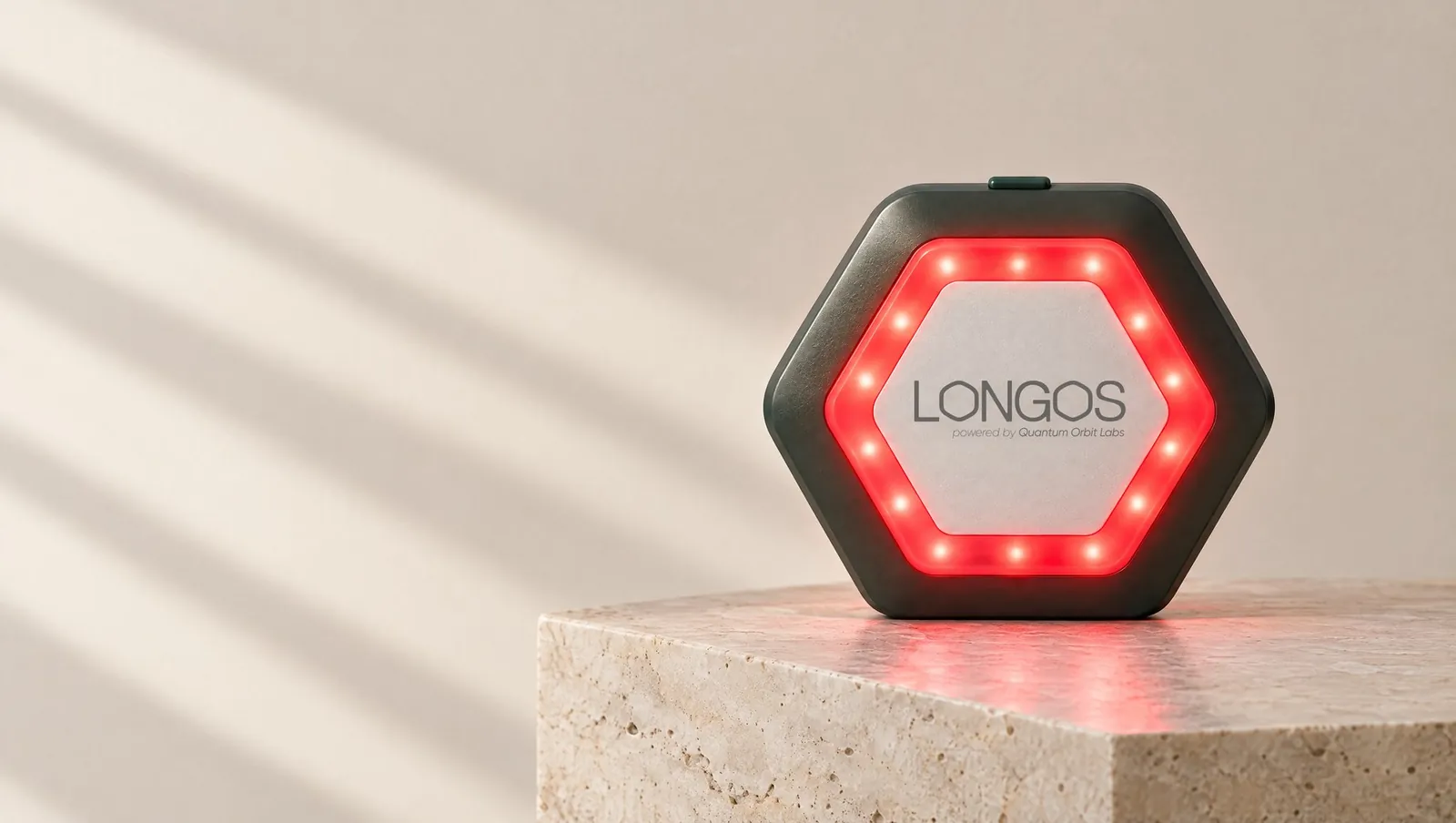
Quantum Orbit Labs, which prepared this guide, is the maker of the Longos Sense device and of eight Longos serums. According to the user manual, Longos Sense is a cosmetic skincare device designed for adults aged 18 and over and intended for non-prescription home use. It has two application surfaces for the face and neck; developed with German engineering, the device carries the CE mark.
The device offers six technologies in one. The values are from the user manual:
- Quantum Dot Light technology: red (about 630 nm), blue (about 415 nm) and near-infrared (about 850 nm) light.
- Radiofrequency (RF): bipolar, 1 MHz; temporarily warms the skin tissue.
- Ultrasonic Wave: 1 MHz; provides a gentle vibration massage and can be used together with a serum.
- Thermal Therapy: at most 39°C on the contact surface, with automatic cutoff by an NTC sensor; gently warms the skin surface and is intended to support the absorption of cosmetic products.
- Cryo Therapy: about 10°C on the contact surface, 3-5 minutes per session.
- Mechanical Vibration: available on both application surfaces; provides a gentle mechanical vibration massage that stimulates the skin and is a separate mode from Ultrasonic Wave.
The device connects to the Longos app by Bluetooth; the modes and an intensity level from 1 to 6 are chosen in the app, and it is applied for 5-10 minutes per area. The artificial intelligence skin analysis in the app scores the parameters of wrinkles and fine lines, pore appearance, pigmentation and tone evenness, redness, and breakouts and blemishes on a 0-100 scale from a photo taken with the phone camera, and recommends a cosmetic routine accordingly. The manual states clearly that this analysis is a cosmetic appearance tracking tool and does not diagnose. The device is not used during pregnancy and breastfeeding, by people with an active electronic implant, if there is a metal implant or an active skin infection in the application area, or under the age of 18.
The eight Longos serums were developed by Prof. Dr. Ömer Tahir Günkara and his team in the laboratories of Yildiz Technical University and are formulated at a defined pH below 40°C to protect the actives. The main ingredient of each serum is as follows:
- Anti-Aging Serum: Anigozanthos Flavidus extract and Hexapeptide-9; for firmness and fine lines.
- Brightening Serum: stabilized 3-O-Ethyl Ascorbic Acid; for evenness of tone and the appearance of dark spots.
- Detox & Blue Light Serum: Epilobium (Oenothein B) and Theobroma cacao; for blue light and environmental stress.
- Moisturizing Serum: 8D Hyaluronic Acid Complex; for hydration and the barrier.
- Soothing Serum: Tasmannia Lanceolata; for sensitive and reactive skin.
- Midnight Repair Serum: Hydroxypinacolone Retinoate; for night care.
- Pore Minimizer Serum: Epilobium and plant extracts; for the appearance of pores and oil balance.
- Anti-Acne Serum: Salix Purpurea (natural salicylates); for breakout-prone skin.
An 8-point checklist before you buy
- Write your need in one sentence. "Fine lines around the eyes" and "oiliness on the cheeks" lead to different groups.
- Choose the format. An at-home device, a serum with active ingredients, a prestige cosmetic or a clinic treatment; plan your budget and time accordingly.
- Read the technology as numbers. Nanometers for LED, MHz and the temperature cutoff for RF, the contact temperature for cold; if an FDA wording is given, check the record number and which model it belongs to.
- Work out the weekly time and the consumables. Write the recommended session frequency into your calendar; if gel, conductive serum, a mask or a cartridge is needed, think about a year's supply.
- For a serum, read the ingredient list. Check the name and form of the active, its concentration, the Parfum line and the test footnote; try a new active on a small area first.
- Buy from an official channel. Prefer the brand's own site or the authorized sellers it lists on its site; keep the invoice and the after-sales support information.
- Check when not to use it. Pregnancy and breastfeeding, electronic implants, active skin infection and medicines that cause light sensitivity are the most common warnings; if you have a medical skin problem, consult your dermatologist first.
- Ask three questions at the clinic. Who performs the procedure, in which licensed setting is it done, and which device is used, with which registration?
Where to start this week?
Before you buy anything this week, write the one skin concern that bothers you most in a single sentence and find the matching row in the short-answer table. Then open the official pages of at most two brands in that row and note three things side by side: the technology or concentration, the weekly time of use and the consumables needed over one year. These three lines make your decision, not an advertising image.
If you would rather measure than guess which appearance parameter stands out on your skin, you can run the artificial intelligence skin analysis in the Longos app once on clean, product-free skin. This is a care guide, not medical advice; for a persistent or inflamed skin problem, consult your dermatologist first.
Frequently Asked Questions
Which is the best skincare brand?
There is no single best skincare brand. The choice depends on three things: your main skin concern, your budget, and whether you want a device, a serum with active ingredients or a treatment in a clinic. For the appearance of wrinkles you can look at at-home LED or RF devices, for the appearance of dark spots at serums with vitamin C or niacinamide, and for pronounced laxity at clinic treatments. First write your need in one sentence, then, on the official pages of the brands in that group, note the technology or concentration, the frequency of use and the consumables required.
FOREO or Medicube, which suits me?
The two brands follow different paths, so the decision depends on the technology you want. FOREO spreads its technologies over separate devices: BEAR 2 is a microcurrent device used with a conductive serum, UFO 3 applies LED, heat and cold with a face mask, and FAQ 102 includes RF, LED and EMS. Medicube AGE-R Booster Pro, on the other hand, combines booster, microcurrent, sonic vibration and LED modes in one device and works with the skincare products you already use. Check which technology, what kind of application and which official sales channel you want.
Does an at-home skincare device replace HIFU or Thermage?
No. At-home cosmetic devices do not replace these treatments; they work at a different energy level and for a different purpose. According to the FDA summary, Thermage FLX delivers RF at 6.78 MHz with a maximum average power of 400 W, while HIFU focuses ultrasound energy on points at millimeter-level depths under the skin. At-home devices are designed for the surface and for regular use. If you are considering a clinic treatment, ask who performs the procedure, in which licensed healthcare establishment it is done and which device is used.
Which skincare brands are sold in pharmacies?
According to the brands' own Turkey pages, the brands in this guide that show a pharmacy channel are these: La Roche-Posay and Vichy direct visitors from their sites to a pharmacy locator, and CeraVe's site shows authorized pharmacies; SVR writes that its products can be bought from authorized pharmacies; SkinCeuticals is sold at authorized pharmacies and clinics; Bioderma shows NAOS Stars and the online channels it lists alongside authorized pharmacies. Caudalie and Cosmed are found in pharmacies as well as in their own online stores. Before buying, check the list of authorized sales points on the brand's site.
What should I look at on a serum label?
First look at the name and concentration of the active; the concentration is often written in the product name or on the brand's page. Under the Cosmetic Products Regulation, the ingredient list is written in descending order by weight, and ingredients below 1% can be added at the end in any order. Then check the form: is the vitamin C pure L-ascorbic acid or a derivative, and is the retinoid retinol or an ester? Compare phrases on the front such as "fragrance-free" with the Parfum line in the list, and see whether the test footnote is a self-assessment or a measurement.
Which are the Turkish skincare brands?
This guide has six serum brands founded in Turkey: The Purest Solutions, Dermoskin, Cosmed, Maruderm, Cream Co. and Skin401. All of them sell through their own online stores; Cosmed is also found in the pharmacy channel, and Maruderm's niacinamide serum appears on the pages of Watsons, Rossmann and Gratis. INO Beauty, based in Istanbul, sells tinted cosmetics with marine collagen, a care cream and a sunscreen; its catalog has no serum. When choosing, check the concentration of the active and the skin type the brand states.
Clinical evidence