
blue light
Is There a Device That Helps Acne-Prone Skin? Blue Light, Tools to Avoid and a Buying Guide
Is there a device that helps acne-prone skin? A short, honest answer
Among devices used at home, the group with the most accumulated evidence for acne-prone skin is LED devices that emit blue and red light. In a 2025 meta-analysis of six randomized trials with 216 people who had mild to moderate acne, those who used these devices had a larger drop in pimple counts than control groups. Still, the studies are small and the devices differ from one another. The American Academy of Dermatology's (AAD) 2024 acne guideline, meanwhile, found too little evidence to develop a recommendation for light therapies.
The limit of light is also drawn clearly. According to the AAD, visible light may help red pimples; it is not effective on blackheads, whiteheads, cysts and nodules. For vacuums, extraction tools, harsh brushes, steamers and high-frequency devices, there is either no controlled evidence or the potential for harm stands out.
Practical rule: Think of a light device as a support added to a routine with strong evidence behind it, not as a replacement for that routine. If you have deep, painful pimples, pimples that leave marks, or severe acne that suddenly starts in adulthood, see a dermatologist before buying a device.
What does blue light do on acne-prone skin? The mechanism in brief
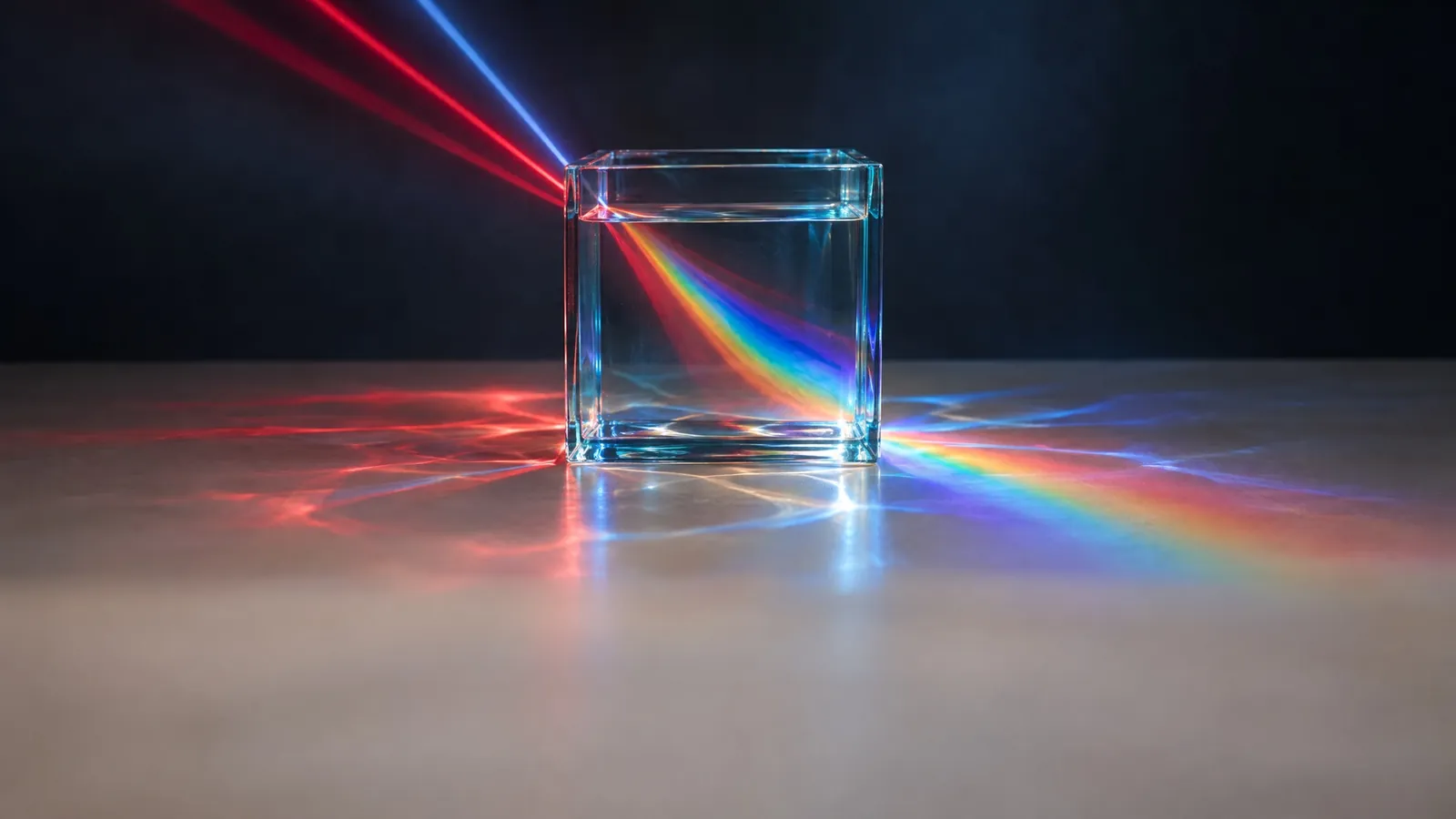
The target is a molecule the bacteria make themselves. Cutibacterium acnes, the bacterium that lives in hair follicles, produces light-sensitive molecules called porphyrins. According to Gold's 2008 review of photodynamic therapy, the strongest absorption peak of these porphyrins lies around 415 nm (400-420 nm according to Degitz), known as the Soret band; there is a second peak around 630 nm, in the red range. When porphyrin absorbs light, reactive oxygen species form inside the bacterium. The 2012 review by Dai and colleagues presents this as the widely accepted hypothesis, but adds that the mechanism is not fully understood.
Red light looks at the inflammation side. In their 2000 study, Papageorgiou and colleagues attributed the success of mixed blue-red light to the combination of an antibacterial and an anti-inflammatory effect.
Light works on the surface, and its reach is narrow. According to the AAD, devices that emit blue, red or blue-red light may help red pimples (papules and pustules). They are not effective on blackheads, whiteheads, cysts and nodules. Degitz's 2009 review likewise writes that a direct effect of blue light on comedones is hardly expected and that severe acne did not improve. We cover in detail how wavelength, light intensity and dose are calculated in our guide to at-home LED light therapy.
How strong is the evidence? Cochrane, the AAD guideline and the blue-red combination
Cochrane: no high-quality evidence. The 2016 Cochrane review by Barbaric and colleagues pooled 71 randomized trials of light therapies with a total of 4,211 participants. Most studies were small (median 31 people), wavelengths and doses varied widely, and two thirds were funded by industry. The authors' conclusion is clear: no high-quality evidence.
AAD 2024: no recommendation, plus a warning. The AAD guideline states that there is not enough evidence to develop a recommendation for many physical methods, including the combined use of 420 nm blue and 660 nm red, 635-670 nm red light, intense pulsed light and comedone extraction. The only recommendation under this heading is negative: the guideline makes a conditional recommendation against adding a method that combines a vacuum with broadband light to 0.3% adapalene gel. The reason is a single study: the addition did not reduce pimple counts and carried a risk of pigmentation and bruising.
2025 meta-analysis: small but positive. The JAMA Dermatology meta-analysis by Ershadi and Barbieri combined six randomized trials of home or portable LED devices. The 216 participants were aged 12-50; blue devices ranged from 414-445 nm and red devices from 630-670 nm. Those who used LED saw a larger reduction than control groups in both inflammatory and non-inflammatory pimples; improvement was generally noticed after 4-12 weeks of use, and no serious side effects were reported. The authors add two cautions: differences between studies were large, and results may not generalize to other devices on the market.
Blue plus red. The basis for the combination is largely the study by Papageorgiou and colleagues. A total of 107 people with mild to moderate acne used portable light sources for 15 minutes a day for 12 weeks. In the blue-red group, inflamed pimples improved by an average of 76%. This result was significantly better than blue light alone at weeks 4 and 8, but not at week 12; the 58% improvement in comedones also did not differ significantly from the other groups. The combination is promising, but the weight of the evidence still rests on this single study.
Acne devices on the market: which have evidence and which to avoid
Products sold as "acne devices" do very different jobs:
| Device type | What it is claimed to do | Evidence and risk | Verdict |
|---|---|---|---|
| LED mask | Blue and/or red light over the whole face | Small randomized trials; eye safety is critical | Worth considering if it passes the checklist |
| Handheld LED device | Targeted light by contact | Small randomized trials | Worth considering if it passes the checklist |
| Vacuum pore cleaner | Sucks out pore contents | Only works on already loosened blackheads; risk of bruising and small blood vessels | Avoid |
| Extraction tool and pimple popper | Pressure with a metal loop | Risk of marks and infection | Avoid |
| Harsh or spinning brush | Mechanical scrubbing | Scrubbing can flare pimples | Do not use on red pimples |
| Facial steamer | Heat and moisture | No controlled study for acne; burn risk | Not needed |
| High-frequency wand | Current from a glass electrode, ozone | Laboratory data only | No evidence |
Vacuum pore cleaners
According to an aesthetician from the dermatology department at University of Utah Health, home vacuum devices only work on blackheads that are already loosened. Too much suction can cause bruising, irritation, micro-tears in the skin and visible small blood vessels known as telangiectasia; a laser may be needed to improve how these vessels look. We examined one by one what tapes, vacuums and metal tools pull out of a blackhead and what that costs in our guide to how blackheads go away.
Extraction tools and pimple poppers
According to the AAD, when you squeeze a pimple at home, some of the contents is often pushed deeper into the skin. This increases inflammation, can make the pimple more noticeable and painful, and may leave a lasting mark; bacteria on the hands also carry a risk of infection. The Academy stresses that picking at a deep, painful pimple raises the risk of marks and color change, especially in darker skin. Comedone extraction with a sterile instrument is a dermatologist procedure; according to Mayo Clinic, even in a clinic it only temporarily improves appearance and can leave marks.
Harsh brushes and scrubbing
Acne is not caused by dirty skin. According to Mayo Clinic, scrubbing the skin hard or cleansing with harsh soaps and chemicals irritates the skin and can make acne worse. The AAD recommends applying cleanser with the fingertips in light, circular motions and rinsing, again, with the fingers. A hard spinning brush over red pimples contradicts that advice.
Facial steamers
We could not find a controlled study measuring the effect of steam on acne. According to dermatologist Susan Massick of The Ohio State University Wexner Medical Center, steamers can cause burns and, in people with rosacea, seborrheic dermatitis and eczema, can irritate rather than help. Massick advises skipping these devices and settling for the steam from your shower.
High-frequency wands
These wands, which pass current through a gas-filled glass electrode, are sold with antimicrobial claims. The 2022 study by Frommherz and colleagues begins by noting that there are no solid data on efficacy and mechanism of action. Bacterial counts fell in laboratory dishes and ozone built up in the room as the device ran; but the experiments were done only in the laboratory, not on human skin.
Checklist before you buy: what to look for on the box and in the manual
The criteria are mainly for light devices; most also apply to devices that heat or vibrate. If you cannot find an answer to a row, ask the seller in writing.
| Criterion | Why it matters | What to look for on the box, in the manual or on the product page |
|---|---|---|
| Wavelength (nm) | Porphyrins absorb most around 415 nm; the home devices in the meta-analysis used 414-445 nm blue and 630-670 nm red | A written nm value for each color, not just the number of colors |
| Light intensity and dose (mW/cm², J/cm²) | The same color can carry different amounts of energy; Mayo Clinic says the ideal light source and dose have not yet been determined | The technical specifications table; if it is missing, ask the manufacturer |
| Session time and timer | Protocols differ widely: 15 minutes a day in the Papageorgiou study, 30-60 minutes twice a day for 4-5 weeks for some home devices according to the AAD | Session length, weekly frequency, automatic shut-off |
| Eye safety | The effect of blue light on the retina depends on intensity and duration; eye injury was the most common problem in FDA reports | An eye warning, an eye opening in the mask or light-blocking goggles |
| Heat control | Heat carries a burn risk and can strain redness-prone skin | Maximum temperature (°C) and automatic cut-off |
| Contact surface and cleaning | A surface that touches your skin every day can carry bacteria and oil | Cleaning method, water resistance, whether a gel or serum is required |
| Battery and charging | Usage pattern and safety | Charging time, a "do not use while charging" warning |
| CE mark | Shows conformity with the relevant technical regulation; it is not proof of effectiveness | CE mark on the device and the packaging |
| Turkish manual | Article 55 of Turkish Law No. 6502 makes it mandatory in Turkey; contraindications are in it | A printed manual in the language of your market, with a list of contraindications |
| Warranty and manufacturer information | Under Article 56 of the Turkish law, the warranty period is at least two years from delivery | A warranty certificate; the clear name and address of the manufacturer or importer |
| Return terms | The 14-day right of withdrawal has an exception related to hygiene | The seller's pre-contract information text |
| App | Makes tracking easier, but does not diagnose | What it measures and whether it clearly states that it is not a diagnosis |
Read the return terms before opening the packaging. Under Turkey's Distance Contracts Regulation, you have the right to withdraw within 14 days without giving a reason for a product bought online. But the regulation exempts goods whose protective elements such as packaging, tape or seal have been opened and which are not suitable for return for health and hygiene reasons. Look in the seller's pre-contract information text for whether a device that touches the face counts as such; if it does not say, ask before ordering. This is Turkish consumer law; if you buy in another country, check your own local rules.
Read the CE mark correctly. According to Turkey's Ministry of Trade, the CE mark shows that a product conforms to the relevant technical regulation and will not harm life and property when used as intended. According to the European Union, the manufacturer affixes the mark on its own responsibility; there is no central EU body that grants permission. So CE is a declaration of conformity, not proof that a device works on acne-prone skin.
Red flags: walk away when you see these promises
- "Treats acne" or "ends pimples for good." According to the AAD, even light and laser treatments in a clinic rarely clear acne on their own.
- "Dries out cysts and deep pimples." According to the AAD, visible light is not effective on cysts and nodules.
- "Clinic results at home." The AAD notes that home devices are weaker than the devices dermatologists use.
- "No medication needed." The AAD guideline's strong recommendations go to actives such as benzoyl peroxide and topical retinoids; there is no recommendation for light.
- Number of colors instead of wavelength. A "multicolor" device that gives no nanometer value is not telling you what it delivers or at what dose.
- A mask or lamp without an eye warning. In the 2024 study by Hill and Lipner, the FDA's adverse event database held 87 reports about home-use energy-based devices for acne and anti-aging. The most common problem was eye injury (32%); 22 of the 28 eye reports were linked to a single device withdrawn from the market in 2019. Reports do not prove cause and effect, but they show why an eye warning matters.
- No CE mark, Turkish manual, warranty certificate or manufacturer address. If any of these is missing, you may find no one to turn to when a problem arises.
- Marketing built on extraction and vacuum videos. The message that "the more that comes out of the pore, the better" ignores the risks described above.
Does blue light cause pigmentation in darker skin?
It did in one experiment. In the 2014 study by Duteil and colleagues, healthy volunteers with skin types III and IV, corresponding to medium and brown tones, received increasing doses of 415 nm blue-violet light and 630 nm red light on small areas of skin. The 415 nm light caused dose-dependent darkening; this darkening was more pronounced than what UVB produced and lasted up to 3 months. The 630 nm light caused no darkening.
Know its limits, too. The doses were set by the researchers and the light was applied to small test areas, not the face; the study does not show how much pigmentation a home device would cause. Still, the signal should not be ignored. According to Mayo Clinic, dark spots and marks after pimples are more common in people with darker skin. The AAD guideline also noted a pigmentation risk with the vacuum-light system.
What should you do in practice? If your pimples leave brown marks after they clear, or if you have melasma, talk to a dermatologist before starting blue light. If you do start, use a broad-spectrum sunscreen every morning and take photos in the same light every two weeks; if you see new dark spots, take a break. We describe the cycle in which inflammation and irritation leave marks in our guide to reducing redness and irritation in acne-prone skin.
Home device or clinic: who can do what?
A home LED device is not the equivalent of a procedure done in a clinic. The two do different jobs:
| Topic | Home LED device | Dermatologist in a clinic |
|---|---|---|
| Power | Weaker than a dermatologist's devices according to the AAD | Lasers, intense pulsed light and stronger light sources |
| Target | Mild to moderate, red pimples | Treatment planned together with medication, including cysts and nodules |
| Photosensitizer | Not used | In photodynamic therapy, a solution is applied to the skin and left on for 15 minutes to 3 hours; according to the AAD, sun is avoided for 48 hours afterward |
| Pimple clearing | Not recommended | Comedone extraction with a sterile instrument, drainage with a needle or scalpel, a corticosteroid injection into a single painful nodule |
| Evidence | Small randomized trials with home devices | According to Cochrane, the benefit of photodynamic therapy over standard treatment is of low certainty; for medications, the AAD's strong recommendations |
| Continuity | Regular use for weeks | A series of sessions; according to the AAD, one or two follow-up sessions a year may be needed |
According to the AAD, results of light and laser treatments in a clinic also vary from person to person. If your pimples have left depressed scars, you are outside what a home light device is meant for; we compared clinic options such as microneedling, laser and subcision in our guide to how acne marks fade.
Who should not buy one, and who should see a dermatologist instead?
Talk to a doctor first if:
You take a medicine that causes photosensitivity. According to DermNet, drug-induced photosensitivity is a skin reaction that appears after a person taking a photosensitizing medicine is exposed to visible light or UV rays. The list includes tetracyclines such as doxycycline, oral retinoids such as isotretinoin, and topical retinoids; in other words, some of the medicines commonly used for acne. Degitz's review also says photosensitizing medicines should not be used at the same time as blue light. If you take one of these medicines, ask the doctor who prescribed it before you buy a device.
You have an eye condition. Hill and Lipner recommend that people with eye disease, or who take medicines that make the eyes sensitive to light, be specifically informed about eye risks.
Situations the manual lists as not for use. Ask for the contraindication list before you buy. If pregnancy, breastfeeding, epilepsy or a history of light-sensitive seizures, or an electronic implant such as a pacemaker applies, check the list and talk to your doctor. If there is an open wound or a crusted or infected pimple in the area of use, do not apply the device to that area.
When you need a dermatologist instead of a device
- Deep, painful, swollen pimples (nodules and cysts). According to Degitz's review, people with nodulocystic acne did not improve with blue light; the AAD also refers people to a dermatologist when there are several deep and painful pimples.
- Pimples that leave scars. The AAD guideline treats acne that leaves scars or is psychologically distressing as severe acne.
- Severe acne that suddenly starts in adulthood. According to Mayo Clinic, in older adults this picture can be a sign of an underlying condition that needs medical evaluation.
- Pimples that come with irregular periods, increased hair growth or thinning hair. We explain what these signs mean in our guide to the causes of hormonal acne and when tests are needed.
- Pimples that do not change despite 6-8 weeks of regular care. The AAD recommends giving an acne product that long.
A device is not enough: the rest of the routine and device hygiene
The weight of the evidence is still on actives. The AAD's 2024 guideline strongly recommends benzoyl peroxide and topical retinoids on moderate-certainty evidence; azelaic acid and salicylic acid are conditional recommendations. According to Degitz, blue light can be used together with topical products; because light has a weak effect on comedones, an active that opens comedones is especially recommended. We explain how salicylic acid enters the pore and at what concentrations it is used in our salicylic acid guide.
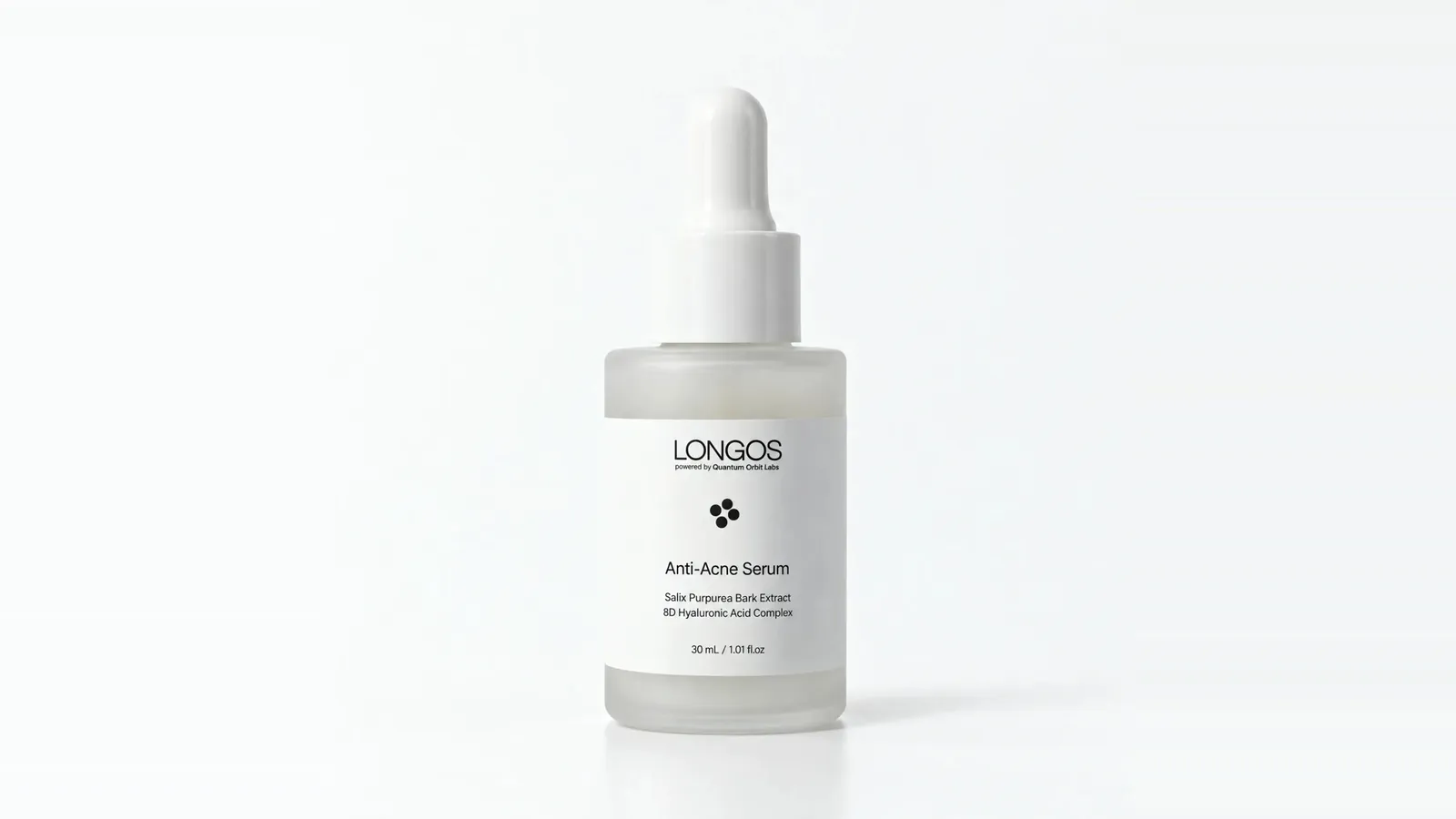
The main active ingredient of Longos Anti-Acne Serum is natural salicylates derived from Salix Purpurea (purple willow), and it is formulated for acne-prone skin. It is a cosmetic care step; it does not replace a dermatologist for deep or stubborn pimples.
Keep the routine short. The AAD recommends washing the face twice a day, on waking and before bed, applying the active as a thin layer over the entire acne-prone area rather than only on pimples, and choosing products that do not clog pores. Because some acne actives can make skin sensitive to the sun, apply a broad-spectrum sunscreen of at least SPF 30 every morning.
Device hygiene. Apply the device to clean, dry skin without makeup; after each use, wipe the contact surface with the method the manual describes and let it dry. Do not share your device: the AAD says that even sharing a makeup brush can carry someone else's bacteria and oil to your skin and cause pimples. The same logic applies to a device surface that touches your face every day.
After you buy: the first 4 weeks and a realistic timeline
- Before you start. Read the manual from beginning to end and compare the contraindications with the medicines you use. Take one photo from the front and one from each side in daylight; because change is slow, you will trust the photos rather than your eye.
- Week 1: getting used to it. Start with the shortest time and lowest intensity in the manual, and protect your eyes. Do not add a new active to your routine in the same week; according to the AAD, changing products often can irritate skin and lead to new pimples.
- Week 2: tolerance check. The side effects reported in the meta-analysis were mild dryness, redness and discomfort during sessions. If dryness occurs, the AAD recommends a moisturizer made for acne-prone skin; if you notice burning, pain or new dark spots, take a break.
- Week 3: routine. Set sessions on fixed days; the studies with positive results were run with regular use. According to Degitz, pimples may temporarily get worse now and then with blue light; do not judge by a single bad week.
- Week 4: interim review. Compare the photos. It is normal not to see a big difference, because in the meta-analysis improvement was generally noticed at 4-12 weeks.
- Weeks 8-12: decision. The 76% improvement in the Papageorgiou study was measured at week 12. The AAD also suggests giving an acne product 6-8 weeks and waiting generally 3-4 months for full clearing. If nothing has changed at 12 weeks, it is time to change the plan, not the device; see a dermatologist.
Where does Longos Sense stand on this checklist?
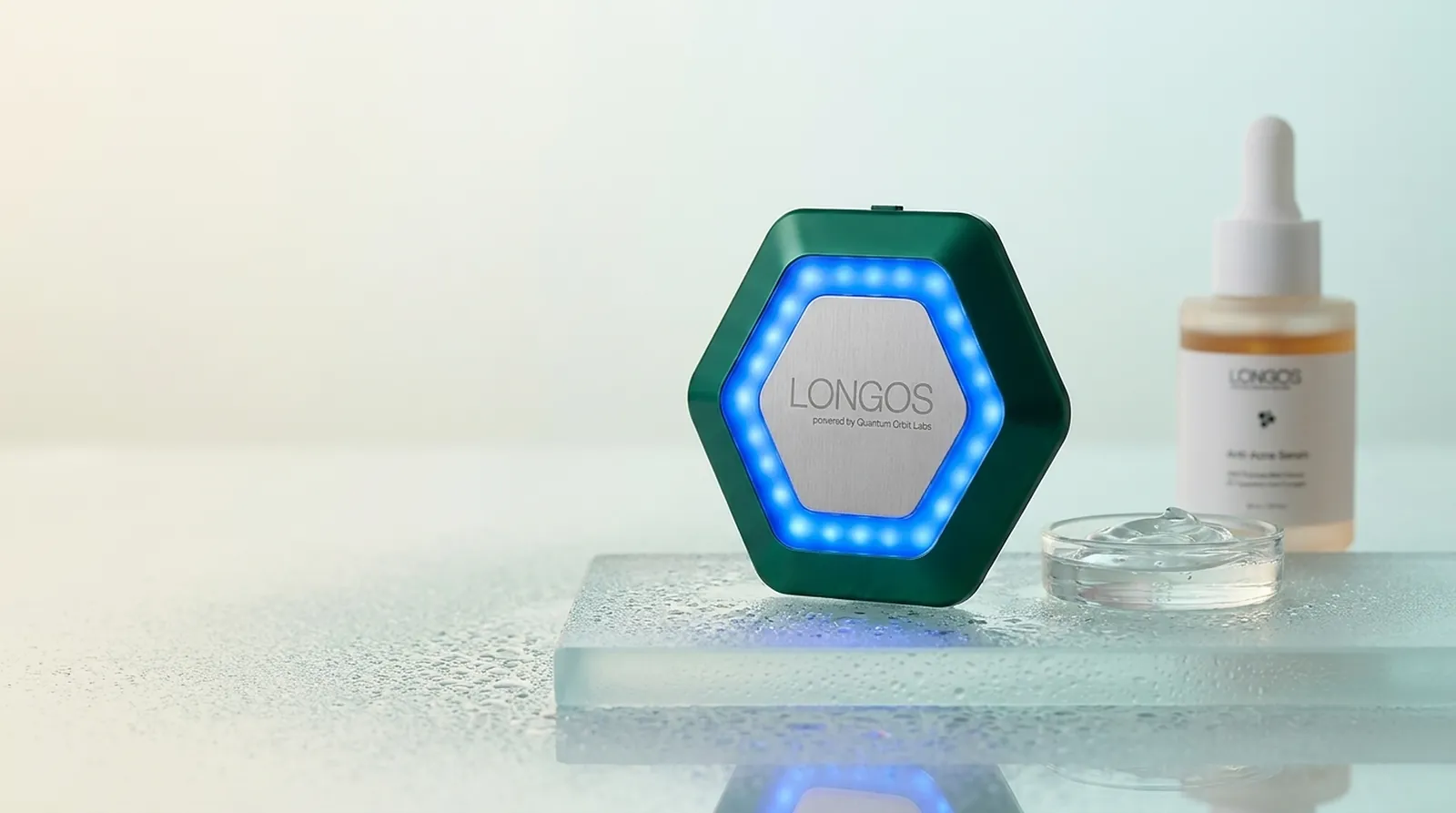
Longos Sense is a handheld cosmetic care device developed by Quantum Orbit Labs for the face and neck. Of its six technologies, the one relevant here, Quantum Dot Light, is an LED array that emits light at specific wavelengths. The entries below rely only on the user manual (version 1.2):
| Criterion | What the manual says |
|---|---|
| Wavelength | Blue LED 415 nm, red LED 630 nm, near-infrared 850 nm; the color is chosen in the app |
| Cosmetic indication | Blue light: to improve the appearance of acne-prone skin. Red light: to improve the appearance of skin and to visually reduce wrinkles and fine lines |
| Session | In LED modes up to three times a day, 5-10 minutes per area; start low on the intensity scale of 1-6 |
| Light intensity | The manual gives no value in mW/cm² |
| Eyes | Not applied over the eyes or eyelids; used only on the face and neck |
| Heat control | In Thermal mode, at most 39°C at the contact surface, with automatic cut-off by an NTC sensor |
| Cleaning | After each use, with a dry cloth; for deep cleaning, a cloth lightly moistened with 70% isopropyl alcohol. The device is not waterproof |
| Battery | 1800 mAh lithium-ion, about 2 hours to charge; not used while charging |
| Documents | CE mark, Turkish manual, 2-year warranty, the manufacturer's clear name and address |
| App | AI skin analysis scores five cosmetic appearance parameters, including acne/blemishes, from 0 to 100; it does not diagnose |
Contraindications are written out. The manual lists people under 18, pregnancy and breastfeeding, epilepsy or a history of light-sensitive seizures, active electronic implants, metal implants in the area of use, known light sensitivity, and the use of photosensitizing medicines (consult your doctor) among the situations where it should not be used. If the area of use has an active skin infection, an open wound, a rash or an active lesion, the device is not used on that area; if you are unsure whether a pimple falls under this definition, ask your dermatologist.
Let us state the limits plainly, too. Quantum Orbit Labs has no published human study carried out with this device, so we make no efficacy claim beyond the cosmetic indications in the manual. The 415 nm of the blue LED is the same wavelength that caused pigmentation in the Duteil study; if you tend to get dark marks after pimples, talk to your dermatologist before starting the blue light mode. You can find the contents of the kit and the technical details on the Longos Sense kit product page.
Where should you start this week?
Before a device goes into your basket, list the medicines you take and ask your doctor about any that cause photosensitivity. Then find three lines in the candidate device's manual: the nm value of the blue light, the eye warning and the contraindication list. If one is missing, take that device off your list.
If you use Longos Sense, run the AI skin analysis in the app once this evening on clean, product-free skin before your first session and note the acne/blemish score; repeat it in the same light four weeks later. The analysis does not diagnose; this article is a care guide, not medical advice.
Frequently Asked Questions
Is there a device that helps acne-prone skin, and does blue light work?
Among devices used at home, the group with the most evidence is LED devices that emit blue and red light. In a 2025 meta-analysis of six randomized trials with 216 people who had mild to moderate acne, those who used LED had a larger drop in pimple counts than control groups. Still, the studies are small, the Cochrane review found no high-quality evidence, and the American Academy of Dermatology's 2024 guideline made no recommendation for light. Visible light may help red pimples; it is not effective on blackheads, whiteheads, cysts and nodules. Use the device alongside your routine, not instead of it.
How do you use a blue light device, and for how many minutes?
Your own device's manual sets the time, because protocols differ a lot: in a study from 2000 a portable light source was used for 15 minutes a day, while the American Academy of Dermatology notes that some home devices call for 30-60 minutes twice a day for 4-5 weeks. Apply the device to clean, dry skin without makeup, start at the lowest intensity and protect your eyes; do not hold the light toward your eyes or eyelids. Do not use it over open wounds or crusted or infected pimples, and track progress every two weeks with photos taken in the same light.
Does blue light cause pimples, and what are its downsides?
According to one review, some people who use blue light may see their pimples temporarily get worse now and then, so do not judge by a single bad week. Side effects reported in home-device studies were mild dryness, redness and discomfort during sessions. Three more risks deserve attention: 415 nm light caused darkening lasting up to 3 months in volunteers with skin types III and IV; light reaching the eye can damage the retina; and medicines such as doxycycline and isotretinoin can cause photosensitivity. If you are prone to dark spots or take one of these medicines, talk to a doctor first.
Are pore vacuums and pimple extraction tools harmful?
According to an aesthetician at University of Utah Health, home vacuum devices only work on blackheads that are already loosened; too much suction can cause bruising, irritation, micro-tears and visible small blood vessels. According to the American Academy of Dermatology, when you squeeze pimples at home, some of the contents is pushed deeper into the skin, which increases inflammation and carries a risk of lasting marks and infection. The Academy's 2024 guideline also advises against adding a method that combines vacuum with light to an adapalene gel. Do not use these tools on red or deep pimples.
When does an acne device show results?
Not quickly. In the 2025 meta-analysis of home LED devices, improvement was usually noticed after 4-12 weeks of regular use. In a blue-red light study, the average 76% improvement in inflamed pimples was measured at week 12. The American Academy of Dermatology also suggests giving an acne product 6-8 weeks and waiting generally 3-4 months for full clearing. Not seeing a big difference at week four is normal; if nothing has changed at 12 weeks, see a dermatologist.
What should you check when buying an acne device?
The manual should list the wavelength in nanometers for each color, the session time, an eye warning and a list of contraindications; if it does not state light intensity, ask the manufacturer. The device should carry the CE mark, and in Turkey the box should include a Turkish manual and a warranty certificate; under Turkish Law No. 6502 the warranty period is at least two years. The CE mark shows conformity with technical regulations, not effectiveness. If you buy online, read the return terms before opening the packaging, because under Turkish rules hygiene-related exceptions to the right of withdrawal may apply. Stay away from products that promise to treat acne, permanent results or clinic results at home.
Clinical evidence

