What does an ice roller do? The short answer
An ice roller cools the skin surface for a few minutes. It may briefly reduce the look of morning puffiness and redness, and it feels refreshing as you use it. It does not close pores, burn fat or lift the face for good. According to dermatologist Shilpi Khetarpal, speaking to Cleveland Clinic, the improvement from a face roller is temporary and usually fades within a few hours.
The outcome is not decided by the name or colour of the roller. Three questions decide it: how cold is the tool when it meets the skin, how long does it stay there, and what is it made of? A steel globe fresh from the freezer and a stone roller that has sat in the fridge are sold on the same shelf, but they place a very different load on the skin.
We covered how cold affects blood vessels, cryo chambers and the risks of rubbing bare ice on the face in our in-depth guide to Cryo Therapy and rubbing ice on the face. The comparison below is only about tools: ice rollers, metal globes and spoons, stone rollers, gel masks, cold compresses and devices whose temperature is set electronically.
Ice roller, metal globe, gel mask: how cold does each one get on the skin?
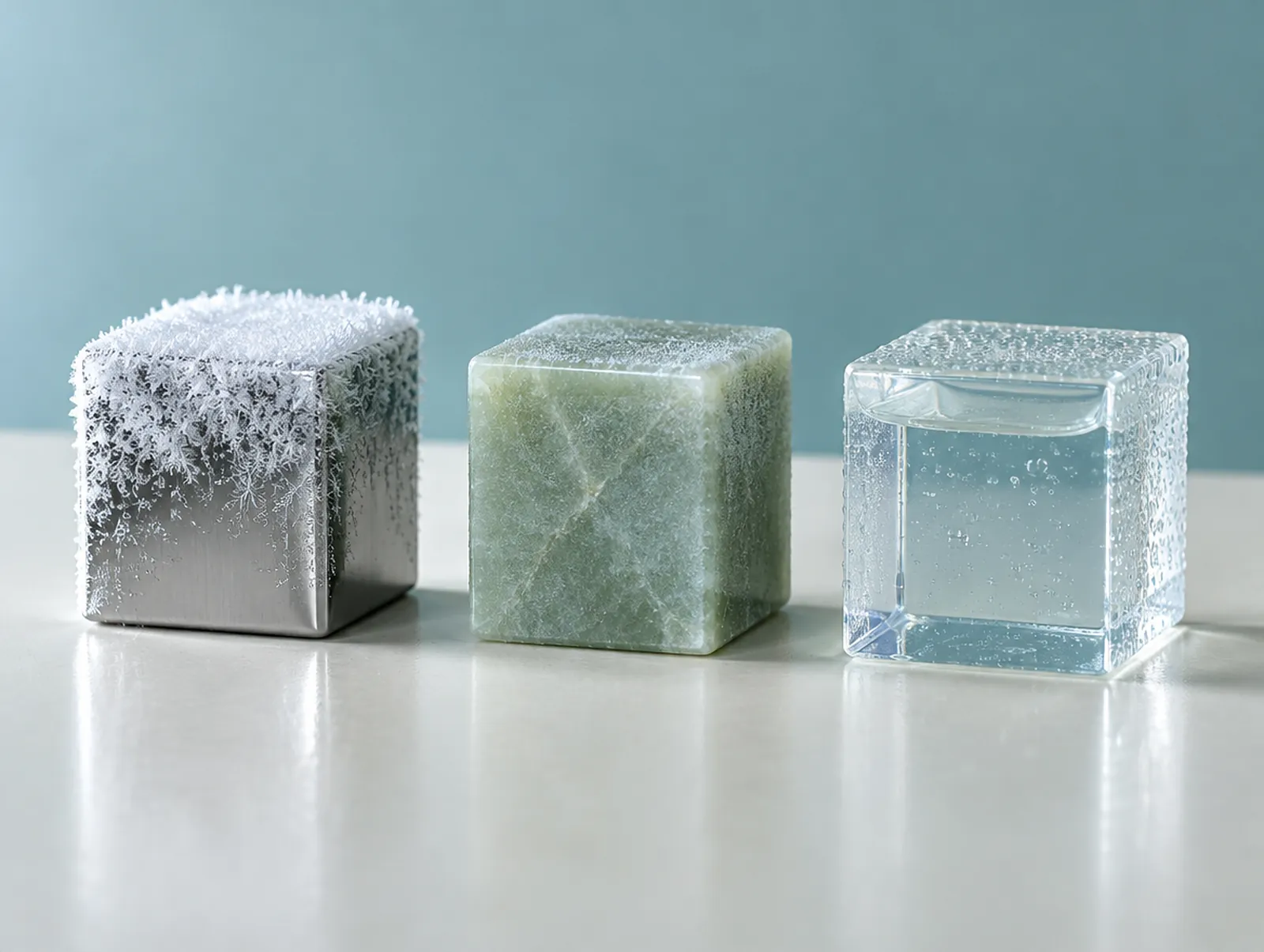
According to the US Food and Drug Administration (FDA), a home freezer should be set to -18°C and the fridge to 4°C or below. Two tools taken from the same freezer behave differently the moment they touch the skin. How fast a material cools the skin depends not only on its own temperature, but on how quickly it pulls heat away and how much heat it can store.
Gel- and water-filled rollers: they start cold and warm up fast
A gel-filled ice roller is essentially a miniature gel pack. In the 2007 study by Kennet and colleagues, four different cold applications were applied to the ankles of nine healthy volunteers for 20 minutes. The gel pack from the freezer was about -14°C before application, yet the lowest skin temperature reached was 16.1°C. With crushed ice that value was 9.2°C.
The reason is physics. During application the gel does not change from frozen to liquid; the heat it takes from the skin goes straight into warming the gel itself. In the same study the gel pack was also the one whose temperature rose the most during application: 12.3°C. The 2003 study by Merrick and colleagues likewise shows that melting ice absorbs far more heat during that phase change and cools the skin more than a gel pack does.
The practical takeaway for an ice roller: the first contact is the coldest moment, and then the cooling drops off quickly. We could not find a study that measures minute by minute how cold an ice roller keeps facial skin. The data above come from the leg and ankle, but the physics is the same.
Metal globes and spoons: the fastest to chill, the fastest to numb
Metal pulls heat very quickly. In the 2006 study by Geng and colleagues, 40 volunteers touched aluminium, stainless steel, nylon and wood blocks, chilled between +2 and -40°C, with the tip of the index finger a total of 1,655 times. The result is clear: on metal at -15°C, fingertip skin fell to 0°C, the threshold where freezing risk begins, in 2 to 6 seconds. On non-metal surfaces, numbness took 15 to 65 seconds to begin even at -35°C.
The recommended home freezer temperature of -18°C is colder than the -15°C in this experiment. A steel globe or spoon fresh from the freezer is the harshest tool on this list when it is pressed to one spot and held still. The same globe chilled in the fridge stays above freezing and gives a much gentler coolness.
Stone rollers, gel masks and cold compresses
Stone chills more slowly than metal. According to a 2000 report from the same research group, contact temperature falls faster on metal surfaces than on non-metal surfaces such as stone, nylon and wood. A jade or quartz roller therefore gives a softer cold than a steel globe at the same temperature.
A gel eye mask does not move; contact lasts for minutes. Kennet's team warns that low starting temperatures of -10 to -14°C can cause cold burns and serious discomfort. A mask that will sit on the face for a long time is better chilled in the fridge than in the freezer.
A cold compress is the simplest option. Mayo Clinic and the American Academy of Ophthalmology (AAO) suggest gently pressing a clean cloth soaked in cool water under the eye for a few minutes while sitting upright. The cloth stays close to tap-water temperature, never nears freezing, and is re-wetted as it warms.
| Tool | Typical starting temperature | What happens during use | What to watch for |
|---|---|---|---|
| Gel- or water-filled ice roller | About -18°C in the freezer | Warms as the gel absorbs heat, so cooling fades | The first contact is the coldest moment |
| Metal globe, spoon | About -18°C in the freezer | The material that pulls heat fastest | Held still, it drops to the freezing threshold within seconds |
| Stone roller | 4°C in the fridge, or in the freezer | Chills more slowly than metal | Kept in the freezer, it still gives a harsh cold |
| Gel eye mask | Fridge or freezer | Stays still, so contact lasts long | Long contact at freezer cold is risky |
| Cold compress | Cool tap water | Warms within minutes and is re-wetted | No freezing risk; the cloth must be clean |
| Peltier-cooled device | The set value, for example about 10°C | The value holds as the device pumps heat away | Held in one spot, it can feel sharply cold |
Where morning puffiness comes from: fluid, lymph and loose under-eye tissue
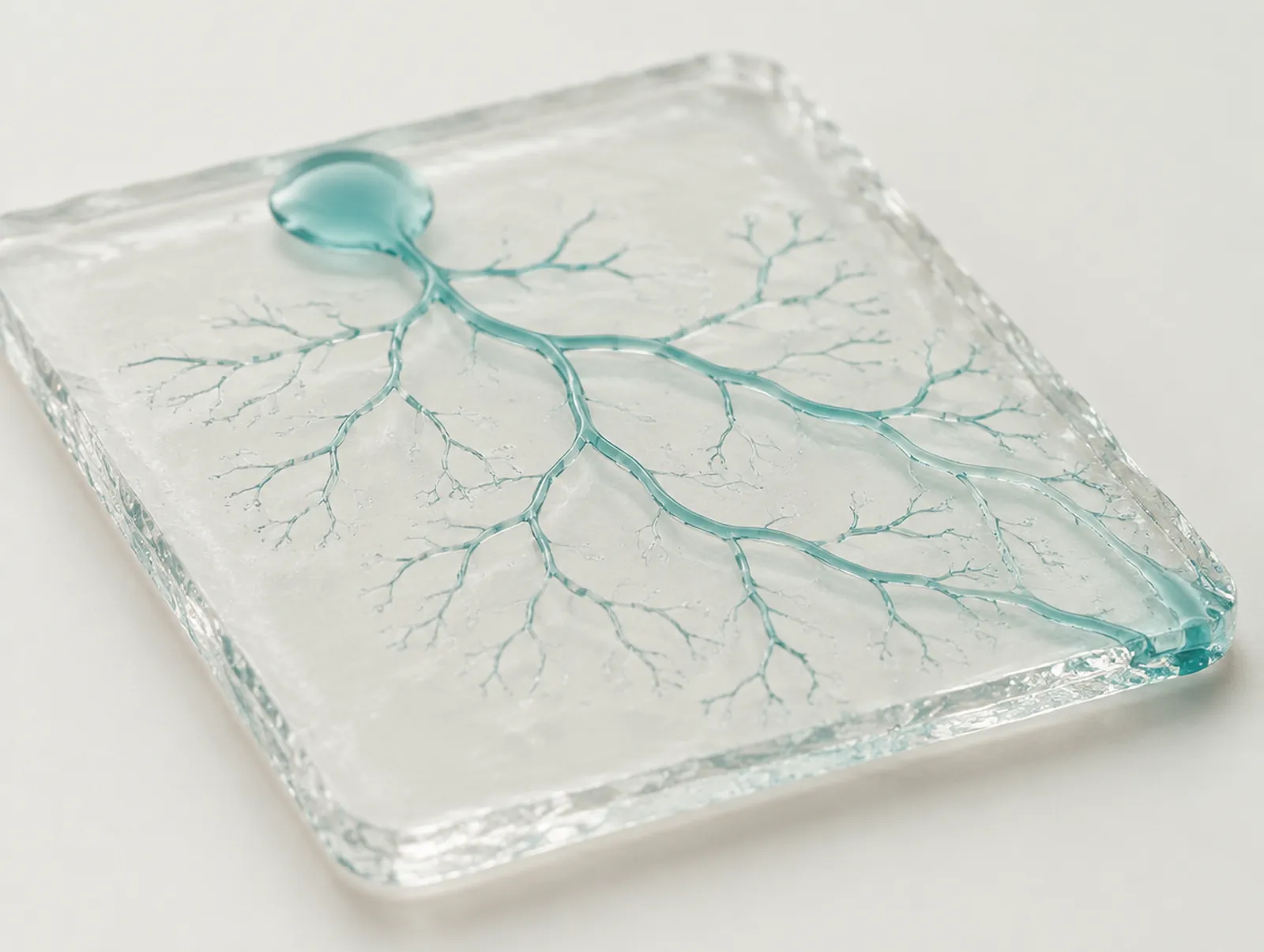
Mayo Clinic describes under-eye bags as mild swelling and points to two sources. With age, the tissues that support the eyelid loosen and the fat that supports the eye shifts toward the lower lid. Fluid can also collect in the space under the eye. According to Mayo Clinic, fluid buildup is most noticeable on waking and after a salty meal; lack of sleep, allergies, smoking and heredity make the picture worse.
Why the under-eye area first? According to the eyelid anatomy chapter of NCBI StatPearls, there is no subcutaneous fat under the eyelid skin, and this is the thinnest skin on the body. On the lower lid, the skin is loosely attached to the orbital septum beneath it. This creates a potential space where fluid can gather when there is oedema.
What does lymph do here? According to the 2025 review by Gandhi and colleagues, a steady amount of fluid filters out of the capillaries into the tissue, and the lymphatic system collects this fluid and returns it to the circulation. Swelling appears when more fluid filters out than is collected. The eye area has a rich lymphatic network: according to StatPearls, the outer part of the eyelids drains to the nodes in front of the ear and the inner part to the nodes under the jaw.
Sleeping position matters too. Mayo Clinic writes that sleeping with the head slightly raised helps prevent fluid from collecting around the eyes overnight. It also advises reducing fluids before bed and limiting salt, for the same reason.
This distinction sets what you can expect from cold tools. Swelling that comes from fluid changes through the day and may respond briefly to cold. A bag caused by fat shifting or loosened tissue does not shrink with cold.
How cold acts on puffiness: vessels narrow, massage draws blood back
When skin cools, small vessels at the surface narrow. According to the 2010 review by Johnson and Kellogg, local cooling strengthens the vasoconstrictor receptors and suppresses the vasodilating nitric oxide system. With less blood reaching the surface, redness fades and skin tone may look more even for a while.
The logic is similar for swelling: Rana and colleagues attribute the oedema-reducing effect of cold to vasoconstriction. This is why surgeons apply cold after operations. In the 2016 study by Kayiran and Calli, one eye area was cooled and the other was not in 50 rhinoplasty patients; on the cooled side, oedema and bruising were lower in the first week. In the randomised 2024 study by Ilce and colleagues, periorbital oedema on the first day was higher in the group that used ice packed in a glove than in the group that used a gel eye mask.
These data concern surgical swelling, and some studies found no difference after eyelid surgery. We could not find a controlled study that tested ice rollers or gel masks on morning puffiness in healthy skin.
The roller's second effect: massage. In the 2018 study by Miyaji and colleagues, a facial massage roller was applied to the right cheek of 12 people for 5 minutes; the study examined mechanical massage, not cold. Skin blood flow increased only on that cheek and stayed high for at least 10 minutes. One of the study's authors works at the research centre of a beauty-device company.
So an ice roller sends the skin two opposing signals: cold narrows the vessels, while pressure and movement increase blood flow. No study measures which one wins on the face. The practical takeaway is simple: light pressure, short time.
Cold for the under-eye area: how well does a cold eye massager work?
Eyelid skin is the thinnest skin on the body; according to Gandhi and colleagues, it can be as thin as 0.2 millimetres around the eyes. Skin this thin is also sensitive to pressure: Khetarpal says that using a roller too firmly on fragile skin can cause bruising.
The lowest-risk method is the simplest one. Mayo Clinic and the AAO recommend the same thing: a clean cloth soaked in cool water, held for a few minutes while sitting upright, with very light pressure. This method carries no freezing risk and can be repeated with a fresh cloth each time.
If you do use a roller or a metal tip. Chill the tool in the fridge, not the freezer. Khetarpal advises moving the roller away from the eye, outward; this direction also matches the path along which eyelid lymph drains toward the front of the ear. Do not press on the eyeball or on the eyelid itself, and do not let a metal tip rest in one spot.
When to see a specialist? The AAO says under-eye bags are usually harmless, but advises seeing an eye doctor if the swelling is painful, itchy or red, or if it does not go away. Mayo Clinic asks you to see a doctor when vision problems, irritation, headache or a rash come with it; the doctor then tells apart causes such as thyroid disease, infection and allergy. According to Mayo Clinic, hair dye, soap and cosmetic products can also cause an allergic reaction around the eyes.
Does an ice roller close pores, burn fat or lift the face?
Pores. It does not close them, and it does not shrink them for good. According to dermatologist Jane Wu, speaking to Cleveland Clinic, genetics largely determine pore size and pores cannot be permanently shrunk. An ice cube or a chilled roller tightens the skin briefly, but according to Wu this effect lasts only a few minutes and fades as the skin warms.
Burning fat. The clinical method that reduces fat with cold is called cryolipolysis, and its dose is entirely different. According to the 2023 review by Murphrey and Garibyan, the applicator contains thermoelectric cooling plates and often a vacuum; in the traditional protocol the plates are applied at -10°C for 60 minutes. According to the 2014 publication by Jalian and colleagues, tissue drawn in by the vacuum falls to about 0°C during a one-hour treatment. Even this treatment has a rare side effect: unexpected growth of fat tissue in the treated area. The 2025 meta-analysis by Mah and colleagues estimated this side effect at about 1 in 455 patients and rated the certainty of the evidence as low.
A roller passed over the skin for a few minutes comes nowhere near these conditions. We could not find a study showing that a roller reduces fat on the face; the "slimming" seen in the morning is most likely fluid draining away.
Lifting. Khetarpal describes the roller's effect as a temporary improvement in skin texture and colour. Cold makes the skin feel tight for a short time; the structure that causes sagging does not change. We have not come across a study that measures a roller lifting the face.
Lymphatic drainage. Khetarpal says that rolling in a particular direction increases lymph flow in the face, but no study measures this for a roller. The closest data come from after surgery. In the 2023 systematic review by Galdino-Santos and colleagues, manual lymphatic drainage after jaw surgery did not significantly reduce oedema at 72 hours or at 30 days; the authors graded this result as high-certainty evidence. The claim that a roller "drains lymph" is therefore unproven.
Cold gel for the face: does it cool the skin, or only feel cold?
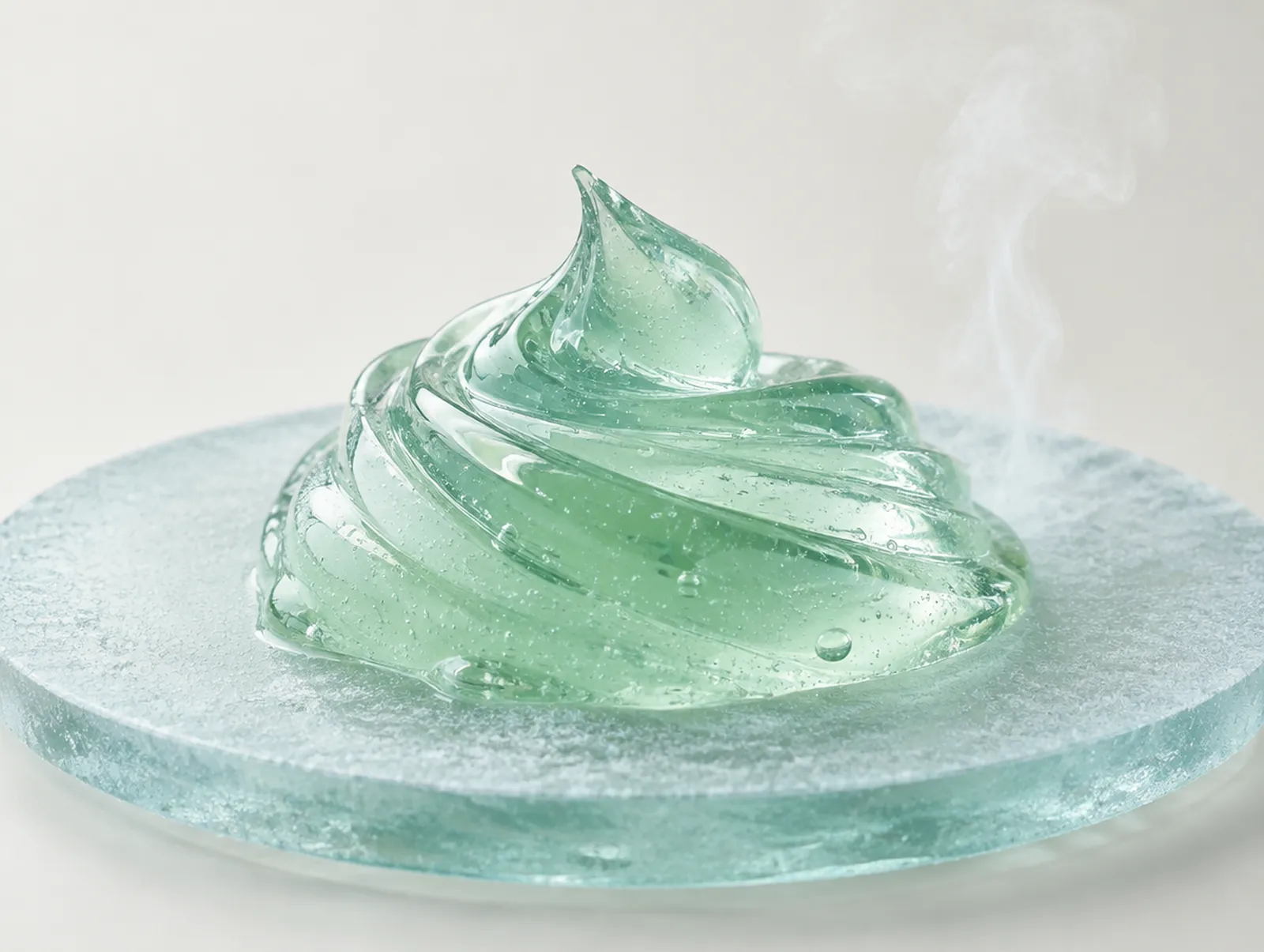
A search for "cold gel" leads to two different products. The first is a gel mask or gel pack chilled in the fridge; it is physically cold and follows the rules in the table above. The second is a cooling gel or cream applied to the skin. Some of these feel cold rather than actually cooling the skin.
Why does menthol feel cold? David Julius and Ardem Patapoutian, who shared the 2021 Nobel Prize in Physiology or Medicine, independently used menthol to identify a cold-activated receptor, TRPM8. Menthol activates this receptor and the brain reads the signal as coolness. The source of the sensation is a nerve signal, not heat loss.
A feeling is not a measurement. In the 2019 study by Bilkhu and colleagues, a room-temperature cleansing gel was applied to one eyelid of 25 healthy volunteers. Eyelid temperature fell by about 1°C compared with the other eye in the first minute and the difference disappeared within 3 minutes, but the cooling sensation continued. In other words, a cool feeling is not proof that the skin has truly cooled or that swelling has gone down.
Care with sensitive skin. The American Academy of Dermatology (AAD) recommends avoiding products that contain menthol, camphor and alcohol on rosacea-prone skin. If a cooling gel stings or burns, that may mean it is irritating your skin, not that it is "working".
How clean is an ice roller stored in the freezer?
A freezer is not a sterilizer. According to the USDA's food safety agency, freezing at -18°C makes bacteria, yeasts and moulds inactive but does not destroy them; they can multiply again once thawed. Skin bacteria and product residue left on the roller wait in the freezer and return to your face when the tool warms up.
Wipe it after every use. Khetarpal reminds us that bacteria are already present on the skin and product residue can build up, and recommends wiping the roller with alcohol after each use.
Do not share it. The US Centers for Disease Control and Prevention (CDC) advises not sharing towels, washcloths, eye and face makeup or makeup brushes, to prevent the spread of conjunctivitis (pink eye). A roller that travels around the eye area belongs in the same class: it is personal.
Three habits are enough for everyday hygiene:
- Dry the roller and store it in a clean, closed bag or box, away from food.
- Do not use a tool that is cracked, leaking gel or has a loose wheel.
- Do not roll over active acne, open wounds or a rash; otherwise you carry the same tool on to healthy skin afterwards.
Ice burn and cold urticaria: who should stay away from cold tools?
Numbness is a stop sign. Geng's study uses three thresholds for skin temperature: pain begins at 15°C, numbness at 7°C and freezing risk at 0°C. In NASA's 2010 technical paper on its touch-temperature standard, it is noted that staying above the numbness threshold matters because numbness can mask skin damage. If your face has started to go numb, the cooling is enough; continuing adds risk, not benefit.
If you see whitening, burning, increasing pain or a blister, stop at once. If a blister forms, or colour change does not pass within a few hours, see a doctor.
Cold urticaria. According to DermNet, cold urticaria is a rare condition affecting about 0.05% of the population; it is most often diagnosed in young and middle-aged adults and is twice as common in women as in men. Itchy welts appear 2-5 minutes after cold exposure and last 1-2 hours. In severe cases the reaction can spread through the whole body; the most common severe trigger is swimming in cold water. A doctor diagnoses it by placing ice on the forearm for 1-5 minutes. If you see itchy welts after a cold tool, stop using it and consult a dermatologist.
Redness and rosacea. According to the AAD, cold can trigger a rosacea flare, and winter windburn can do the same. So the redness a cold tool calms in one person may increase in another. To work out where your redness comes from, see our guide to the causes of facial redness and ways to calm sensitive skin.
Ask your doctor first. Do not use a cold tool if you have a cold-triggered circulation problem such as Raynaud's phenomenon or cryoglobulinaemia, after a recent laser treatment, peel or operation, or on an open wound, unless your doctor recommends it. Do not use a tool chilled in the freezer on children's faces.
How to use an ice roller: a safe step-by-step routine
- Clean the skin and the tool. Khetarpal says the roller works best on freshly cleansed skin. If the roller was not wiped after the last use, wipe it with alcohol first.
- Choose the fridge over the freezer. Khetarpal recommends the fridge for coolness. A tool at 4°C gives a noticeable coolness but, unlike one at -18°C, cannot take the skin down to the freezing point.
- Use a thin layer of product. Khetarpal says a roller can help spread a moisturiser or serum more evenly. Spreading is not the same as delivering; we explained the delivery of actives into the skin separately in our guide on how ultrasonic devices deliver serum into the skin.
- Roll from the inside out and downward. Move from the centre of the face toward the ears and jawline with light pressure. Khetarpal says back-and-forth movement does not add to blood flow.
- Keep to the time. According to Khetarpal, about 5 minutes a day or every other day is enough; using it longer does not give a different result.
- Stop at a warning sign. Stop if numbness, burning, whitening or itchy welts begin.
- Moisturise and put the tool away. Close the routine with your usual moisturiser; our guide to moisture loss in the skin and moisturising explains why the skin barrier and moisture matter. Then wipe the tool, dry it and put it in its closed case.
What is a cryo device? How a fixed-temperature device differs from ice
The name "cryo device" covers two separate worlds. In clinics and salons there are cryo treatments and cryolipolysis devices that work at very low temperatures; at home there are thermoelectric tools that produce cold with electricity. The comparison below is for home-type tools.
With ice, the dose changes every minute. As gel from the freezer warms, cooling declines; in Kennet's study the gel pack's own temperature rose by 12.3°C in 20 minutes. Melting ice, on the other hand, stays around 0°C while it changes phase, so it works right at the edge of the freezing threshold.
How does a Peltier module cool? According to the 2022 review by Ren and colleagues, when direct current passes through two different thermoelectric materials, heat is absorbed at one of the junctions and released at the other, creating a cold face and a hot face. There are no moving parts, refrigerant gas or ice. The cold face touches the skin and the heat is pumped to the other side of the module.
The heat needs somewhere to go. The 2022 study by Dąbrowska and colleagues observed that cooling weakens if the heat on the hot face is not removed well enough; it also warned that if power is not limited, the effect can reverse and warm the skin. The same team's control unit could adjust power or temperature. A well-designed device can therefore hold the contact surface at a set value; it does not follow the ice pattern of very cold first and lukewarm later.
Why does staying above freezing matter? Skin cooled by conduction cannot get colder than the surface it touches. A contact surface of about 10°C stays above Geng's numbness threshold of 7°C and freezing threshold of 0°C. But it is below the pain threshold of 15°C; NASA also classifies skin temperatures between 0 and 15°C as a range of pain and loss of performance. That is why such a surface should not be held in one spot; it is moved across the skin.
Hot and cold facial massage tools. Thermoelectric structures are not one-way: the wearable device by Hong and colleagues (2019) could both cool and heat the skin with the same thermoelectric layer. This is why some facial tools offer two modes on a single surface. We could not find a study showing that applying heat and cold one after the other adds anything to skin appearance compared with using each alone; it is enough to limit each mode to the time in the instructions.
The clinical counterpart. The closest data suggesting that a fixed temperature may give a different result from ice again come from surgery. In the 2011 study by Rana and colleagues, 30 patients who had wisdom tooth surgery received either a water-circulating face mask set to 15°C or a cold compress for 45 minutes. On the second day swelling measured 72.2 mL in the mask group and 96.6 mL in the compress group. The study is small, concerns the post-operative period, and the application time is far longer than the few minutes used at home; it cannot be carried over directly to home use.
You can find the categories of home devices and the technologies brands rely on in our skincare brands guide comparing 30 brands.
Cryo Therapy on Longos Sense: what the user manual says
Longos Sense is a cosmetic home device designed for adults aged 18 and over, combining six technologies on two application surfaces. Cryo Therapy is one of them, and the user manual calls it Cooling (Cryo) Mode.
How does it work? Cooling is done by the Peltier module on Surface 2, the Cooling, Thermal and Cryo surface. The manual gives the contact surface temperature as about 10°C. Because the device makes its own cold, it is not kept in the freezer; the manual asks that it be stored between 5 and 60°C and not left in very cold or humid places.
How is it used? You select Cooling mode and glide Surface 2 gently over the treatment area. A session lasts 3-5 minutes, and the manual describes this mode especially for areas with puffiness. Intensity is set from 1 to 6 before use; the manual advises starting at a low level.
What does it not promise? The cosmetic intended use in the manual is to improve the look of skin tone and reduce the look of puffiness by temporarily cooling the skin surface. Cryo Therapy does not close or tighten pores, and its effect is temporary. There is no published human study of this mode; the device does not replace a clinical procedure.
Safety and cleaning. According to the manual, the device is not applied to the eye or eyelid. It is not used during pregnancy and breastfeeding, under the age of 18, with an active electronic implant, or on areas with active infection, an open wound or a rash. The application surface is wiped with a clean, dry cloth after each use; for deep cleaning, use a cloth lightly dampened with 70% isopropyl alcohol. The device is not waterproof and is never immersed in any liquid. Read the full list of contraindications in the manual before first use.
Where to start this week
Tomorrow morning, take your ice roller from the fridge, not the freezer, roll it from the inside out on your face for 5 minutes at most, and make do with a cool cloth under the eyes. For one week, note whether the puffiness goes down by midday. If it does, the swelling most likely comes from fluid, and pillow height, salt and sleep will do more than a colder tool; if it never goes down for weeks, or comes with pain, itching or redness, see an eye doctor.
If redness or uneven tone also catches your eye alongside the puffiness, run the AI skin analysis in the Longos Sense app once on clean skin with no products; seeing your redness and tone scores lets you follow the change over weeks by measurement, not guesswork. This is a care guide, not medical advice.
Frequently Asked Questions
What does an ice roller do?
An ice roller cools the skin surface for a few minutes. The cold narrows small surface vessels, which may briefly reduce the look of morning puffiness and redness. A dermatologist speaking to Cleveland Clinic says the improvement from a face roller is temporary and usually fades within a few hours. It does not close pores, burn fat or lift the face for good. No controlled study has tested ice rollers on morning puffiness in healthy skin, so it is best to treat it as a short-lived refresher rather than a treatment.
How do you use an ice roller, and for how many minutes?
Clean your face and the tool, and chill the roller in the fridge rather than the freezer. Roll it with light pressure from the centre of the face toward the ears and jawline; do not go back and forth, and around the eyes move away from the eye. The dermatologist at Cleveland Clinic says about 5 minutes a day or every other day is enough, and that using it longer makes no difference. Stop right away if numbness, burning, whitening or itchy welts appear. After use, wipe the tool with alcohol, dry it and store it in a closed container.
Should an ice roller be stored in the freezer or the fridge?
The fridge is safer. According to the FDA, the fridge is kept at 4°C or below and the freezer at -18°C. Metal straight from the freezer chills very fast: in the 2006 study by Geng and colleagues, metal at -15°C brought fingertip skin down to 0°C, where freezing risk begins, in 2 to 6 seconds. Gel-filled rollers start cold but warm up quickly in use. The freezer does not clean the tool either: according to the USDA, freezing does not kill bacteria, it only makes them inactive. Dry the roller and keep it in a clean, closed bag.
Does an ice roller shrink pores or slim the face?
No. According to dermatologist Jane Wu, speaking to Cleveland Clinic, genetics largely determine pore size and pores cannot be permanently shrunk; the tightening effect of an ice cube or a chilled roller lasts only a few minutes. There is no evidence for facial slimming either. In cryolipolysis, the clinical method that reduces fat with cold, cooling plates are traditionally applied at -10°C for 60 minutes. A roller passed over the skin for a few minutes comes nowhere near those conditions; the slimmer look you notice in the morning is most likely just the swelling going down.
Does a cold eye-area massager help under-eye puffiness?
The fluid part of puffiness may respond briefly to cold; a bag caused by fat shifting into the lower lid does not shrink with cold. Mayo Clinic and the American Academy of Ophthalmology suggest gently pressing a clean cloth soaked in cool water against the area for a few minutes while sitting upright. The skin around the eyes is very thin, so if you use a tool, chill it in the fridge, move it away from the eye and do not press on the eyelid. See an eye doctor if the swelling is painful, itchy or red, or if it does not go away.
What is a cryo device, and how does it differ from an ice roller?
Cryo devices used at home produce cold with electricity, not ice. When direct current passes through a Peltier module, one face cools and the other heats up; as the heat is carried away, the contact surface stays at a set value. An ice roller starts very cold and then warms, so the cold you receive changes every minute. A surface set above freezing cannot take the skin below the value it touches, yet it still should not be held in one spot; it is moved across the skin. Very-low-temperature cryo treatments in clinics and cryolipolysis are entirely different procedures, and a home device does not replace them.
Clinical evidence