Near-Infrared
What Is Red Light Therapy and What Does It Do? Blue Light, Near-Infrared and Quantum Dot LEDs
What is red light therapy? The short answer
Red light therapy is the delivery of visible red light to the skin at low power for set periods; studies most often use the 630-660 nanometer (nm) range. Its scientific name is photobiomodulation. The light does not work by heating or burning the skin but by being absorbed by light-sensitive molecules in the cell. As Cleveland Clinic notes, it contains no ultraviolet light.
What does it do? In small human studies, red and near-infrared light produced a measurable but modest improvement in the look of fine lines. Blue light reduced inflammatory lesions in mild to moderate acne. The effect is slow and needs regular use over weeks. Cleveland Clinic also finds the results promising but says the evidence is still insufficient for most uses.
What is a quantum dot? A quantum dot is a semiconductor crystal a few nanometers across whose color is tuned by particle size. This discovery earned the 2023 Nobel Prize in Chemistry. For skin, the word "quantum" carries no promise of energy. What matters is the wavelength the light arrives at, how narrow its band is and what dose it delivers.
For general questions such as choosing a device, color choice by skin type and common mistakes, see our step-by-step guide to LED light therapy at home.
How does light affect skin? A molecule has to catch it first
The first rule of photobiology. According to the 2009 review by Huang and colleagues, low-level light must first be absorbed by a molecule to have any effect. The molecules that capture light are called chromophores. Light that is not absorbed changes nothing in the cell, however bright it looks.
In red and near-infrared, the target is the mitochondrion. The 2013 review by Avci and colleagues names cytochrome c oxidase, an enzyme in the mitochondria, the cell's power plants, as the main receptor for this light. In the proposed model, light releases nitric oxide that binds to and slows the enzyme, after which production of the energy molecule ATP and signaling inside the cell change. The authors state plainly that this mechanism is not yet fully understood.
In blue, the target is different: bacterial porphyrins. Cutibacterium acnes, which plays a role in acne (called Propionibacterium acnes at the time of the study), naturally produces porphyrins in its cells. In the 2003 laboratory study by Ashkenazi and colleagues, most of these porphyrins were coproporphyrin. In cultures illuminated with blue light in the 407-420 nm range, bacterial membranes were damaged and the number of live bacteria fell. This is a laboratory finding, not a human study; still, it explains why blue light was chosen for acne.
Wavelength determines depth. According to Huang's review, the "optical window" in which light reaches deepest in tissue lies roughly between 650 and 1200 nm. Hemoglobin and melanin absorb shorter wavelengths more strongly, and tissue scatters them more. Avci's review sums up the practical result: 390-600 nm is used for surface tissues and 600-1100 nm for deeper tissues.
Red, blue and near-infrared: three wavelengths, three different targets
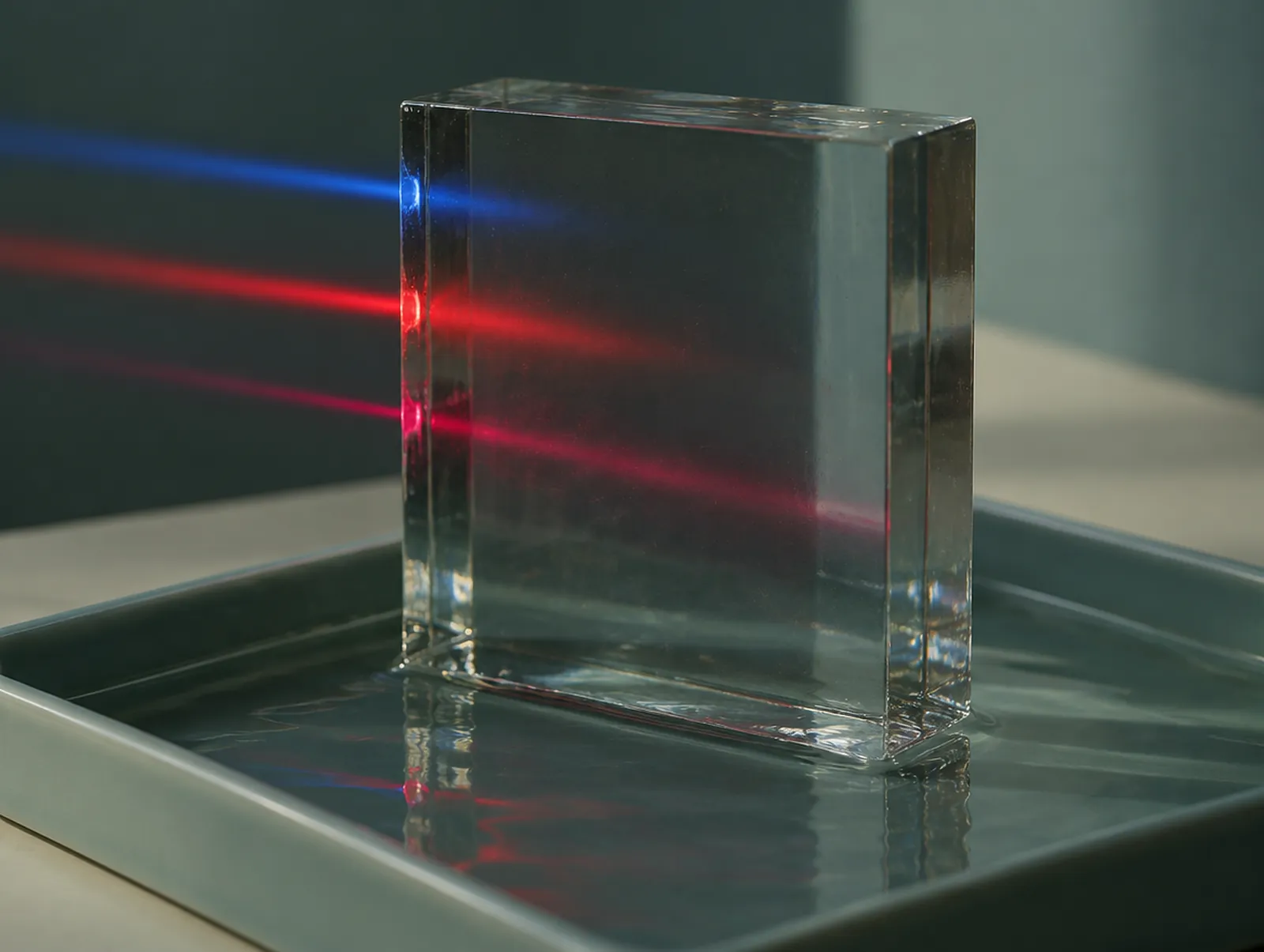
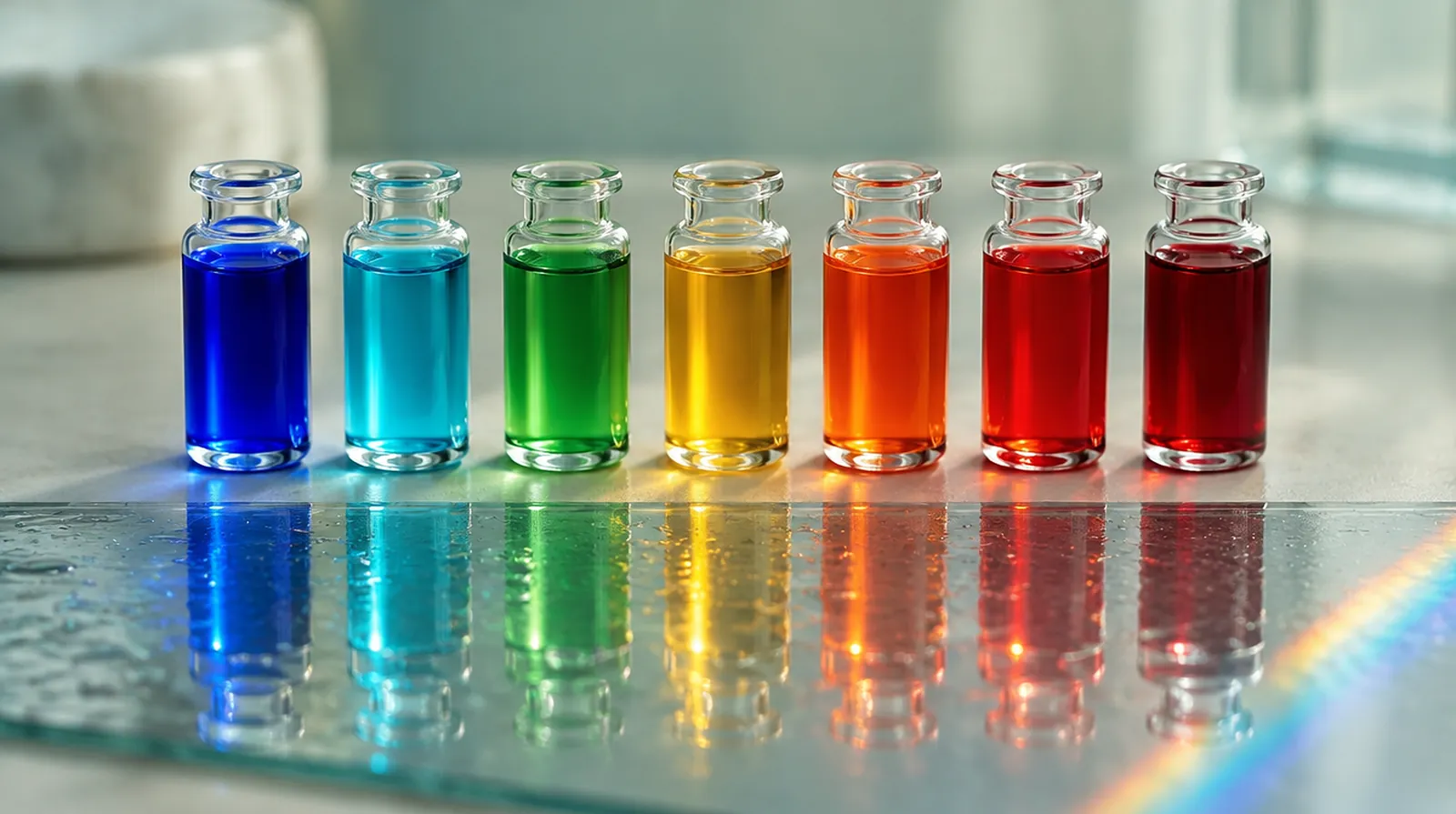
When people say red light therapy, they picture a single color. Yet home and clinic devices often combine three wavelengths, and they are not interchangeable: each targets a different molecule at a different depth.
| Light | Approximate wavelength | Main target | Cosmetic area studied most | State of the evidence |
|---|---|---|---|---|
| Blue | 415 nm | Bacterial porphyrins | Acne-prone skin | Many small studies; little high-quality evidence |
| Red | 630-660 nm | Cytochrome c oxidase | Fine lines, skin texture | Small randomized studies |
| Near-infrared | 830-850 nm | Cytochrome c oxidase | Fine lines, elasticity | Mostly tested together with red |
Not every shade near red is the same. According to Avci's review, the 700-750 nm range has limited biochemical activity and is therefore rarely used. That is why it is worth knowing at how many nanometers a device's "red" mode actually works.
Colors are often combined. Some clinical studies used blue with red, others red with near-infrared. The logic is simple: one reaches the target at the surface, the other a target deeper down. There is not enough data to say the combination is better in every case.
We explain why 630 nm red light reaches the fibroblasts in the dermis more easily, and how deep each wavelength travels into the skin, in our guide to the dermis and the depth red light reaches.
What does red light therapy do? What human studies show
The question people ask most is about wrinkles. Most of the evidence comes from small, short studies run with different protocols. Still, there are a few important studies assessed with measuring instruments:
| Study | Design | Light and sessions | Finding |
|---|---|---|---|
| Lee et al., 2007 | 76 people, randomized, sham-controlled, double-blind | 633 nm, 830 nm or both; 2 sessions a week, 4 weeks | Up to 36% reduction in wrinkles and up to 19% increase in elasticity from baseline |
| Barolet et al., 2009 | Two halves of the face compared, single-blind | 660 nm pulsed light, 12 sessions | Wrinkle depth and roughness decreased in more than 90% of participants |
| Russell et al., 2005 | 31 people, no control group | 633 and 830 nm together, 9 sessions | At week 12, 25-50% improvement in photoaging score in 52% of participants |
| Mota et al., 2023 | 137 women, two halves of the face | 660 nm and 590 nm, 10 sessions over 4 weeks | 31.6% and 29.9% reduction in wrinkle volume; hydration and elasticity unchanged |
The strongest design is the Lee study. 76 people were randomly split into four groups, and one group received sham light; neither participants nor assessors knew who was in which group. In the light groups, skin samples showed more collagen and elastic fibers, and no side effects were reported. Still, the percentages in the table show each group's change from its own baseline, not the difference from the sham group.
The Mota study carries a warning. Red and amber light produced almost the same improvement, and neither side received sham light. In that case it is hard to separate how much of the measured change comes from the light and how much from simply taking part in a study.
Reviews are cautious. The 2018 systematic review by Jagdeo and colleagues, covering 31 randomized studies, gave LED treatment a grade B recommendation for acne, cold sores, shingles and acute wound healing, and grade C or D for other uses such as skin rejuvenation. The main limits were small samples, lack of blinding and no sham light group. The review by Das and colleagues, published in October 2026, pooled 8 studies with home LED devices and 365 participants. Significant improvements in wrinkles, texture and elasticity were reported; but the authors point to the scattered protocols and the poor representation of different skin types.
Red light offers slow, limited but measurable support for fine lines and skin texture. On its own it does not erase deep wrinkles or established expression lines. For other evidence-based options at home, depending on the type of wrinkle, see our guide to what works at home for wrinkles.
You will find how red light differs from radiofrequency, and how the two work together, in our guide comparing radiofrequency and red light.
What does blue light therapy do for acne, and what doesn't it do?
Blue light therapy uses light around 405-420 nm to activate the porphyrins of the bacterium that contributes to acne. It is used for acne-prone skin, not for wrinkles.
The classic study. In the 2000 study by Papageorgiou and colleagues, 107 people with mild to moderate acne were split into four groups: blue light, mixed blue and red light, white light and 5% benzoyl peroxide cream. The light groups used portable devices for 15 minutes every day. At the end of 12 weeks, inflammatory lesions fell by an average of 76% in the blue-red group. This group was better than blue light alone at weeks 4 and 8; at week 12 the difference was not significant.
The bigger picture is more modest. The 2016 Cochrane review by Barbaric and colleagues examined 71 studies and 4,211 participants. The median study size was 31 people, two thirds were industry-supported, and the authors concluded that there is no high-quality evidence for light treatments. In the 2024 review by Akuffo-Addo and colleagues, blue light was the most commonly used option. Across all light types, total lesion count fell by an average of 43% from baseline at week 4, but only 2% of people treated with blue light had their acne completely cleared.
Which acne does it help? According to the American Academy of Dermatology (AAD), blue, red and blue-red light devices can treat acne, but they are not effective on blackheads, whiteheads, cysts and nodules. The AAD states that these treatments rarely clear acne on their own and that a dermatologist often adds a topical treatment. For ingredients that dissolve the plug in the pore, see our guide to what salicylic acid does for blackheads and pores.
Do not lose time with light on painful, deep acne that leaves scars; a dermatologist should evaluate it. On darker and pigmentation-prone skin, the dose of blue light matters in particular, and you will find the reason under the safety heading.
Near-infrared light: where is the evidence for an invisible wavelength?
What is the wavelength of near-infrared light in nm? The 2013 guidelines of the International Commission on Non-Ionizing Radiation Protection (ICNIRP) define the first part of the infrared range (IR-A) as 780-1400 nm. Near-infrared light in skincare devices is usually around 830-850 nm. This light is almost invisible to the eye; according to the same guidelines, light above 780 nm can be perceived only from very bright sources.
Light, not heat. The word infrared suggests warmth. But according to Huang and colleagues, low-level light therapy works by a photochemical effect, not by heat. At these power levels the aim is not to warm the skin.
The evidence is mostly alongside red. In Lee's 2007 study, 830 nm was also tested alone as a separate group. According to the summary in the 2022 meta-analysis by Ngoc and colleagues, wrinkle improvement was 26% in the red group, 33% in the near-infrared group and 36% in the group using both. In a home-device study included in Das's review, 637 and 854 nm were used together; skin elasticity increased significantly at weeks 6 and 8, and smoothness at week 2.
850 nm alone is little tested. We could not find a strong randomized study testing near-infrared at 850 nm alone on facial skin. The available data support it as a deeper-reaching wavelength that complements red. The eye risk that comes with its invisibility should be understood separately.
What is a quantum dot? The nanocrystals behind the 2023 Nobel Prize in Chemistry
Quantum dots are semiconductor crystals measured in nanometers. According to the 2010 review by Wood and Bulović, their diameters are typically between 3 and 12 nm. As the Nobel Committee describes it, a quantum dot often consists of only a few thousand atoms; its size relative to a football is like a football's size relative to the Earth.
Size determines color. In chemistry, the number of electrons determines an element's properties. When matter shrinks to the nanometer scale, electrons are squeezed into a tiny space and quantum effects take over. The result is surprising: dots made of the same material emit different colors of light depending on their size. Small dots glow closer to blue, large ones closer to red. The Nobel Committee writes that by changing the particle size, the color of the emitted light can be set precisely.
The story of the prize in three steps. The Royal Swedish Academy of Sciences awarded the prize to Moungi Bawendi, Louis Brus and Aleksey Yekimov "for the discovery and synthesis of quantum dots":
- Aleksey Yekimov, 1981: In glass colored with copper chloride, he showed that particles ranging from about 2 to 30 nm in size absorb light further into the blue region as they get smaller.
- Louis Brus, 1983: He was the first to prove the same size effect in particles floating freely in a liquid.
- Moungi Bawendi, 1993: By injecting the materials that form the crystal into a heated solvent and controlling the temperature, he produced nearly flawless crystals of the desired size.
Where is quantum dot technology today? According to the Nobel Committee, the best-known use is QLED displays, where part of the blue LED light is converted to red and green by quantum dots. They are also used to tune the tone of light in some LED lamps and, in biochemistry, to map cells and organs. As Wood and Bulović describe, in a quantum dot LED the light is either produced directly by the quantum dots or the quantum dots convert the light of another source to the desired color.
Here, quantum is not a promise; it is physics. The word describes the physical law that sets the color of the light. Skin does not sense whether a particle is quantum; it only absorbs light that arrives at a given wavelength and a given dose.
Why does a narrow, controlled wavelength matter for skin?
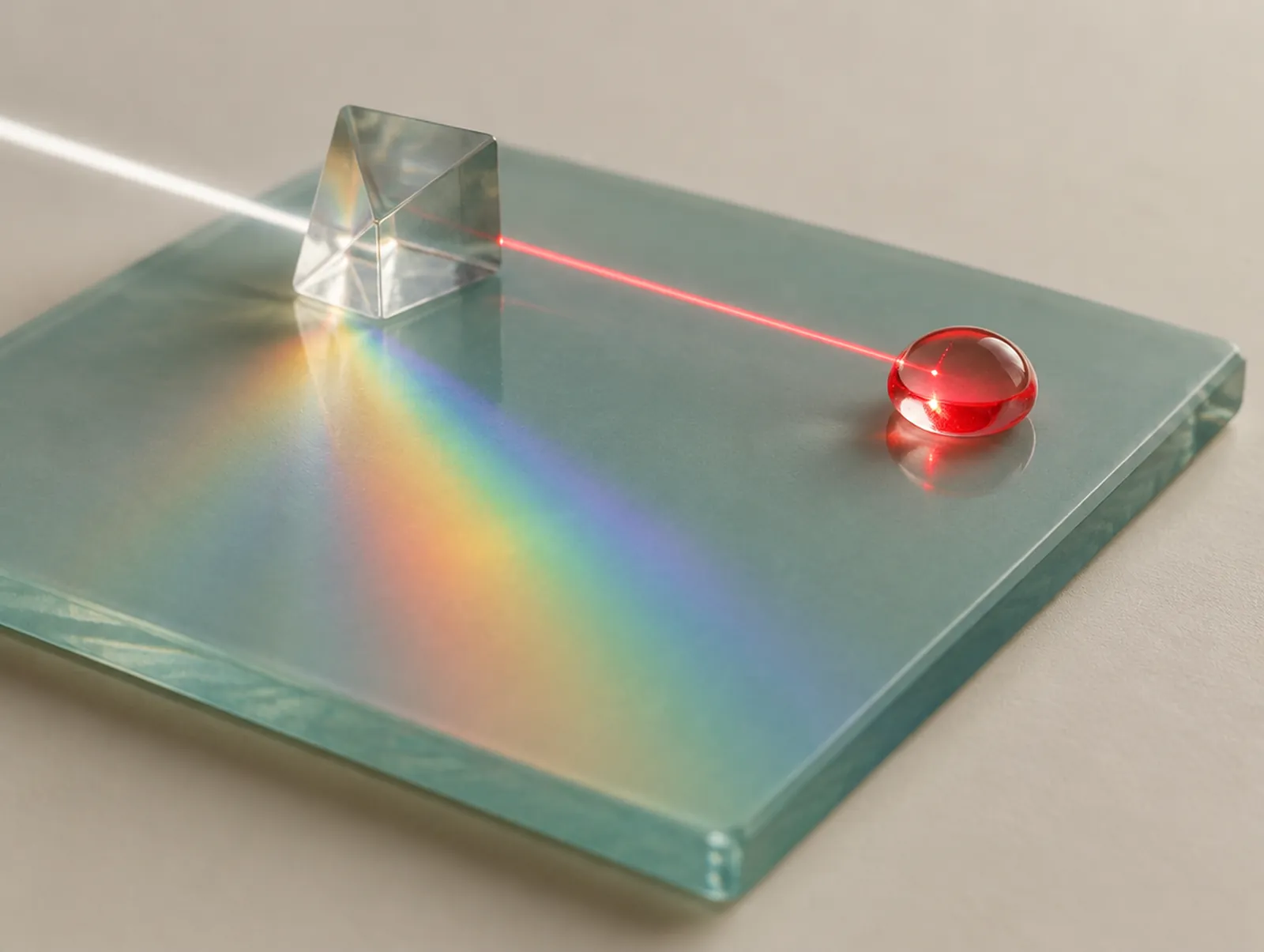
What does narrow band mean? A light source does not emit at a single wavelength but over a range around a peak. The width of this range is usually measured as "full width at half maximum": the distance between the two points where intensity falls to half of the peak. According to Wood and Bulović, in quantum dot solutions this width is typically 30-40 nm, and the peak can be positioned by size during synthesis.
Targets have a band too. Light works only if it is absorbed, and every target molecule absorbs certain wavelengths more strongly. For example, the 2015 study by Langendonk and colleagues describes how protoporphyrin in skin is excited by blue light at 400-410 nm. A narrow, well-positioned emission places more of the energy in the band the target absorbs. Chen and colleagues used this reasoning in 2017 when proposing quantum dot LEDs for light therapy: a narrow band and tunable color make it easier to fit the emission into the absorption window of cytochrome c oxidase.
Unwanted wavelengths have effects too. Wavelength determines not only benefit but also side effects. In the 2014 study by Duteil and colleagues, 415 nm blue-violet light caused dose-dependent dark spots on phototype III and IV skin, while 630 nm red light did not. That is why it matters that a red mode really stays red.
What the evidence says today. Narrow band is not unique to quantum dots: the peaks of the clinical LED panels used in studies were also defined around 415, 633 and 830 nm with a tolerance of a few nanometers. What sets quantum dots apart is that color can be tuned by particle size. Their use in light therapy is, however, a new field of research. In Chen's study, a red quantum dot LED raised metabolic activity in cell cultures by 12.5% to 27.9% over control, and the result was similar to a standard LED. This is a laboratory finding; we could not find a study comparing a quantum dot source with an ordinary LED on human skin.
So when evaluating a device, the question is not "is it quantum?" but this: Is the peak wavelength of each color stated, is the band narrow, and are the duration and frequency clear?
How is dose calculated? Irradiance, fluence and time
According to Jagdeo and colleagues, an LED application is usually defined by five parameters: wavelength, irradiance (the power reaching the skin, in mW/cm²), fluence (J/cm²), duration and the fraction of time the light is on. Fluence is irradiance multiplied by duration in seconds.
A real example. In the 2006 acne study by Lee and colleagues on phototype IV skin, blue light was applied at 40 mW/cm² and red light at 80 mW/cm² irradiance for 20 minutes. The calculation: 0.04 W/cm² × 1,200 seconds = 48 J/cm² for blue; for red over the same time, 96 J/cm². The same duration means two different doses.
A longer session does not "complete" the dose. According to Huang and colleagues, doubling the power and halving the time delivers the same energy but often produces a different biological response. In other words, using a weak device for twice as long does not automatically replace a strong device.
Too little and too much may both fail. The same review describes a biphasic dose response in light therapy: a low dose stimulates tissue, and above a threshold, more dose reduces the benefit. According to Avci, excessively high values can also cause tissue damage; the authors note that these treatments generally use a fluence of 0.04-50 J/cm² and an irradiance below 100 mW/cm².
The ideal dose for skin is not yet known. The Mota study used 3.8 J/cm² per session and the Russell study 126 J/cm² for red light, and both reported improvement. The difference is more than thirty-fold. According to Das's review, home device studies do not report irradiance and fluence consistently, which makes it hard to link dose to outcome.
What changes the dose at home? As the distance between the device and the skin grows, the irradiance reaching the skin falls. According to Avci, makeup and oil residue can block light from entering the skin, and skin tone should also be taken into account. The practical rule is simple: use the device at the contact or distance the manufacturer specifies, on clean, dry skin, for the specified time.
How to do red light therapy at home: mask, handheld device and clinic
According to Cleveland Clinic, red light devices used at home are generally safe, but they can be weaker than devices in dermatology clinics and may not deliver the expected result. The same source asks that you protect your eyes at home and follow the instructions. The differences between a mask, a handheld device and a clinic panel can be summarized like this:
| Clinic LED panel | LED mask | Contact handheld device | |
|---|---|---|---|
| Who applies it? | A physician or trained specialist | You | You |
| Light power | Usually higher | Varies by device | Varies by device |
| Distance to skin | The specialist sets it | Depends on how the mask sits on the face | Fixed, because it touches the skin |
| Eyes | With protective goggles | Eye openings can leave the eyes exposed to light | Kept away from the eye area |
| Coverage | Whole face | Whole face at once | Area by area |
Whichever format you choose, a home session becomes safe and measurable in this order:
- Choose your goal. Red or near-infrared for fine lines and texture, blue for acne-prone skin. If you are prone to dark spots, be cautious with blue.
- Clean your skin. Remove makeup, sunscreen and oil, and dry your skin.
- Protect your eyes. Keep your eyes closed; do not aim the light at your eyelids or into your eyes.
- Stick to the time and frequency. Do not extend the specified time; if you skip a session, do not try to make it up the next day by doubling the time.
- Continue your routine. Apply your serum and moisturizer after the light, and do not skip sunscreen during the day.
- Take photos in the same lighting. Take photos from the same angle at the start and every four weeks; because change comes slowly, the mirror can mislead.
- Watch your response. Pause if you have redness that does not go away, burning or itching.
If you want to compare home devices by the technologies they carry, take a look at our guide that reviews skincare brands by their technologies.
You will find the 2026 systematic review of at-home LED devices, and how red light compares with other home technologies, in our beauty technology trends 2026 guide.
Eyes, medications, skin tone: who should be careful?
According to Cleveland Clinic, red light therapy appears safe when used briefly and according to instructions; its long-term safety is not yet known. Most of the risk is concentrated in three places.
Eyes: blue light and invisible near-infrared
Blue light is the color that needs the most care for the retina. According to the review published by Walker and colleagues in 2011 in the journal of the American Academy of Dermatology, excessive blue light can contribute to retinal disease. Damage depends on both intensity and duration, and it can accumulate even with low-dose but long exposure. In the case reported by Kim and colleagues in 2020, a person who used the blue light of an LED mask with open eye areas for a long time developed retinal damage.
Near-infrared gives no warning because you cannot see it. According to ICNIRP, when there is no visible stimulus, natural protective responses such as blinking and pupil constriction do not kick in. In bright light you squint automatically; in near-infrared this reflex does not work.
Red is not harmless for the eye either. The American Academy of Ophthalmology reports that a US study of devices that shine red light directly into the eye for myopia points to the possibility of retinal damage. The rule is the same for every color: light on the skin, not in the eyes.
Photosensitizing medications and porphyria
According to DermNet, drug-induced photosensitivity is a reaction that can develop when the skin of a person taking certain medications is exposed to ultraviolet or visible light, and it often requires a threshold to be crossed. The list includes commonly used drugs: tetracyclines such as doxycycline, fluoroquinolones such as ciprofloxacin, oral retinoids such as isotretinoin and acitretin, painkillers such as ibuprofen and naproxen, hydrochlorothiazide, amiodarone and St. John's wort. If you take any of these, talk to your doctor or pharmacist before starting light sessions.
Porphyria. According to the study by Langendonk and colleagues published in NEJM in 2015, in erythropoietic protoporphyria the protoporphyrin that accumulates in the skin is excited by blue light at 400-410 nm and causes pain lasting hours or even days. This band is very close to the 415 nm used for acne; if you have a porphyria diagnosis, do not use blue light unless your doctor recommends it.
Photodynamic therapy. If you have had photodynamic therapy with a photosensitizing drug in a clinic, the AAD says you need to avoid the sun for 48 hours afterwards. During that time, also ask your doctor before doing a home light session.
Dark and pigmentation-prone skin: dose matters with blue
In the 2010 study by Mahmoud and colleagues, visible light produced darker and longer-lasting pigmentation than ultraviolet A on phototype IV-VI skin; no pigmentation was seen on phototype II. In Duteil's 2014 study as well, 415 nm caused dose-dependent dark spots lasting up to three months on phototype III and IV skin; 630 nm did not. If you are prone to melasma or post-acne marks, red light is a more cautious place to start; use blue only after consulting your doctor, and at a low level.
When should you see a dermatologist?
Show a dermatologist any new mole or spot, or one that is changing shape or color, before trying light on it. Also get a specialist's opinion first for cystic, nodular or scarring acne, a rosacea or eczema flare, and an open wound or infection. If you get blisters, redness that does not go away or blurred vision after a session, stop using the device and see a doctor.
When will you see results? A realistic timeline
| Goal | Pattern in studies | First assessment | What you should know |
|---|---|---|---|
| Acne-prone skin (blue or blue-red) | 2 sessions a week or short daily sessions | Around week 4 | Complete clearing is rare |
| Fine lines and texture (red, near-infrared) | 2-3 sessions a week | Between weeks 4 and 12 | Does not remove deep wrinkles and sagging on its own |
| Studies with home devices | 3-21 minutes per session, 2-7 times a week | Studies ran 4-12 weeks | Long-term data are scarce |
The calendar, not the session, brings the result. Cleveland Clinic states that red light therapy is not a one-time treatment and needs sessions one to three times a week over weeks or even months. The AAD also writes that with light treatments the best result is often seen weeks after the last session, and that maintenance sessions may be needed to keep it.
Why are forum reviews so mixed? If you search "red light therapy reddit," you find both very satisfied and disappointed reviews. There are concrete reasons: the device dose is often unknown, results are judged after two or three weeks, the color does not match the target, or the change is looked for in the mirror. There is also a question of expectations. As reported in the 2023 study protocol by Bragato and colleagues, light therapy is not an alternative for volume loss, changes in facial contour, sagging and deep wrinkles. You can read which layers sagging comes from in our guide to the causes of facial sagging and what works at home.
How do you use Quantum Dot Light on Longos Sense?
Longos Sense is a home cosmetic skincare device that combines six technologies in one body and is designed for adults aged 18 and over. Quantum Dot Light is one of these technologies. According to the user manual, the red light works at 630 nm and is used to improve the appearance of skin and to visually reduce wrinkles and fine lines. The blue light is at 415 nm and aims to improve the appearance of acne-prone skin. The near-infrared is at 850 nm and supports the appearance of the skin.
These wavelengths line up with the science above: 415 nm is close to the band that porphyrins absorb strongly, 630 nm is the same red that did not cause dark spots in the Duteil study, and 850 nm lies within the optical window of tissue. The Quantum Dot LED array is on both of the device's application surfaces, and LED mode is used with the same instructions on Surface 1 and Surface 2. Use according to the manual is as follows:
- Choose the color in the application; start the intensity at a low level on the 1-6 scale.
- Place the surface gently on cleansed skin; hold it in place or move it slowly.
- Apply for 5-10 minutes per area; use the LED modes at most three times a day.
- Do not apply over the eyes and eyelids.
The manual excludes use under age 18, pregnancy and breastfeeding, epilepsy or a history of light-sensitive seizures, active infection, an open wound or a rash in the application area, active cancer, a history of skin cancer and conditions that suppress the immune system. It also lists known light sensitivity and use of photosensitizing medication, and asks you to talk to your doctor in those cases. These uses are cosmetic; the device is not designed to diagnose or treat any disease. The studies cited above were not done with this device but with light sources of similar wavelengths.
Where should you start this week?
First choose a single goal: red for fine lines, blue for acne-prone skin. Ask your pharmacist once about the medications you take regularly, take a photo in the same lighting before the first session, and write fixed days in your calendar for four weeks; do not assess before the fourth week.
If you use Longos Sense, run the AI skin analysis in the app once this evening on cleansed, product-free skin. Based on your wrinkle and acne scores, the app suggests a care mode and a serum; a second measurement four weeks later also shows the change more honestly than the mirror. This is a care guide, not medical advice; for deep and painful acne, or new or changing spots, see your dermatologist.
Frequently Asked Questions
What does red light therapy do?
Red light therapy stimulates skin with light of roughly 630-660 nm without heating it. In small randomized studies, the look of fine lines and skin texture improved in a measurable but modest way; for example, in a 76-person study a reduction in wrinkles of up to 36% from baseline was measured after four weeks of sessions. The effect is slow, and results are usually judged between 4 and 12 weeks. On its own it does not remove deep wrinkles, volume loss or sagging.
How do you do red light therapy at home?
First choose your goal: red or near-infrared for fine lines, blue for acne-prone skin. Remove makeup, sunscreen and oil, dry your skin, keep your eyes closed and never aim the light at your eyelids. Follow the duration and frequency the device specifies; a longer session does not speed up results. Apply your serum and moisturizer after the light, use sunscreen in the daytime, and track the change every four weeks with photos taken in the same lighting.
Is a red light therapy mask or a handheld device better?
Each has strengths and weaknesses. A mask covers the whole face at once, but the distance depends on how it sits on your face, and the eye openings can leave the eyes exposed to light; retinal damage has been reported in a person who used the blue light of a mask with open eye areas for a long time. A contact handheld device keeps a fixed distance and is easy to hold away from the eyes, but you treat the face area by area. Clinic panels are usually stronger and are applied by a professional.
What is blue light therapy good for?
Blue light, at around 405-420 nm, excites the porphyrins produced by the bacterium that contributes to acne, and it is used for mild to moderate inflammatory acne. According to the American Academy of Dermatology, it is not effective on blackheads, whiteheads, cysts and nodules, and it rarely clears acne on its own. In a 2024 review, only 2% of people treated with blue light had completely clear skin. You should also know that 415 nm light can cause dose-dependent dark spots on darker, pigmentation-prone skin.
What is the wavelength of near-infrared light in nm?
The 2013 ICNIRP guidelines define the first part of the infrared range, IR-A, as 780-1400 nm. The near-infrared used in skincare devices is usually around 830-850 nm. This light is invisible to the eye and reaches deeper than red. Because there is no visible stimulus, natural protective responses such as blinking do not kick in, so the device should never be aimed at the eyes.
What is a quantum dot, and why does it matter in skincare?
A quantum dot is a semiconductor crystal, typically 3-12 nm in diameter, whose color is tuned by its size: small dots emit light closer to blue, large ones closer to red. Its discovery and synthesis earned the 2023 Nobel Prize in Chemistry. What matters for skin is not the word quantum but that the light arrives at the right wavelength and in a narrow band, because light only works if the target molecule absorbs it.
Clinical evidence