Sonophoresis
Ultrasound Skincare Guide: The Difference Between a Spatula, Sonophoresis, 1 MHz and HIFU
What does ultrasound skincare do? The short answer
Ultrasound skincare is the shared name for treatments that touch the skin with sound waves too high-pitched for the ear to hear. It is not a single technology. A spatula glided over wet skin, low-frequency sonophoresis in the lab that makes skin permeable, 1 and 3 MHz massage heads, and focused ultrasound (HIFU) in the clinic all go by the same name, yet their frequencies, the depths they reach and what they can do differ enormously.
Roughly, they separate like this. The spatula cleans the skin surface. Low-frequency sonophoresis is the method that raises skin permeability the most, but it stays largely in research and clinical settings. 1-3 MHz heads are used for a gentle massage together with a serum. Focused ultrasound tightens by creating heat points deep in the tissue, and it is a procedure that must be performed under a physician's control.
No at-home ultrasound device replaces clinical tightening. The shortest way to understand what each device is for is to look at a single number: frequency.
Why does frequency change everything? Wavelength, depth and bubble size
What is ultrasound? According to NCBI StatPearls, ultrasound is sound above 20 kHz, meaning 20 thousand vibrations per second, which is the upper limit of human hearing. The piezoelectric crystal in the device head converts an electrical signal into a mechanical vibration. That vibration reaches the skin not as light or electricity but as a pressure wave that alternately compresses and relaxes the tissue.
Wavelength. According to the same source, sound travels through soft tissue at about 1,540 meters per second. At that speed a 1 MHz wave is roughly 1.5 millimeters long, while a 25 kHz wave is about 6 centimeters long. There is roughly a forty-fold difference in frequency between a spatula and a 1 MHz head; the two do not produce the same "sound".
Depth. By the rule of thumb in StatPearls, ultrasound loses as many decibels of energy per centimeter of tissue as its frequency in megahertz. A 3 MHz wave releases its energy over a path about three times shorter than a 1 MHz wave. This is why physical therapy chooses 1 MHz for deep tissue and 3 MHz for tissue close to the surface.
The air barrier. Ultrasound cannot travel through air. StatPearls states that the head must contact the skin through a medium such as gel or water. At home that medium is usually water, gel or serum. An ultrasound head moved over dry skin cannot deliver its energy to the skin well.
Bubble size. Frequency also determines the size of the bubbles that form in a liquid. According to the 2011 review by Polat and colleagues, the radius at which an air bubble in water resonates with the wave is about 150 micrometers at 20 kHz and only 1 micrometer at 3 MHz. At low frequency the bubbles grow outside the skin, in the layer of water or serum. At high frequency they are small enough to fit into tiny spaces of the skin such as hair follicle openings. This difference explains why the device families do such different jobs.
Three effects of ultrasound on skin: cavitation, heating and acoustic streaming

At any frequency, ultrasound interacts with tissue in three ways. The 2001 review by Baker and colleagues stresses that these effects cannot be fully separated: where there is heat there is mechanical action, and where there is mechanical action there is also some heat.
Cavitation: bubbles that grow and collapse
Cavitation is the behavior of bubbles that a sound wave creates in a liquid. Polat's review distinguishes two types. In stable cavitation, the bubble oscillates, growing and shrinking over many wave cycles. In transient (inertial) cavitation, the bubble grows quickly and collapses; if it collapses near a surface, it produces a thin liquid jet that hits that surface, a so-called microjet.
According to the review, the main factor that makes skin permeable at low frequency is this transient cavitation in the liquid outside the skin. Cavitation effects get stronger as frequency falls. The small increase in permeability measured at high frequency is attributed to cavitation inside the skin's small spaces. Baker and colleagues add a caution here: at physical therapy intensities, cavitation has been hard to demonstrate in living tissue, and it is not generally accepted that it occurs.
Heating: part of the energy turns into heat
As ultrasound travels through tissue it weakens, and part of the lost energy turns into heat. In the 1995 study by Draper and colleagues, with temperature probes placed in the calf muscle, the average rise at an intensity of 1 W/cm² was 0.16°C per minute at 1 MHz and 0.58°C per minute at 3 MHz. 3 MHz heated faster at every intensity tested.
The picture is different in experiments that deliver substances into the skin. According to Polat's review, in most studies at 1-16 MHz and 0.2-3 W/cm², the liquid under the head warmed by no more than 1-2°C, and heat made no contribution to permeability. In experiments where heat played a clear role, the rise exceeded 10°C. The review also notes that heat at this level, if prolonged, can cause harm such as burns and detachment of the upper skin layer.
Acoustic streaming: pushing the liquid in one direction
Acoustic streaming is the sound wave driving a liquid in a particular direction. According to Polat's review, in low-frequency application this flow carries the coupling liquid and the bubbles in it toward the skin surface.
Baker and colleagues distinguish two types. Unidirectional bulk streaming also occurs in living tissue. The strong microstreaming right around a vibrating bubble, on the other hand, depends on cavitation and is not seen in tissue where there is no cavitation. The second type is the one strong enough to affect a cell membrane.
Four device families in one table: frequency, depth and purpose
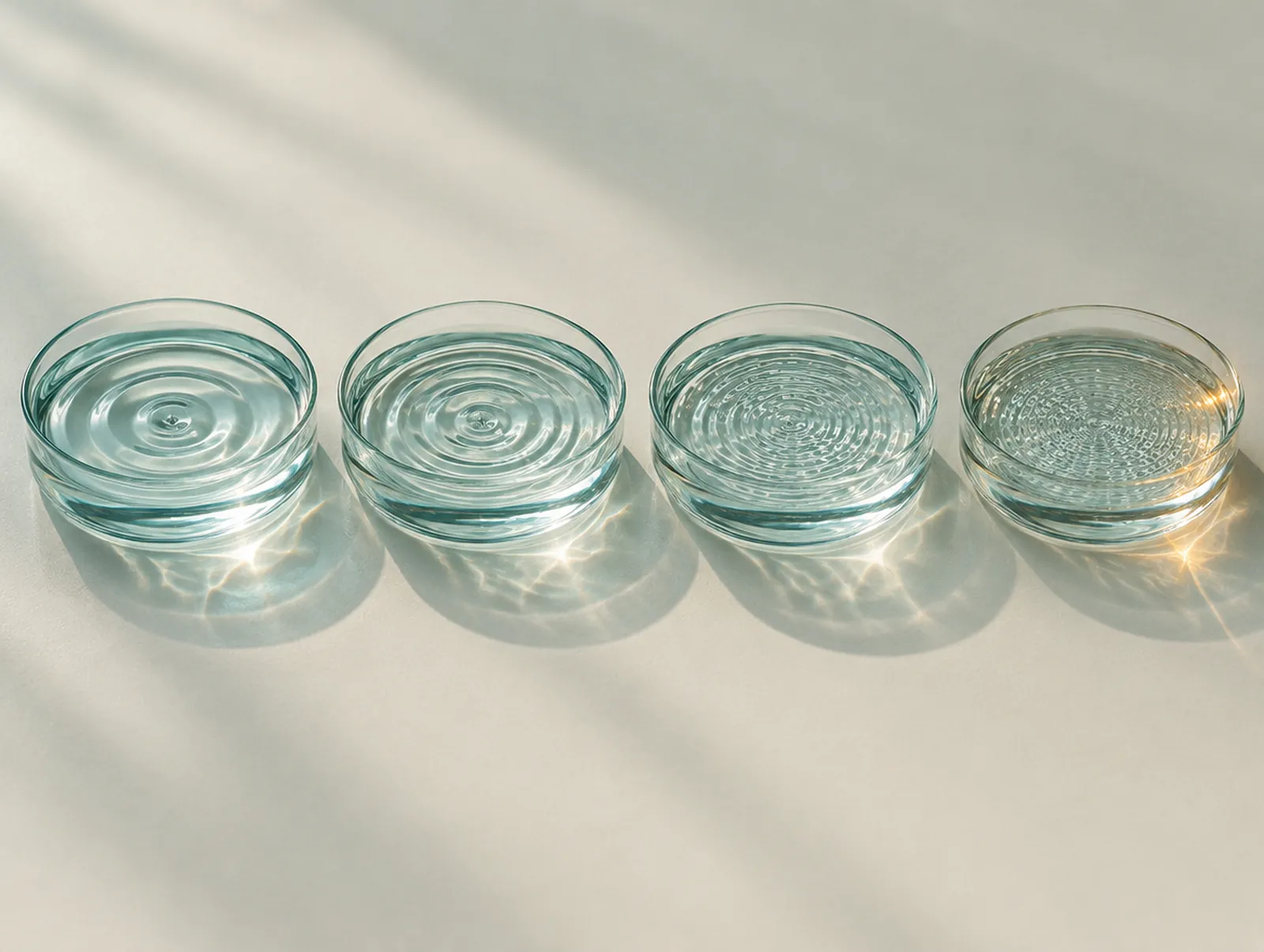
Someone who types "ultrasonic" into a search box may mean any of these four groups. The table shows the frequency each family works at and what it was designed for.
| Device family | Frequency | Where is the effect? | What for? | Where? |
|---|---|---|---|---|
| Ultrasonic facial spatula | About 24-28 kHz | The water layer on the skin surface | Surface cleansing, light peeling | Home, salon |
| Low-frequency sonophoresis | 20-100 kHz | The liquid just above the skin and the top layer | Increasing skin permeability | Laboratory, clinical research |
| Therapeutic range | Mostly 1 and 3 MHz | 1 MHz deeper, 3 MHz closer to the surface | Gentle massage, use with serum; heating in physical therapy | Home, physical therapy |
| Focused ultrasound (HIFU, MFU) | 2-10 MHz, mostly 4 and 7 MHz | Focal points 1.5, 3 and 4.5 mm below the skin | Tightening with heat points | Clinic, under physician control |
Frequency alone is not enough; intensity, duration and focusing also shape the result. In Draper's data, 1 MHz at 0.5 W/cm² heated the muscle by only 0.04°C per minute. At that rate the rise does not reach half a degree in 10 minutes. According to the same study, for a thermal effect in physical therapy the tissue has to warm by 1°C to 4°C and above, depending on the target.
Ultrasonic facial spatula and ultrasonic peeling: what they do and what they can't
How does it work? The spatula is a thin, flat metal tip. Aesthetician training materials describe it as working at 24 to 28 thousand vibrations per second and being used mainly to remove excess dead cells from the surface. When the skin is wet, the tip vibrates the thin layer of water on the surface. The bubbles and vibration in this layer loosen dead cells, oil and dirt, and the tip scrapes them away. The name "ultrasonic peeling" comes from this: it is not a chemical peel but the mechanical removal of loose cells.
There is no point in using a spatula on dry skin. No coupling layer of water remains, and the metal tip rubs directly against the skin.
What does the evidence say? We did not find a peer-reviewed study that tests at-home spatulas against a control group. The most direct data we could find is small and old. In a 2005 study in Korea by Han and colleagues with 13 women in their 20s, skin roughness fell by an average of 1.36% by the end of the care program. In the same study, the moisture value measured right after the spatula dropped from 52.7% to 44.7% and returned to its previous level only after a seaweed mask applied afterward. Because the program also included steam and a mask, it is impossible to separate how much of the effect came from the spatula.
The practical lesson is clear: a spatula can dry the skin briefly, and a moisture-retaining step must follow. You can find out why the size of the molecules that bind moisture matters in our guide to how 8D hyaluronic acid works.
What can't it do? We did not find a study showing that a spatula removes the hardened plug inside a pore. In a blackhead, the real work is done by ingredients that dissolve in oil and can get inside the pore; we covered these in our article on how salicylic acid works in the pore. There is also no data showing that a spatula produces collagen, tightens skin or creates an "ultrasonic facelift" effect.
How often? There is no evidence-based frequency of use for a spatula. It makes sense to treat it like a peeling step: start once a week, and if there is no redness or tightness, increase the frequency slowly. If you have rosacea, active inflamed acne or very sensitive skin, talk to your dermatologist first.
Ultrasonic facial cleansing device or sonic brush?
Some of the devices people search for as an "ultrasonic facial cleansing device" may actually be sonic brushes. The word sonic describes the audible range. A vibration below the 20 kHz limit drawn by StatPearls does not count as ultrasound, whatever the box says. These brushes clean the skin mechanically, with bristles or silicone nubs.
The data on sonic devices is small too. In the 2021 study by Aiello and colleagues, one half of the face of 12 people was cleansed by hand with the same cleanser and the other half with a sonic device. The moisture measurement fell by 17.19% on the hand-cleansed side and stayed close to baseline on the device side. There was no difference between the two sides in oil, water loss or skin temperature measurements.
This result does not show that the device cleans better; it shows that in this protocol it dried the skin less than hand cleansing. We compared which cleansing tool works and when in our article examining the real effect of facial cleansing devices.
What is sonophoresis? How does low frequency open the door to the skin?
Definition. Sonophoresis (also called phonophoresis) is the delivery of a substance onto or through the skin with ultrasound. The review by Polat and colleagues distinguishes two families: low-frequency sonophoresis at 20-100 kHz and high-frequency sonophoresis, mostly performed at 1-3 MHz. Both serve the same purpose, but their mechanisms differ.
The power of low frequency. In a study published in Science in 1995 by Mitragotri, Blankschtein and Langer, low-frequency ultrasound increased the permeability of human skin by several orders of magnitude. Large proteins such as insulin, interferon gamma and erythropoietin could be delivered through human skin. In the same team's 1996 study, 20 kHz increased the passage of substances such as salicylic acid and estradiol through cadaver skin by 3 to 3,000 times. The increase at physical therapy frequencies was typically below 10 times.
The authors reported that ultrasound left no long-lasting loss in the skin barrier. However, these results were obtained in cadaver skin and hairless rats, in setups with adjusted power and duration.
How does it work? According to Polat's review, the main mechanism has been shown by experiments: bubbles collapsing in the liquid just above the skin, most likely through microjets hitting the skin, disrupt the top layer and make it permeable. The effect is not spread evenly. In experiments where a surfactant was added to the liquid, high-permeability "localized transport regions" appeared as scattered islets covering 5% to 25% of the skin surface.
Why not at home? The same review writes that the clinical use of low-frequency sonophoresis is still at an early stage and that high-frequency applications lack a long safety record. Research focuses on medical goals such as drugs, vaccines, blood glucose monitoring and local anesthesia. We did not find a study showing that a home spatula reproduces the thousand-fold differences seen in the laboratory.
You will find the stratum corneum that a serum has to cross in our guide to the epidermis and the limit serums can pass, and how deep ultrasound, light and heat travel into the skin in the depth table in our article on subcutaneous tissue.
1 and 3 MHz: what does the therapeutic range do in massage and with a serum?
A range from physical therapy. StatPearls describes the typical physical therapy application as follows: 1-3 MHz, about 1 W/cm², a head moving continuously over gel, and about 10 minutes. 1 MHz is chosen for deeper tissue, 3 MHz for tissue closer to the surface. If you see a value such as 1 MHz on a skincare device with an ultrasonic head or on an ultrasonic facial massager, the device is in this range.
The honest state of the evidence. The 2001 systematic review by Robertson and Baker examined 35 randomized trials comparing real ultrasound with placebo ultrasound in pain and soft tissue problems. Of the 10 trials whose methods were found adequate, only 2 showed real ultrasound to be more effective than placebo, while 8 did not. The biophysical review by the same team also writes that the frequently described cellular effects either do not occur under treatment conditions or have no proven clinical counterpart.
This data comes from physical therapy, not skincare. Still, it is a good reason not to assume that ultrasound in the therapeutic range has a strong biological effect on its own.
Together with a serum. The main place of this range in skincare is high-frequency sonophoresis. According to Polat's review, permeability typically rises 1 to 10 times, and it works best with small molecules. We covered in detail how a 1 MHz device is used with a serum and which studies measured what in our article on the effect of an ultrasonic skincare device on serum absorption.
Skin appearance. We did not find a controlled human study showing that 1 MHz ultrasound alone changes the texture or roughness of facial skin. The home-device studies we could find test ultrasound together with light, radiofrequency or microcurrent. Seeing this range as a gentle massage step used together with a serum is the expectation most consistent with the evidence.
Focused ultrasound (HIFU and MFU): how does clinical tightening work?
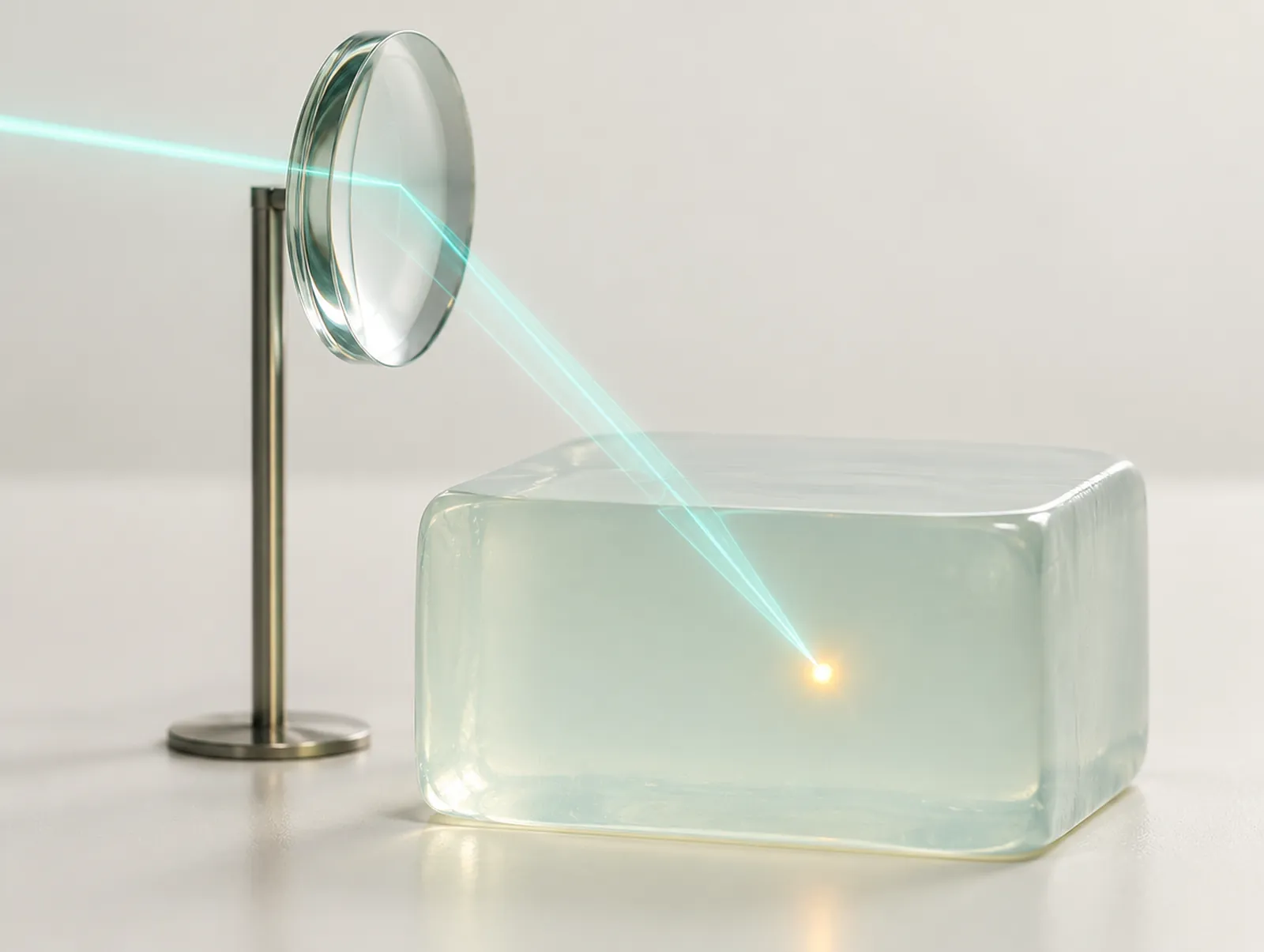
The difference focusing makes. Focused ultrasound uses a curved head to bring the waves together at a single point, like sunlight gathered by a magnifying glass. According to the 2023 systematic review by Contini and colleagues, the procedure creates thermal injury zones of about 1 mm³ at chosen depths under the skin. Typical depths are 1.5 mm (dermis), 3 mm (deep dermis) and 4.5 mm. The last is the SMAS, the connective tissue layer that wraps the facial muscles.
At these points the temperature rises to about 60-70°C and the collagen contracts immediately. The body's repair response then produces new collagen over the following months. This is what is meant by ultrasound skin tightening.
Frequency and depth. According to Contini's review, head frequencies range from 2 to 10 MHz, with 4 and 7 MHz used most. In the 2019 study by Shome and colleagues, the 10 MHz head focuses at 1.5 mm, the 7 MHz head at 3 mm and the 4 MHz head at 4.5 mm. The rule is the same again: the higher the frequency, the shallower the energy stays.
Results. Contini's review covers 16 studies, and all participants were women. Brow lifts of 0.47 to 1.7 mm were measured. In the pooled data of 337 people at day 90, physician assessment found improvement in tightness or wrinkles in 92% of patients. In patients' own assessments, the most common response was "mild improvement" (42% at day 90, 53% at one year); the share saying "no change" fell from 25% to 5%, but the one-year data rests on only 19 people. The American Academy of Dermatology (AAD) also states that after a single session most people see a moderate lift and tightening within 2 to 6 months.
The cost. The procedure is moderately painful. The mean pain score in the review is 3.8 out of 10, and this score was often measured together with numbing cream or painkillers. Temporary redness and swelling occur in almost everyone; rare side effects such as numbness, bruising and burns were reported in 2% of patients. Results weaken in marked sagging and when body mass index is above 30, so these count as relative obstacles.
You can find which layer sagging starts in and what is realistic at home in our guide to the causes of facial sagging and what works at home.
Can HIFU be done at home? The risks come from depth
When evaluating home devices sold on the promise of an "ultrasonic facelift" or "ultrasound skin rejuvenation", keep this in mind: tightening in the clinic comes from focused energy that raises the tissue above 60°C at depth. When the same energy lands in the wrong place, it causes harm.
Data from Japan. The national survey by Kono and colleagues, published in 2026, reached 1,792 institutions using HIFU; 165 side effects were reported in 139 cases. The most common were burns (61) and nerve damage (49); two cases developed cataracts. The head most associated with side effects was the one focused at a depth of 4.5 mm, with 79 cases.
According to an information note from Japan's Consumer Affairs Agency, 70% of the 135 HIFU accidents recorded in the accident database up to 2022 occurred on the face. In 2024 Japan's Ministry of Health announced that performing HIFU as a business by people who are not physicians violates the medical practitioners law.
The eye. There are case reports of clouding of the lens (cataract) and damage to the cornea and iris after applications near the eyelid. In the case published by Roditi and colleagues in 2020, a 45-year-old woman who had focused ultrasound applied to her eyelids lost vision severely within four days and needed cataract surgery.
Regulators. The Thai Food and Drug Administration announced that it does not permit HIFU devices for self-use and that the procedure requires a specialist physician.
A home device with "HIFU" on the box is risky if it really operates in a focused, high-intensity way; if it does not, it cannot be compared with clinical tightening. If you want focused ultrasound, plan it with an examination by a dermatologist or plastic surgeon.
Beyond ultrasound, you will find how to use LED, radiofrequency, heat and cold modes safely at home in our guide to the safety of at-home skincare devices.
Who should not use ultrasound? The limits of safe use
General medical limits. According to the summary of the American Academy of Physical Medicine and Rehabilitation, therapeutic ultrasound is not applied over the eyes, a pregnant uterus or a malignant area, nor near the heart, brain and spine. It is not used in people with a pacemaker or on children's growth plates; metal plates, screws and prostheses call for caution. StatPearls also lists active infection and tissue with impaired circulation among the barriers.
The manual comes first. The manufacturer's manual determines which conditions rule out use of a cosmetic home device. Read the contraindication list before first use; if you have a health condition that is not on the list, ask your doctor.
A stationary head raises burn risk. According to StatPearls, low-intensity ultrasound can cause a superficial burn if it stays on the same spot for a long time. The head must keep moving while it touches the skin.
Permeability works both ways. If ultrasound makes the skin more permeable to a serum, it does so for a potentially irritating substance as well. Polat's review describes that surfactants used together with ultrasound in low-frequency experiments markedly increased permeability. Do not put high-strength acids, retinoids or a product you are trying for the first time into the same evening as the ultrasonic step.
When to see a dermatologist? If you notice burning, blistering, discoloration or numbness that does not go away after a session, stop the device and see a dermatologist. Blurred vision, eye pain or loss of strength in the face after focused ultrasound requires urgent evaluation.
Ultrasonic care at home, step by step
The sequence below is written for a 1 MHz head used with a serum; for a spatula, use water instead of serum in step 3.
- Read the manual. Find out your device's frequency, purpose and contraindications. If the frequency is below 20 kHz, what you hold is a sonic device, not ultrasound.
- Cleanse the skin gently. Makeup, sunscreen and oil residue keep the coupling layer from contacting the skin properly.
- Apply a generous coupling layer. A water-based, fluid serum or gel leaves no air between the head and the skin.
- Start at the lowest level. In the first sessions, do not raise the intensity before you see how your skin responds.
- Keep the head moving. Draw slow, upward lines; stay away from the eyelids and the thin skin around the eyes.
- Respect the time. Do not exceed the per-area time in the manual; longer is not always better.
- Close the routine. Apply your moisturizer; if you used the device in the morning, add sunscreen afterward.
Four mistakes to avoid. Using it on dry skin, leaving the head in one spot, using the spatula every day like a peel, and expecting clinical HIFU results from a home device. What they all have in common is ignoring what frequency and intensity allow.
Ultrasonic Wave on Longos Sense: what does the manual say?
Longos Sense is an at-home cosmetic skincare device that brings six technologies together on two application surfaces. Ultrasonic Wave appears in the manual under the name "Ultrasonic Vibration mode" and works with the 1 MHz transducer on Surface 1. The cosmetic intended use in the manual is to provide a gentle vibration massage and to improve the appearance of skin texture.
The usage description is short. Surface 1 is applied to clean skin, the transducer provides a gentle micro-vibration massage, the mode can be used together with a cosmetic serum, and the head is moved slowly over the area. According to the general instructions, intensity is chosen from 1 to 6 in the mobile app, you start at a low level, and you apply for 5-10 minutes per area. The manual describes this mode as a gentle massage, not as a procedure that creates heat points at depth; it does not replace clinical focused ultrasound.
Mechanical Vibration is a separate mode. It is available on both surfaces and provides a gentle mechanical vibration massage to get the skin moving. The manual describes it separately from Ultrasonic Wave.
The same number, a different energy. Surface 1 also has a 1 MHz bipolar radiofrequency electrode. Although the number is the same, the energy is different: according to Elsaie's 2009 review, radiofrequency works when an electric current meets the resistance of the tissue and turns into heat, whereas ultrasound is a mechanical pressure wave.
The contraindications in the manual include an active electronic implant, a metal implant in the treatment area, active infection or an open wound, pregnancy and breastfeeding, active cancer, a history of skin cancer, immunosuppressive conditions and age under 18; if you use a blood thinner, you are asked to consult your doctor first. The device is not applied to the eyes and eyelids.
Where to start this week?
Look once at the box or manual of the device you have and find its frequency; that number tells you what you can expect. A device below 20 kHz is a sonic cleanser. A spatula around 24-28 kHz is for surface cleansing; start with once a week. A 1-3 MHz head is a gentle massage used with a serum. Focused ultrasound is a clinical procedure to consider only after a physician's examination.
If you use Longos Sense, before adding the ultrasonic mode to your routine, run the AI skin analysis in the app once on clean skin with no product, and repeat it four weeks later in the same light. This is a care guide, not medical advice; if you notice burning, blistering or a reaction that does not go away, consult your dermatologist.
Frequently Asked Questions
What does ultrasound skincare do?
It depends on the frequency of the device. An ultrasonic spatula working at about 24-28 kHz removes loose dead cells, oil and dirt from the surface of wet skin. Low-frequency sonophoresis at 20-100 kHz is the method that raises skin permeability the most, but it is largely a matter for research and the clinic. 1-3 MHz heads are a gentle massage step used with a serum. Focused ultrasound (HIFU) creates heat points of 60-70°C at 1.5-4.5 mm below the skin; according to the American Academy of Dermatology, after a single session most people see moderate tightening within 2-6 months. Home devices do not replace this clinical procedure.
Does an ultrasonic facial spatula clean pores and blackheads?
On wet skin the spatula vibrates the layer of water on the surface, loosening and scraping away loose dead cells, oil and dirt. There is no controlled study showing that it removes the hardened plug inside a pore; in a blackhead, ingredients that dissolve in oil are more effective. In a small 2005 study, skin moisture dropped from 52.7% to 44.7% right after the spatula, so use a moisturizer afterward. Since there is no evidence-based frequency, think of it as a peeling step and start with once a week.
Can ultrasound skin tightening be done at home?
Tightening with ultrasound comes from focused ultrasound, which raises the tissue to 60-70°C millimeters below the skin, and it is a procedure that must be performed under a physician's control. A national survey in Japan reported 165 side effects in 139 cases; the most common were burns and nerve damage. The Thai Food and Drug Administration does not permit HIFU devices for self-use. The 1 MHz massage heads used at home cannot be compared with clinical focused ultrasound. If you want tightening, start with an examination by a dermatologist.
What is sonophoresis and what does it do in skincare?
Sonophoresis (phonophoresis) is the delivery of a substance onto or through the skin with ultrasound. In low-frequency sonophoresis at 20-100 kHz, bubbles collapsing in the liquid outside the skin make the top layer temporarily permeable; in a 1996 laboratory study, 20 kHz increased the passage of some substances through cadaver skin by 3 to 3,000 times. In high-frequency sonophoresis at 1-3 MHz, the increase is typically 1 to 10 times and works best with small molecules. The home counterpart is an ultrasonic head used with a serum.
Who should not use an ultrasonic skincare device?
Therapeutic ultrasound is not applied over the eyes, a pregnant uterus or a malignant area; it is also unsuitable for people with a pacemaker, and metal implants call for caution. For home devices, the manufacturer's manual determines the contraindications; for example, an active electronic implant, a metal implant in the treatment area, pregnancy and breastfeeding, active infection or an open wound, and age under 18 may be on this list. Do not leave the head on one spot, because low-intensity ultrasound that stays in the same place for a long time can cause a superficial burn.
Is an ultrasonic facial massager the same as mechanical vibration?
No. Ultrasound is a pressure wave above 20 kHz produced by a piezoelectric crystal, and it reaches the skin only through a coupling layer such as water, gel or serum. Mechanical vibration is a separate vibration massage done to get the skin moving. On Longos Sense, Ultrasonic Wave works with the 1 MHz transducer on Surface 1, while Mechanical Vibration is a separate mode available on both surfaces. Sonic brushes that vibrate below 20 kHz are not ultrasound either.
Clinical evidence