
sphingolipids
Signs of dehydrated skin: dehydrated, dry or barrier-damaged? How to tell
What are the signs of dehydrated skin? The short answer
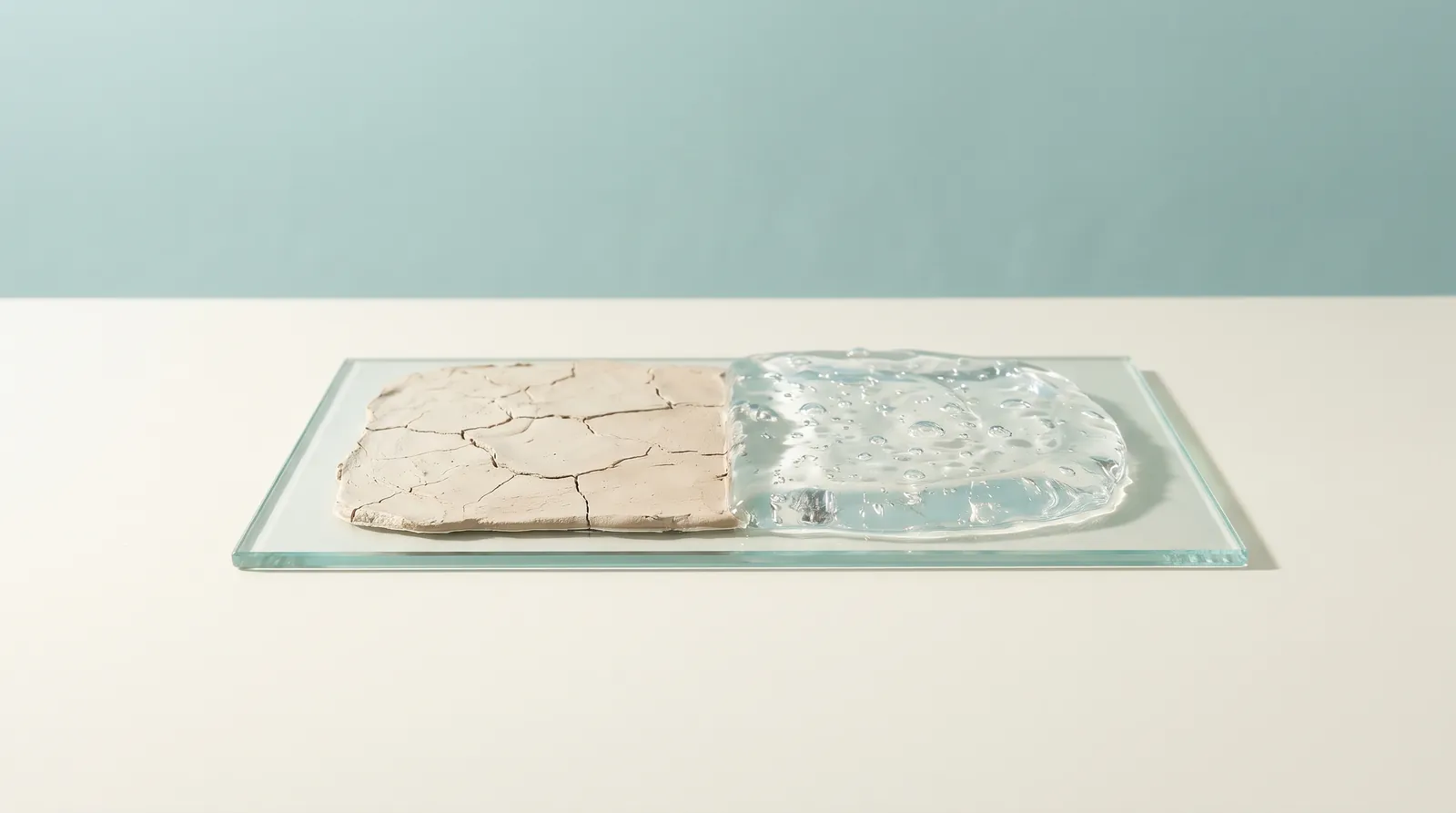
Dehydrated skin is skin whose top layer cannot hold enough water. Its most familiar signs are tightness after you wash your face, a dull look, fine criss-cross lines that soften when you moisturize and come back a few hours later, and makeup settling into those lines. Oily skin can be dehydrated too; a face that shines while feeling tight is not a contradiction.
"Dehydrated" and "thirsty" skin are terms from the language of cosmetics, not a separate medical diagnosis. In cosmetic language, dehydrated skin is described as a temporary state, while dry skin is a skin type that produces little oil (sebum). The clearest clue to a damaged barrier is stinging and burning when you apply products. Dehydrated skin is also not the same thing as dehydration, the loss of fluid from the body.
Rule of thumb: For two weeks, drop harsh cleansers, hot water and drying actives; apply a humectant serum to damp skin and a cream on top. If the tightness and lines ease, the picture was most likely dehydration. If you have stinging, bleeding cracks or itchy red patches, see a dermatologist.
Dehydrated, dry and barrier-damaged skin: the difference in one table
All three can appear in the same skin at once, but each comes from a different shortfall. In medical language, dry skin (xerosis) is a broader concept: a 2019 position paper by German dermatologists (Augustin et al.) defines it as skin that lacks lipids, the natural moisturizing substances that bind water, or both.
| Dehydrated skin | Dry skin | Barrier-damaged skin | |
|---|---|---|---|
| What is missing | Water in the top layer | Sebum and barrier lipids | Barrier integrity |
| Duration | Temporary; changes with weather, routine and season | A lasting tendency, a skin type | Lasts as long as the trigger continues |
| Typical feeling | Tightness, especially after washing | Dryness and roughness all day | Stinging, burning, sensitivity to touch |
| Appearance | Dullness, fine lines that soften with moisturizer; also seen in oily skin | Flaking, rough and dull surface | Redness, flakes, itching, breakouts |
| Common causes | Harsh cleansing, hot water, dry air | Low sebum, age | Over-exfoliation, harsh soap, layered actives |
| What helps | A humectant on damp skin, a light cream on top | A rich cream with humectants, emollients and occlusives | A break from actives, a simple fragrance-free routine |
What the table is based on. According to Cleveland Clinic, skin that does not produce enough sebum looks dull and feels tight or even flaky; Mayo Clinic also notes that with age the skin produces less of the oils that help it hold water. Cleveland Clinic dermatologist Melissa Piliang lists stinging and sensitivity when applying products among the signs of a damaged barrier. According to Augustin and colleagues, the drier the skin looks, the higher the lipid content of the cream should be. We cover how and how quickly the barrier recovers in our guide to the signs of a damaged skin barrier and how long repair takes.
How does skin lose water? The stratum corneum and TEWL in plain words
Water moves from the bottom up. Water in the living layers of the skin slowly travels up to the topmost layer of dead cells, the stratum corneum, and evaporates from the surface. This loss, which unlike sweat seeps through the layer constantly and unnoticed, is called transepidermal water loss (TEWL). According to a 2018 methods paper by Alexander and colleagues, TEWL is measured in grams per square metre per hour.
Three mechanisms hold the water. According to a 2005 review by Rawlings and Matts, the stratum corneum holds water through the ordered lipid layers between the cells, the arrangement of mature cells that lengthens the path water has to travel, and the natural moisturizing factor (NMF) inside the cells. When harsh cleansing depletes these lipids and the NMF, water escapes faster.
Only the outermost layers dry out. Irvin Blank, one of the pioneers of this field, looked back in 1987 on the 1952 study and wrote that ambient air dries only the outermost two or three cell layers, while most of the layer stays moist. As Rawlings and Matts report, Blank estimated that these layers lose their flexibility when their water content drops below about 10%.
The first visible sign. According to Rawlings and Matts, the first visible step of dehydration is a whitening between the fine network of lines on the surface, with drying cells lifting off as small flakes. The whiteness comes from light scattering on the dried surface; this is one reason skin looks dull. You can read how TEWL is measured and how moisturizers work in general in our guide to the causes of skin moisture loss and ways to keep skin hydrated.
You can read which layer of the epidermis the stratum corneum grows from, and how many days cells take to reach the surface, in our layer by layer guide to the epidermis.
What does dehydrated skin look like? Six signs in the mirror and to the touch
In cosmetic language, these signs describe dehydrated skin. None of them is a diagnosis on its own; if several appear together and change quickly with moisturizing, dehydration becomes more likely.
Tightness after washing. Mayo Clinic lists a feeling of skin tightness first among the signs of dry skin. Harsh cleansers and hot water make this feeling worse.
Dullness. A dried-out surface does not reflect light evenly. According to Mayo Clinic, flaking gives brown and Black skin an ashy look.
Fine criss-cross lines that change with hydration. The skin's natural network of surface lines becomes more visible as water decreases. According to a 2016 review by Sethi and colleagues, moisturizing smooths the "valleys" between the ridges on the surface; the effect of emollients peaks 30 minutes to 1 hour after application and usually lasts about 4 hours. That is why lines that vanish after cream and come back in the afternoon are often due to water. Wrinkles from facial expressions or age do not fade this quickly with a cream.
Makeup settling into lines. Foundation and powder collect in the more visible lines and in flaky areas.
Both oily and tight. A shiny T-zone with tight cheeks shows that oil and water are different things.
Roughness and fine flakes. As dehydration progresses, the surface becomes rough, fine powder-like flakes appear, and in dry air even a few hours can be enough. In a 2002 study by Egawa and colleagues, volunteers' forearm and cheek skin was kept in a low-humidity environment for 3 or 6 hours. The water content of the stratum corneum dropped significantly by hour 3, and surface roughness increased. The study was carried out at a cosmetics company's research centre.
How to tell if your skin is dehydrated: at-home tests and their limits
At-home tests are not measurements; they only point you in a rough direction.
The pinch test. You gently pinch your cheek or the back of your hand and watch how quickly the skin returns to its original shape. This is a form of the skin turgor examination that doctors use to check for fluid loss in the body; it does not measure the water at the skin's surface. According to a 1999 systematic review by McGee and colleagues published in JAMA, poor skin turgor in adults has no proven diagnostic value even for detecting fluid loss in the body.
The tightness and paper test. Wash your face with a gentle cleanser, pat it dry and wait 30 minutes without applying anything. According to Cleveland Clinic, if your skin still feels dry at the end of that time you may have dry skin, and if it feels oily you may have oily skin; blotting paper pressed onto the T-zone and cheeks also gives an idea. Skin that gets oily yet still feels tight fits the oily and dehydrated picture. Cleveland Clinic also adds that there is no universal skin type test.
The fingernail test. Cleveland Clinic suggests lightly running your fingernails over the skin of your arm or leg without pressing: flaking or a pale mark that resembles a chalk line points to dry skin. The test is described for arms and legs; do not try it on your face.
The clock test. Lines that soften about an hour after moisturizer and come back within a few hours match the timing Sethi reports and are a clue in favour of dehydration. No test explains stinging and burning; if you feel either, suspect your barrier.
What should skin moisture levels be? How hydration is really measured
Labs use two measurements. In research, skin hydration is most often measured by corneometry: a small probe touching the skin reads the electrical capacitance, which changes with the water in the stratum corneum. How much water the barrier lets escape is shown by TEWL meters. According to the guideline of the European group on efficacy measurement of cosmetics (EEMCO), updated in 2018, these two methods are still the preferred techniques.
The result is not a percentage but a device-specific unit. In a 2001 study by Li and colleagues, the capacitance device used arbitrary units on a 0-120 scale, while the other two devices used entirely different scales. The EEMCO guideline notes that there is no validation standard to reconcile differences between devices.
Measurement is very sensitive to conditions. According to Alexander and colleagues, TEWL should be measured at 18-21°C in a room with 40-60% relative humidity, after the person has acclimatized for 20-30 minutes, and at least 2 hours after washing. The authors say there is no consensus on reference TEWL values, and the result should be read as a change from the person's own baseline.
So what is a normal value for consumers? None of the sources we reviewed gives a "normal" skin moisture percentage for consumers. The known laboratory threshold is that the outer layers of the stratum corneum lose their flexibility when their water content falls below about 10%; this is not the same as the number on the screen of a home device. We found no validated normal range for home meters that display a percentage. Read such a device's number not as a diagnosis but as a trend, measured at the same time of day and under the same conditions.
The moisture you can really track as a percentage is the air in your home. Mayo Clinic considers it ideal to keep indoor humidity between 30% and 50% and recommends a simple humidity meter (hygrometer) for this.
Why does skin become dehydrated? Main causes, from cleansing to medication
The position paper by Augustin and colleagues lists the external triggers of dry skin as cold, low humidity and dry heated air, intense sun, frequent long hot showers and alkaline soaps.
Harsh cleansers and hot water
Heat amplifies the effect of a cleanser. In a 1995 study by Berardesca and colleagues, a strong cleansing agent (5% sodium lauryl sulfate) was applied to the forearms of 10 volunteers for four days at 4, 20 and 40°C; skin damage increased with temperature. In a 1996 study by Ohlenschlaeger and colleagues with 20 volunteers, a cleanser solution at 40°C increased water loss significantly compared with a solution at 20°C; water alone caused no significant change at either temperature. Mayo Clinic recommends keeping showers to 10 minutes or less and using lukewarm water.
Over-exfoliation and drying actives
According to the American Academy of Dermatology (AAD), prescription retinoid creams and products containing retinol or benzoyl peroxide can make skin sensitive or cause peeling; exfoliating while using them can increase dryness and even trigger breakouts. The Academy recommends taking a break from products with alcohol, fragrance and retinoids while dryness persists.
Dry air: central heating and air conditioning
Mayo Clinic lists central heating, wood stoves and space heaters among the causes that lower humidity; it also notes that air conditioners dry the air. According to a 2016 review by Goad and Gawkrodger, dry skin symptoms appear in low-humidity, air-conditioned indoor settings in some studies, but the authors stress that the literature is not conclusive. For dryness at the change of seasons, see our article on dry skin, flaking and itching in autumn.
Sun and some medications
Mayo Clinic lists sun damage among the causes of dry skin and recommends at least SPF 30 even on cloudy days. The list by Augustin and colleagues of medications that can cause dryness also includes retinoids, long-term cortisone creams, diuretics, cholesterol-lowering drugs, some heart medications such as beta blockers, and birth control pills. Do not stop any of these medications on your own; talk to the doctor who prescribed it about the dryness.
Does drinking water hydrate your skin? What the studies say
There is evidence, but it is thin. A 2018 systematic review by Akdeniz and colleagues screened 216 records and found only 6 studies that met its criteria; according to the authors, the evidence is weak in both quantity and methodological quality. Still, a slight increase in stratum corneum hydration was seen after extra water intake, especially in people who drank little beforehand. The link with water loss was unclear, and the mechanism is unknown.
The most cited study is small. In a 2015 study by Palma and colleagues, about 2 litres of water a day was added to the diet of 49 healthy women with an average age of 24.5 for one month; skin hydration increased, and the effect was more marked in those who drank less than 3.2 litres a day.
The practical takeaway. Mayo Clinic recommends drinking water or caffeine-free beverages when you are thirsty. If you drink little, drinking more may make a small contribution, but there is no evidence that it acts as directly as a cream applied to damp skin and gentle cleansing.
Can dehydrated skin cause acne? What the evidence does and does not show
A direct cause has not been proven. We found no study showing that dehydrated skin causes acne on its own. The link is indirect and runs largely through irritation.
Irritation can feed acne. The AAD advises against drying out acne-prone skin with astringents and acne products; in the Academy's words, dry skin is irritated skin, and every time you irritate your skin you risk more breakouts. The AAD also notes that washing your face many times a day and scrubbing it can make acne flare.
Acne treatments can strain the barrier. According to a 2013 review by Thiboutot and Del Rosso, increased water loss has been reported with benzoyl peroxide, tretinoin, tazarotene and isotretinoin. In one study cited in the review, 36 young men with mild to moderate acne had higher water loss and lower stratum corneum hydration and ceramide levels than a control group of 29 people. A more recent review by Del Rosso and Kircik, however, stresses that it is unclear whether this disruption comes from acne itself or from the inflammation during flares.
What to do? The AAD recommends using treatment as directed, applying a moisturizer made for acne-prone skin twice a day if your skin gets dry, and choosing products that do not clog pores (non-comedogenic).
Why does oily skin dry out? Skin that shines and feels tight
Oil and water are different things: sebum coats the surface, while water is held inside the stratum corneum. That is why skin that produces plenty of sebum can still lose its water.
Trying to remove oil takes water with it. With oily skin, frequent washing, rich-foaming cleansers and alcohol-based toners are tempting. According to Mayo Clinic, many soaps and detergents draw moisture from the skin because they are designed to remove oil. The AAD recommends avoiding astringents, alcohol and anything that dries the skin if you have acne-prone skin.
Flakes beside your nose and in your eyebrows? According to Cleveland Clinic, flaking in oily areas such as around the nose and the eyebrows may be seborrheic dermatitis and may need treatment; this picture is not dehydration. We cover the causes of oiliness and its link with acne in our guide to getting rid of an oily face.
How to increase skin hydration: evidence-based ingredients and habits
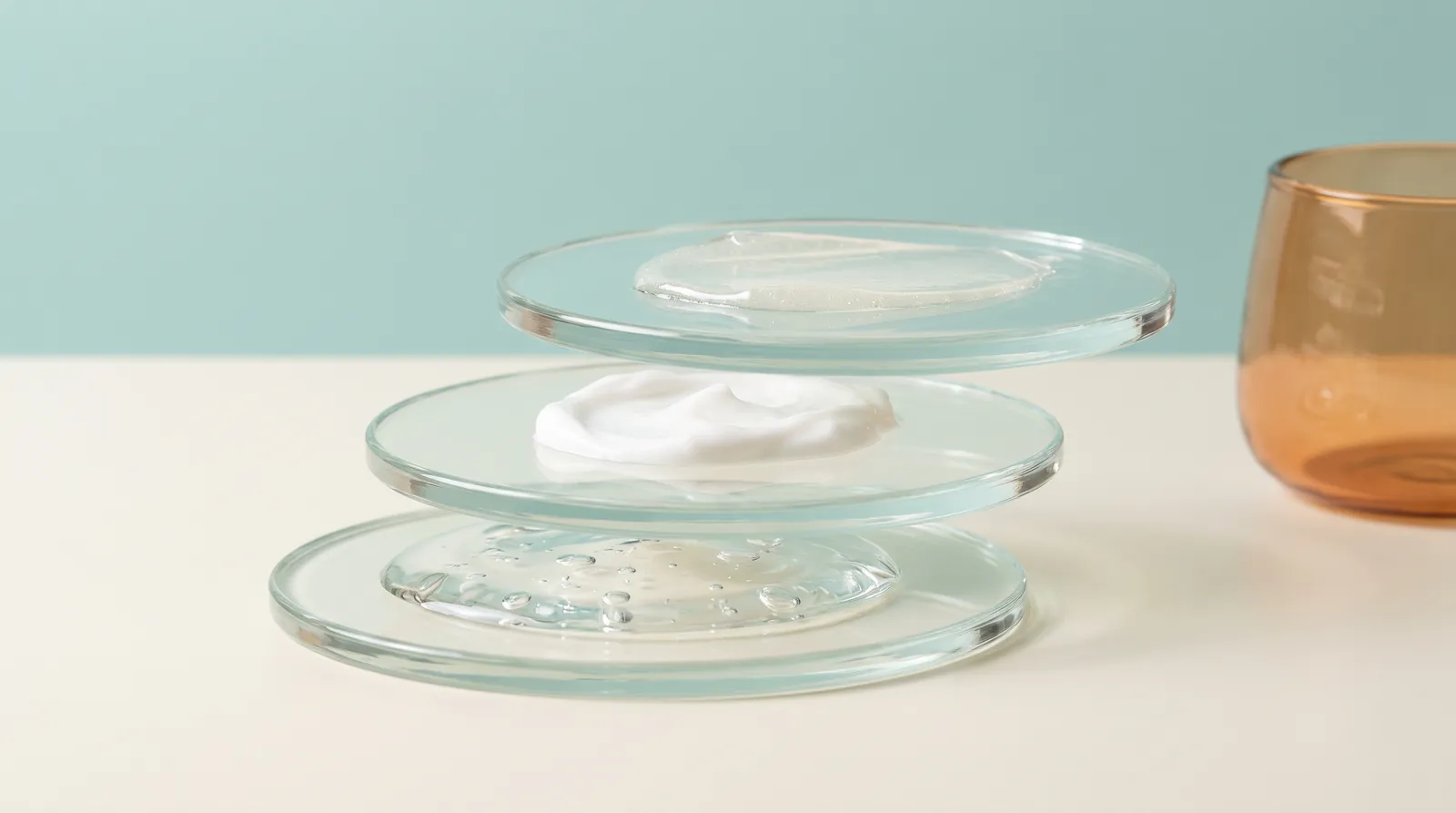
A moisturizer either draws in water (humectants), fills the gaps between cells and softens the surface (emollients), or forms a layer that slows evaporation (occlusives). According to Sethi's review, humectants are a double-edged tool: the water they draw from the lower layers can easily be lost in dry air, which is why they are usually used together with an occlusive.
| Ingredient | What it does | Concentration and findings in studies |
|---|---|---|
| Glycerin | Draws in water | According to Sethi, the most effective humectant; Li et al. (2001) reported that the measured hydration response in formulas with 0-15% glycerin rose linearly with glycerin content |
| Hyaluronic acid | Draws in water | Pavicic et al. (2011): 0.1%, 76 women, 60 days; hydration and elasticity increased compared with a control cream |
| Urea | Draws in water; at high concentrations loosens flakes | 2-10% for hydration and barrier support; 10-30% for hydration and loosening flakes (Piquero-Casals et al., 2021) |
| Panthenol | Draws in water, supports the barrier | Study cited in the review by Proksch et al. (2017): 2.5%, 60 healthy people, 7 days; hydration increased, water loss decreased |
| Ceramides | Replenish barrier lipids | Augustin et al.: the effect of urea increases when combined with other natural moisturizing components and ceramides |
| Petroleum jelly (petrolatum) | Occludes | At 5% or more it reduces water loss by more than 98%; for lanolin, mineral oil and silicones the figure is 20-30% (Sethi) |
When reading the studies. Some of the authors of the Pavicic study work at companies that produce raw materials, and three of the four authors of the Proksch review work for a pharmaceutical company. According to Piquero-Casals and colleagues, urea is well tolerated; mild irritation is seen occasionally and is more frequent at high concentrations.
Hyaluronic acid and the 8D complex. The main active of Longos Moisturizing Serum is an 8D hyaluronic acid complex that brings together hyaluronic acid forms of different sizes, and it is formulated for hydration and barrier support; on dehydrated skin it does the job of the humectant step. We explain why eight forms are used together in our article on 8D hyaluronic acid and why molecule size matters.
Apply to damp skin and humidify the air. The AAD recommends applying moisturizer after washing, while the skin is still damp, and choosing a cream or ointment rather than a lotion; according to Sethi, occlusives have their most marked effect on slightly damp skin. The AAD also recommends a humidifier in the bedroom that runs while you sleep and is cleaned regularly. In the review by Goad and Gawkrodger, humidification with a fine mist increased the water content of the stratum corneum.
Morning and evening routine for dehydrated skin
Follow the routine below for two weeks without changing it.
Morning
- Wash your face briefly with lukewarm water and a fragrance-free, soap-free cleanser with a cream or gel texture.
- Pat dry with a towel without rubbing; while your skin is still slightly damp, apply a serum with glycerin, hyaluronic acid or panthenol.
- Follow straight away with a cream: a rich texture for dry skin, a light one for combination skin.
- Finish with a broad-spectrum sunscreen of at least SPF 30.
Evening
- Remove makeup and sunscreen with a gentle cleanser.
- Apply the humectant serum while your skin is slightly damp.
- Top it with a cream containing ceramides or a low concentration of urea; you can add a thin layer of petroleum jelly to very dry areas.
- If you use a retinoid or acids, pause them during these two weeks (for prescription treatment, ask your doctor first); return to them gradually once your skin calms down.
For oily but dehydrated skin
- Wash morning and evening with a non-comedogenic, low-foaming cleanser; unless you have been sweating, do not wash again during the day.
- Apply an oil-free, gel-textured humectant serum to damp skin.
- Apply a light moisturizer made for acne-prone skin.
- In the morning, use a non-comedogenic sunscreen; in the evening, apply your acne treatment as directed in a thin layer and do not add an astringent.
If you use Longos Sense. The manual asks for the device to be used on cleansed, dry skin and warns that no liquid should get into the device. On evenings with the device, spread the serum on dry skin and save the cream for after the session. The manual defines the Thermal Therapy mode as gently warming the skin surface to support the absorption of cosmetic products; Ultrasonic Wave is a gentle vibration massage that can be used with serum and aims to improve the look of skin texture. Start at the lowest level, do not exceed 5-10 minutes per area, do not hold heat on one spot for more than 10 seconds, and do not use it on the eyes or eyelids. If stinging, burning or irritation occurs, the manual tells you to stop using it; the device is not used on skin with cracks, open wounds or a rash.
When should you see a dermatologist?
Most dehydrated and dry skin responds well to changes in care. According to Mayo Clinic, see a health professional if dryness persists despite all your efforts, if the skin is inflamed or painful, if the discomfort disrupts your sleep, if open sores or infection develop in cracks, or if there is flaking over large areas.
Eczema, psoriasis and bleeding cracks. According to the AAD, dryness that persists despite following advice may have an underlying condition such as atopic dermatitis, psoriasis or kidney disease; itchy, red, recurring scaly patches may not be a moisturizer problem. According to Mayo Clinic, very dry skin can open deep cracks, and bacteria entering through these cracks can cause infection.
If even moisturizer stings. The AAD asks you to tell your dermatologist if any product you apply, including moisturizer, causes burning, stinging or irritation.
It may be a sign of another condition. According to Augustin and colleagues, dry skin can be associated with diabetes, chronic kidney disease, liver diseases, an underactive thyroid gland and some medications; in these cases, dryness is not a separate diagnosis but a symptom.
Where to start this week
Start one experiment this week: follow the routine above for fourteen days without changing it, rate tightness from 0 to 3 every morning in the same light, and note how many hours after cream the lines come back. If your bedroom humidity is below 30% on a hygrometer, add a humidifier as well.
If your scores dropped, your picture was most likely dehydration, and keeping the same routine is enough. If nothing changed or stinging appeared, simplify your routine even further and see a dermatologist. This is a skincare guide, not medical advice.
Frequently Asked Questions
How can you tell if your skin is dehydrated?
Dehydrated skin shows itself mostly through tightness after you wash your face, dullness, and fine criss-cross lines that soften when you moisturize and come back a few hours later. Oily skin can be dehydrated too; a face that shines yet feels tight fits this picture. Waiting 30 minutes after cleansing without applying anything gives a rough idea. The common pinch test, however, does not measure the water at the skin's surface. If products sting and burn when you apply them, your skin barrier may be damaged.
What does dehydrated skin mean, and how is it different from dry skin?
Dehydrated skin, also called thirsty skin, is the cosmetic term for skin whose top layer cannot hold enough water, and it is described as a temporary state; in medicine it is not a separate diagnosis. Dry skin, by contrast, is a skin type that produces little sebum and causes roughness, flaking and dullness all day. For dehydrated skin, a humectant applied to damp skin and a light cream are usually enough. Dry skin needs a richer cream that contains humectants, emollients and occlusives.
Can dehydrated skin cause acne?
No study shows that dehydrated skin causes acne on its own. The link is indirect: according to the American Academy of Dermatology, dried-out skin is irritated skin, and irritation raises the risk of breakouts; washing your face often during the day and scrubbing it can also make acne flare. Acne treatments such as benzoyl peroxide and retinoids can increase water loss. The advice is to use the treatment as directed and add a moisturizer that does not clog pores.
What should skin moisture levels be?
There is no single normal skin moisture percentage that applies to consumers. In research, hydration is measured by corneometry in arbitrary, device-specific units; the result is very sensitive to room temperature, air humidity and the time of measurement, and there is no shared validation standard across devices. The known laboratory threshold is that the outermost layers of the skin lose their flexibility when their water content falls below about 10%. The value you can really track as a percentage is the humidity of the air at home; Mayo Clinic considers 30% to 50% ideal.
Does drinking water hydrate your skin?
It may have some effect, but the evidence is weak. A 2018 systematic review found only six studies that met its criteria and saw a slight increase in the hydration of the skin's top layer when people drank extra water, especially in those who drank little beforehand. The mechanism is unknown, and the methodological quality of the studies is low. Drinking water when you are thirsty makes sense, but do not expect an effect as direct as that of a cream applied to damp skin and gentle cleansing.
Why does oily skin dry out?
Oil and water are different things: sebum coats the surface, while water is held in the skin's top layer. In oily skin, frequent washing, harsh foaming cleansers, alcohol-based toners and layering drying acne products strip away water as well. The result is skin that shines but feels tight. A gentle non-comedogenic cleanser, an oil-free humectant serum on damp skin and a light moisturizer made for acne-prone skin are often enough.
Clinical evidence

