
How to get rid of an oily face? The short answer
The oil that makes your face shine is sebum, made by sebaceous glands that open into the hair follicles, and genes and hormones largely decide how hard those glands work. That is why oiliness does not go away by washing more often or by drying the skin out. What you can do is keep shine, clogged pores and acne under control, and for most people that is achievable.
The routine that works is short. A gentle, foaming cleanser at most twice a day and after sweating; a light, oil-free, pore-friendly (non-comedogenic) moisturiser; and a broad-spectrum sunscreen of at least SPF 30 in the daytime. Add one active ingredient with evidence: 2-4% niacinamide, 0.5-2% salicylic acid or a retinoid. Pressing blotting paper onto a shiny area is the instant fix.
Practical rule: Wait 6-8 weeks before judging a product. If you have deep, painful pimples, lesions that scar, irregular periods or increasing hair growth, stop trying products and see a dermatologist.
What is sebum and why does your skin make oil?
Sebum is not waste, it is a protective film. According to NCBI StatPearls, the sebaceous glands supply 90% of the lipids on the skin surface. The gland cells (sebocytes) fill with oil, break down and release their contents into the hair canal; by the same source this production and release cycle takes about a week. The oil you see in the mirror today is the result of production that started days ago.
What is in it? According to the 2009 review by Picardo and colleagues, human sebum consists of 57.5% triglycerides and fatty acids, 26% wax esters, 12% squalene and 4.5% cholesterol and its esters.
What does it do? The 2011 review by Makrantonaki and colleagues summarises that sebum lubricates the skin against friction, carries antioxidants to the skin surface and has an antibacterial effect. According to the same review, the sebaceous glands are largest and densest in the skin of the face and the scalp.
We explain how sebaceous glands are built, what sebum is made of and how hormones control its production in our guide to sebum and the sebaceous glands.
Why do some faces get oilier? Genetics, hormones and age
Genetics. The 1988 study by Walton and colleagues compared 20 pairs each of identical and non-identical twins: the sebum excretion rates of identical twins were almost the same, while those of non-identical twins differed markedly. Yet even among identical twins producing the same amount of sebum, acne severity differed. According to the authors, the amount of sebum is under genetic control, while the development of acne varies with environmental factors.
Hormones. According to the StatPearls acne review, the type 1 form of the enzyme 5-alpha reductase in the sebaceous gland converts testosterone into dihydrotestosterone (DHT), a stronger androgen; androgens increase the growth and output of the gland. By the same source, most people with acne have normal blood androgen levels. What matters is the gland's excessive sensitivity to these normal levels.
Age. According to the 1979 study by Pochi and colleagues, sebum excretion is low in childhood, rises from the middle to the end of childhood under the influence of androgens and keeps rising until the end of puberty. In men the output stays roughly the same until the age of 80; in women it falls gradually after menopause.
Why do pores look big? In the 2006 study by Roh and colleagues with 30 men and 30 women, pore size was most closely related to the amount of sebum, followed by male sex and age; in women the pores were significantly larger around ovulation. According to Cleveland Clinic's article on oily skin, pores cannot truly be shrunk, but they can be made to look less noticeable. We covered the ingredients that work on how pores look in our guide to the science of pore-minimising serums.
Season, heat, diet and stress: what does the evidence say?
Heat makes oil more fluid. In the 1970 study by Cunliffe and colleagues, the forehead skin of 9 people was locally warmed and cooled; each 1°C change in skin temperature changed the measured sebum excretion by about 10%. The authors note that this difference may come less from production in the gland than from warmed sebum becoming more fluid and spreading across the surface more easily. In the 2005 study by Youn and colleagues, the same volunteers were measured over a year, and the season with the highest sebum turned out to be summer.
Diet: glycaemic load more than fatty food. According to StatPearls, several studies link high dairy intake and a high-glycaemic-load diet with acne in adolescents; there is no strong evidence that chocolate makes acne worse. In the 2012 randomised study by Kwon and colleagues, a low-glycaemic-load diet reduced inflammatory and non-inflammatory lesions in 32 patients with mild to moderate acne in 10 weeks; in skin samples the sebaceous glands had shrunk.
In the 2008 study by Smith and colleagues, funded by a meat-industry organisation, a similar 12-week diet changed the fatty acid proportions in sebum in 31 young men. The samples are small; the findings point in a direction but do not set a firm rule.
Stress. In the 2003 study by Chiu and colleagues, the acne of 22 university students worsened during the exam period, and the worsening was strongly related to perceived stress. The study measured acne severity, not sebum. In the 2002 study by Zouboulis and colleagues, corticotropin-releasing hormone (CRH), which triggers the stress response, increased fat synthesis in cultured human sebaceous gland cells. This is a laboratory finding, not an effect measured in people.
How to tell if your skin is oily: oily, combination and dehydrated-but-oily skin
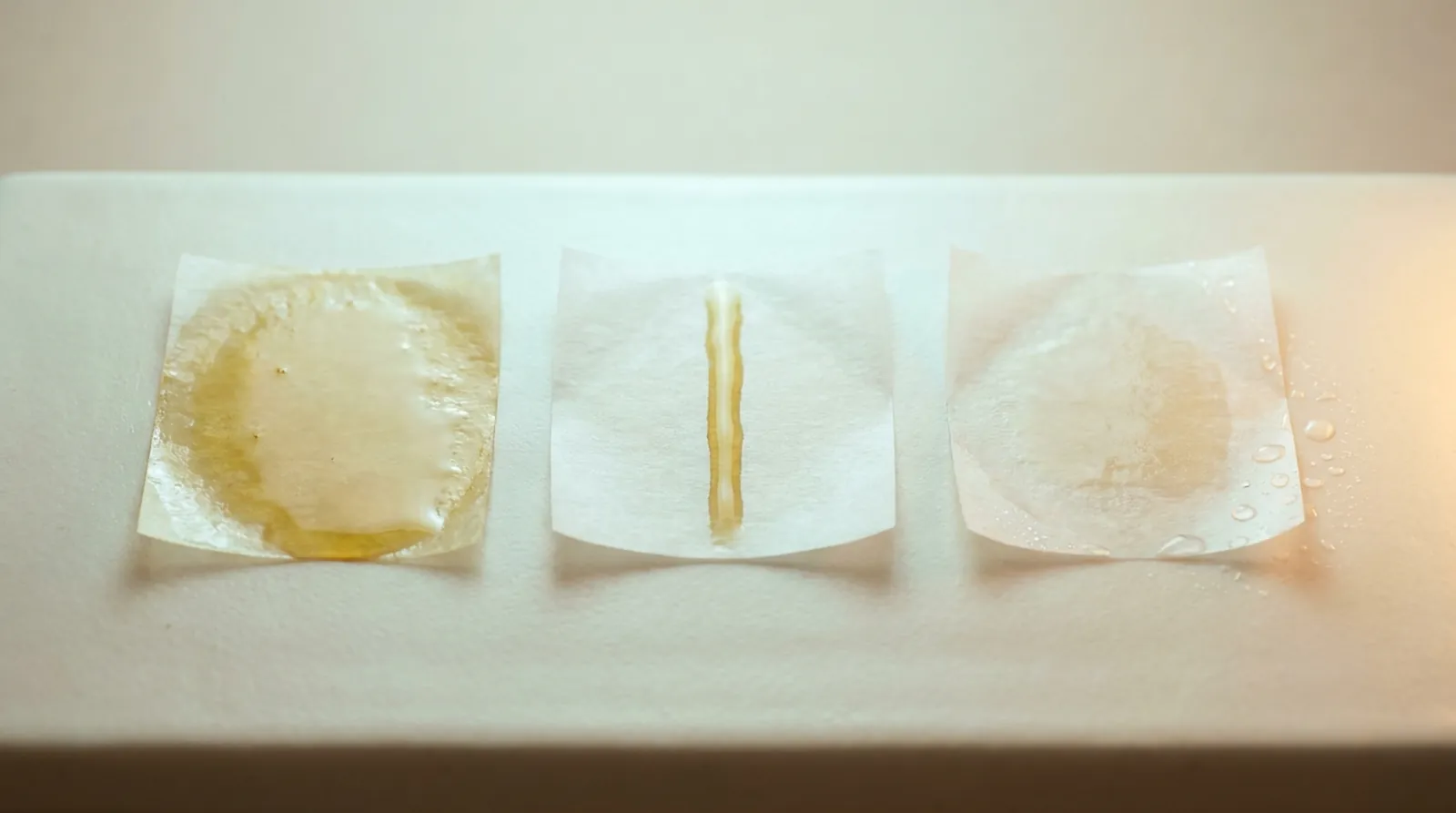
A simple test at home. DermNet's method is this: wash and dry your face, wait an hour without applying any product, then press a paper tissue against your forehead, cheeks, chin and nose. If your face looks shiny and the tissue shows oil marks, your skin is oily. If only the forehead, nose and chin (the T-zone) are oily and the cheeks are normal or dry, that is called combination skin.
Combination skin is common but poorly defined. According to the Youn study, combination skin is the most frequent type in subjective assessments, but its definition is vaguer than the others. The authors suggest defining combination skin as a difference in type between the T-zone and the U-zone, which covers the cheeks, persisting for more than two seasons.
Dehydrated but oily skin. In cosmetics, dry skin describes a lack of oil and dehydrated skin a lack of water in the top layer of the skin; the two can come together in different ways in the same person. In the 1995 study by Yamamoto and colleagues, the skin of 36 acne patients showed fewer ceramides and a weaker water barrier than that of 29 healthy people. So a lot of oil does not mean the barrier is intact.
| Sign | Oily skin | Combination skin | Dehydrated but oily skin |
|---|---|---|---|
| One hour after washing | Whole face shiny, clear oil on the tissue | Only the T-zone shiny | Shiny but tight |
| Cheeks | Oily | Normal or dry | Oily, rough in places |
| Common complaint | Blackheads, pimples | Blackheads in the T-zone, tightness on the cheeks | Tightness and shine together after cleansing |
| First step | Light oil-free moisturiser, one active | Different product by zone | Soften the cleanser, do not skip moisturiser |
Why do an oily face and acne often go together?
Two results of the same gland. The StatPearls acne review ties pimple formation to four processes: excess sebum, cells in the hair canal sticking together and failing to shed, the bacterium Cutibacterium acnes, and inflammation. The bacterium breaks down the triglycerides in sebum and uses them as food; an oil-rich, oxygen-poor environment suits its growth. When a plug of oil and cells builds up in a pore, first an invisible microcomedone forms, then whiteheads and blackheads, and with inflammation a red pimple.
Not just the amount, the composition matters too. According to Makrantonaki's review, linoleic acid is low in the skin-surface lipids of people with acne. The same review recalls that treatments that do not change sebum excretion (topical retinoids, benzoyl peroxide, azelaic acid, antibiotics) can also clear acne. Excess oil alone does not mean pimples. We explained why blackheads keep coming back and how they differ from normal sebaceous filaments in our guide on how to get rid of blackheads.
Flares that come with the cycle. According to StatPearls, 70% of female patients have a premenstrual flare, which is linked to swelling in the hair canal.
Where blue light at home fits. The manual describes the blue mode (415 nm) of Longos Sense's Quantum Dot Light technology as cosmetic use to improve the look of acne-prone skin; the manual assigns this mode no role for oil production or pores. The same manual says the device must not be used on areas with active lesions, open wounds or rashes, or on the eyes and eyelids, and tells people using photosensitising medication to consult a doctor first. In the 2014 study by Duteil and colleagues, 415 nm light caused a dose-dependent darkening lasting up to 3 months in medium and darker skin types (III and IV); if you tend to get dark marks after pimples, talk to your dermatologist before starting. We covered the evidence on blue light separately in our guide to devices that help acne.
Why do frequent washing and harsh cleansers backfire?
Washing more does not mean less oil. In the 2006 randomised study by Choi and colleagues, men with mild to moderate acne washed their faces once, twice or four times a day for 6 weeks with the same gentle cleanser. In the group washing twice a day, blackheads and non-inflammatory lesions fell significantly; among those washing once a day, redness and inflammatory pimples increased; in those washing four times a day, no significant change was seen. There was no statistical difference between the groups and the study was small; according to the authors, excessive washing may not be as guilty as assumed.
The real problem is irritation. According to the American Academy of Dermatology (AAD), a very harsh facial cleanser irritates the skin and can increase oil production; the Academy recommends avoiding oil- or alcohol-based cleansers and not scrubbing even when removing make-up. According to Cleveland Clinic's article too, products that over-dry the skin stimulate oil production. We found no controlled study that measures this rebound effect directly.
Irritation feeds pimples. According to the AAD's acne page, washing the face many times a day irritates the skin and can lead to new pimples; every time you irritate your skin there is a risk of a new pimple. For this reason the Academy recommends avoiding astringent toners, rubbing alcohol and anything that dries the skin.
How to cleanse oily skin: choosing a cleanser, moisturiser and sunscreen
Cleanser. The AAD recommends a gentle, foaming facial cleanser; cleansers, moisturisers and make-up labelled "oil-free" and "non-comedogenic" do not clog pores. The Academy recommends applying the cleanser with your fingertips in light, circular movements; there is no need for a washcloth, scrubbing pad or hard brush.
Moisturiser. According to the AAD, a moisturiser after cleansing matters for oily skin too; the Academy recommends a moisturiser made for acne-prone skin twice a day, after washing. According to the British Skin Foundation's guidance, light textures such as gels or lotions are generally preferred over thick creams for oily skin.
Sunscreen. The AAD recommends a broad-spectrum sunscreen of at least SPF 30 when you go outside; to save time you can also choose a moisturiser with sun protection. To avoid triggering pimples, products containing zinc oxide and titanium dioxide and free of fragrance and oil are recommended. According to Cleveland Clinic, mattifying products can reduce shine during the day on the spot.
What helps an oily face? Active ingredients with evidence
As stated in the introduction to the 2006 study by Draelos and colleagues, most products promising oil control at that time did not change the production of oil but absorbed the oil on the surface. The evidence for active ingredients that target production or the plug in the pore is as follows:
| Active ingredient | What it does | Studied concentration | Limit of the evidence |
|---|---|---|---|
| Niacinamide | May reduce sebum excretion, may reduce inflammatory acne | 2% (sebum), 4% (acne) | Small studies, some manufacturer-sponsored |
| Salicylic acid | Dissolves the plug in the pore | 0.5-2% | One randomised study in the AAD guideline, conditional recommendation |
| Retinoid (adapalene) | Prevents pore blockage | 0.1% | Does not change the amount of sebum |
| Zinc | May reduce inflammatory acne | Varies by study | Oiliness was not measured separately |
| Benzoyl peroxide | Effective in mild inflammatory acne | Starting at 2.5% is recommended | Can cause dryness and irritation |
Niacinamide: the few studies that measured sebum
In the Draelos study, 100 Japanese volunteers used a moisturiser with or without 2% niacinamide for 4 weeks in a double-blind, placebo-controlled design; in the niacinamide group the sebum excretion rate fell significantly at weeks 2 and 4. In a 6-week split-face study in the US with 30 white-skinned volunteers, surface sebum fell, while the excretion rate did not change. Two of the authors worked at a personal-care company; according to a 2005 article by Bissett and colleagues, researchers at the same company, topical niacinamide was well tolerated in many studies.
In the 1995 double-blind study by Shalita and colleagues, 76 patients used a 4% niacinamide gel or a 1% clindamycin gel twice a day for 8 weeks; the two groups gave similar results (the proportion of patients who improved was 82% and 68%, the difference not statistically significant). You can find the brightening and pore side in our guide on what niacinamide serum does.
Salicylic acid: the acid that works inside the pore
The US Food and Drug Administration's (FDA) regulation of over-the-counter acne products defines salicylic acid in the 0.5-2% range. The AAD's 2024 acne guideline conditionally recommends salicylic acid and bases this recommendation on a single randomised study: in 12 weeks, 0.5% salicylic acid achieved a 25% greater reduction in inflammatory lesions and an 11% greater reduction in open comedones than the same product without the active, with no difference in closed comedones. According to the AAD's oily skin page, salicylic, glycolic and lactic acid can help reduce oiliness but may be too harsh for some skin; if irritation occurs, use it less often. We explained what being oil-soluble means in our guide on what salicylic acid does.
The main active of Longos Anti-Acne Serum is natural salicylates from purple willow (Salix Purpurea), and it is formulated for acne-prone skin; plant salicylates are not the same molecule as pure salicylic acid. Pore Minimizer Serum from the same line is formulated with Epilobium and other plant extracts for the look of pores and oil balance. In the 2017 study by Loing and colleagues, Epilobium angustifolium extract reduced fat synthesis in human sebaceous gland cells in the laboratory; the human data is limited to a 24-person trial without a control group, carried out on the scalp. This is not a study done with the serum itself.
Retinoids: they target the plug, not the oil
Topical retinoids stop the cells in the pore from sticking together; according to Makrantonaki's review, they do not change the sebum excretion rate. The AAD states that a product containing adapalene can open pores and prevent new blackheads from forming. In 2016 the FDA approved 0.1% adapalene gel for over-the-counter use in the US for ages 12 and over; according to the announcement, redness, dryness and burning may occur in the first weeks, and a doctor should be consulted if there is no improvement after 3 months of daily use.
Zinc: the data is for acne, not for oil
In the 2020 meta-analysis by Yee and colleagues, the blood zinc level of acne patients was significantly lower than that of controls. The number of inflammatory papules fell significantly in people using oral or topical zinc, and the frequency of side effects did not differ from the treatments compared. This analysis did not measure oiliness separately. Discuss oral zinc supplements with your doctor in terms of dose and duration.
Step-by-step oily skin routine: morning and evening
The order below is largely based on the AAD's recommendations for oily and acne-prone skin; the niacinamide step is optional. Add new products one at a time.
- Morning, cleanse: Apply a gentle, foaming cleanser with your fingertips, rinse with lukewarm water and dry by patting with a towel.
- Morning, serum: If you like, a light serum or gel with 2-4% niacinamide.
- Morning, protect: An oil-free moisturiser and a fragrance-free, broad-spectrum sunscreen of at least SPF 30 with zinc oxide or titanium dioxide; the two can be in one product.
- During the day: Press blotting paper on a shiny area for a few seconds, do not rub. After sweating, wash your face and dry it without rubbing with a towel.
- Evening, cleanse: Remove make-up and sunscreen with the same cleanser. Do not sleep in make-up.
- Evening, one active: Apply salicylic acid or a retinoid as a thin layer over the whole acne-prone area, not only on the pimples. If irritation occurs, reduce the frequency.
- Evening, last step: A light, non-comedogenic moisturiser.
According to the AAD, first improvement shows in 6-8 weeks and full clearing usually takes 3-4 months; changing products every week only irritates the skin.
Shine during the day: blotting paper, clay masks and make-up
Blotting paper. The AAD recommends pressing the paper lightly on your face and holding it for a few seconds; rubbing spreads the oil to other parts of the face. Cleveland Clinic calls this an instant fix and adds that managing the skin with paper alone is not ideal.
Clay mask. Clay masks leave a matte feel on the surface, but we found no solid human study showing that regular use changes oil production. If you use one, do not exceed the time on the label and skip salicylic acid or the retinoid that evening.
Make-up. The AAD recommends oil-free, water-based make-up products; products labelled "matte" may reduce shine. According to the Academy's acne page, even with non-comedogenic products, make-up and sharing brushes and applicators can cause pimples, because someone else's bacteria and oil are carried to you on the brush.
You will find what works at home for pores that look larger along with the oiliness in our guide to shrinking pores.
Oily skin myths and what is actually true
"Oily skin does not need a moisturiser." According to the AAD, a moisturiser is needed to keep moisture in oily skin too. The weak water barrier Yamamoto measured in acne-prone skin shows why: oil on the surface does not mean the layer beneath is holding water. According to Cleveland Clinic's article, skin that dries out makes more sebum; we found no controlled study that tests this directly.
"The more I wash, the less oily I get." In the Choi study, washing four times a day gave no advantage over washing twice.
"Oily skin must be dried out." The honest answer to how to dry out oily skin is: you don't. In the AAD's words, dry skin is irritated skin; choose an oil-free moisturiser instead of an astringent toner and rubbing alcohol.
"Oily skin never wrinkles." According to the AAD, people with oily skin tend to have thicker skin and fewer wrinkles. This is a tendency, not an exemption; according to Pochi's study, sebum in women falls after menopause, and sunscreen is needed for every skin type.
"Fatty food makes your face oily." According to the dermatologist quoted in Cleveland Clinic, there is little evidence linking fatty food to oily skin; research looks more at glycaemic load and milk.
When should oily skin and acne be seen by a dermatologist?
Oily skin is not in itself a health problem, it is a cosmetic condition. A dermatologist's assessment is needed in these situations:
- Deep, painful pimples or scarring. According to the AAD, large pimples sitting deep and acne that leaves scars generally do not clear with store-bought products.
- Dark marks after pimples. The AAD takes this as a sign that the inflammation is too strong for over-the-counter products.
- No change after 6-8 weeks of regular care. According to the AAD, some people need prescription-strength treatment.
- Hormonal signs. According to the AAD, in polycystic ovary syndrome (PCOS), hair loss, marked hair growth on the face, skin that darkens in some areas and irregular periods can occur alongside acne; the Office on Women's Health of the US Department of Health and Human Services describes infrequent periods as fewer than eight periods a year. In this picture the AAD recommends seeing a dermatologist or family doctor without delay. We covered adult acne along the jawline separately in our article on how to get rid of hormonal acne.
- Flaking and itching. According to the AAD, seborrheic dermatitis is an inflammatory rash with white-yellowish, dry or greasy scale around the sides of the nose, on the eyebrows, in the beard area and on the ears; it can flare in winter and with stress.
- Pregnancy. The AAD recommends talking to a dermatologist before treating acne yourself when you are pregnant or planning a pregnancy.
A dermatologist's options. The AAD's 2024 guideline conditionally recommends combined oral contraceptives, spironolactone and topical clascoterone, which targets the hormonal causes of acne. Oral isotretinoin is recommended for severe acne, acne that scars or acne that does not respond to other treatments; according to Zouboulis's 2006 review, it shrinks the sebaceous glands and suppresses sebum production by up to 90%. According to the guideline, preventing pregnancy is mandatory for people who take isotretinoin and could have a child. No product or device used at home replaces these treatments.
Where to start this week?
This evening, wash your face, wait an hour, do the tissue test and note whether the oil is across your whole face or only in the T-zone. Set aside alcohol-based toner and gritty peels, settle on a gentle cleanser and an oil-free moisturiser, and choose just one active ingredient; do not change it for 8 weeks.
If you want to track the change by measurement rather than by eye, run the AI skin analysis in the Longos Sense app once on clean, product-free skin before you start. Look again at the "pore appearance" and "acne / blemish" scores after 8 weeks in the same light. The analysis is cosmetic appearance tracking and does not diagnose; this text is also not medical advice but a care guide.
Frequently Asked Questions
What causes an oily face?
The oil on your face is sebum, made by sebaceous glands that open into the hair follicles. Genes and hormones largely decide how hard those glands work: identical twins have almost the same sebum excretion, and androgens increase the growth and output of the glands. Sebum rises in puberty, stays roughly steady in men until old age and falls in women after menopause. Hot weather and the summer months raise measured oil. A high-glycaemic-load diet and stress are also linked with acne, but their effect on the amount of sebum rests on small studies.
How do you get rid of an oily face and acne?
Oiliness and acne feed on the same sebaceous gland, so the care overlaps. Use a gentle cleanser twice a day and after sweating, an oil-free moisturiser and a broad-spectrum sunscreen of at least SPF 30 in the daytime. Add a single active to this: 0.5-2% salicylic acid, a retinoid (for example 0.1% adapalene) or 2-4% niacinamide. Apply it as a thin layer over the whole acne-prone area and do not change it for 6-8 weeks; full improvement can take 3-4 months. See a dermatologist for deep, painful or scarring acne.
How can you tell if your skin is oily?
Wash and dry your face, then wait an hour without applying anything. Next press a paper tissue against your forehead, nose, chin and cheeks. If your face looks shiny and the tissue shows oil marks, your skin is oily. If only the forehead, nose and chin, the T-zone, are oily and the cheeks are normal or dry, that is called combination skin. If you have both shine and tightness after cleansing, the top layer of your skin may be losing water; in that case soften your cleanser and do not skip moisturiser.
Should oily skin use a moisturiser?
Yes. The American Academy of Dermatology recommends a moisturiser after cleansing for oily skin too. Oil on the surface does not mean the top layer of the skin is holding water: in one study of acne-prone skin the water barrier was weaker and ceramide levels were lower. Choose a gel or light lotion labelled oil-free and non-comedogenic. To save time you can use a moisturiser that contains a broad-spectrum sunscreen of at least SPF 30.
How do you dry out oily skin?
Drying out oily skin should not be the goal. According to the American Academy of Dermatology, every time you irritate your skin you risk new pimples, and very harsh cleansers can even increase oil production. So skip alcohol-based toners, astringents, scrubbing cloths and gritty peels, and use a gentle foaming cleanser and an oil-free moisturiser. Lift midday shine by pressing blotting paper on the skin for a few seconds without rubbing. Matte, oil-free make-up and a mattifying sunscreen also reduce shine.
What helps an oily face?
Among studies that measured oil production, the most notable concerns niacinamide: in a double-blind study in Japan, a moisturiser with 2% niacinamide significantly reduced sebum excretion in 4 weeks, but the studies are small and partly manufacturer-sponsored. Salicylic acid (0.5-2%) dissolves the plug in the pore and retinoids prevent new blockages; both target pore blockage rather than the amount of oil. Blotting papers and clay masks mattify the surface temporarily. If marked oiliness comes with severe acne, a dermatologist's options include hormonal treatments and isotretinoin.
Clinical evidence

