
What is a damaged skin barrier? The short answer
A damaged skin barrier means the stratum corneum, the outermost layer of the skin, can no longer do its two basic jobs: keeping water in and irritants out. The most familiar sign is a cream you have used without trouble for months suddenly starting to sting. Cleveland Clinic lists stinging, dryness, flaking, itching, rough patches, irritation and sensitivity to touch among the signs of a damaged barrier.
The cause is usually external. Exfoliating too often, stacking retinoids and acids on the same evening, harsh cleansers, hot water and dry air are the most common culprits. Eczema-prone skin and some medicines also weaken the barrier.
The barrier renews itself, but more slowly than most people assume. After skin was irritated with a strong cleansing agent (sodium lauryl sulfate), full repair took 17 days in one study; in another, the skin's hypersensitivity to irritation only disappeared in the fourth week.
Practical rule: Stop all actives this evening and cut your routine down to a gentle cleanser, a fragrance-free cream and sunscreen in the morning. Wait about four weeks before returning to actives. If there are blisters, oozing, swelling or small bumps clustering around the mouth, this may not be a barrier problem; see a dermatologist.
What is the skin barrier? Bricks, mortar and the acid mantle
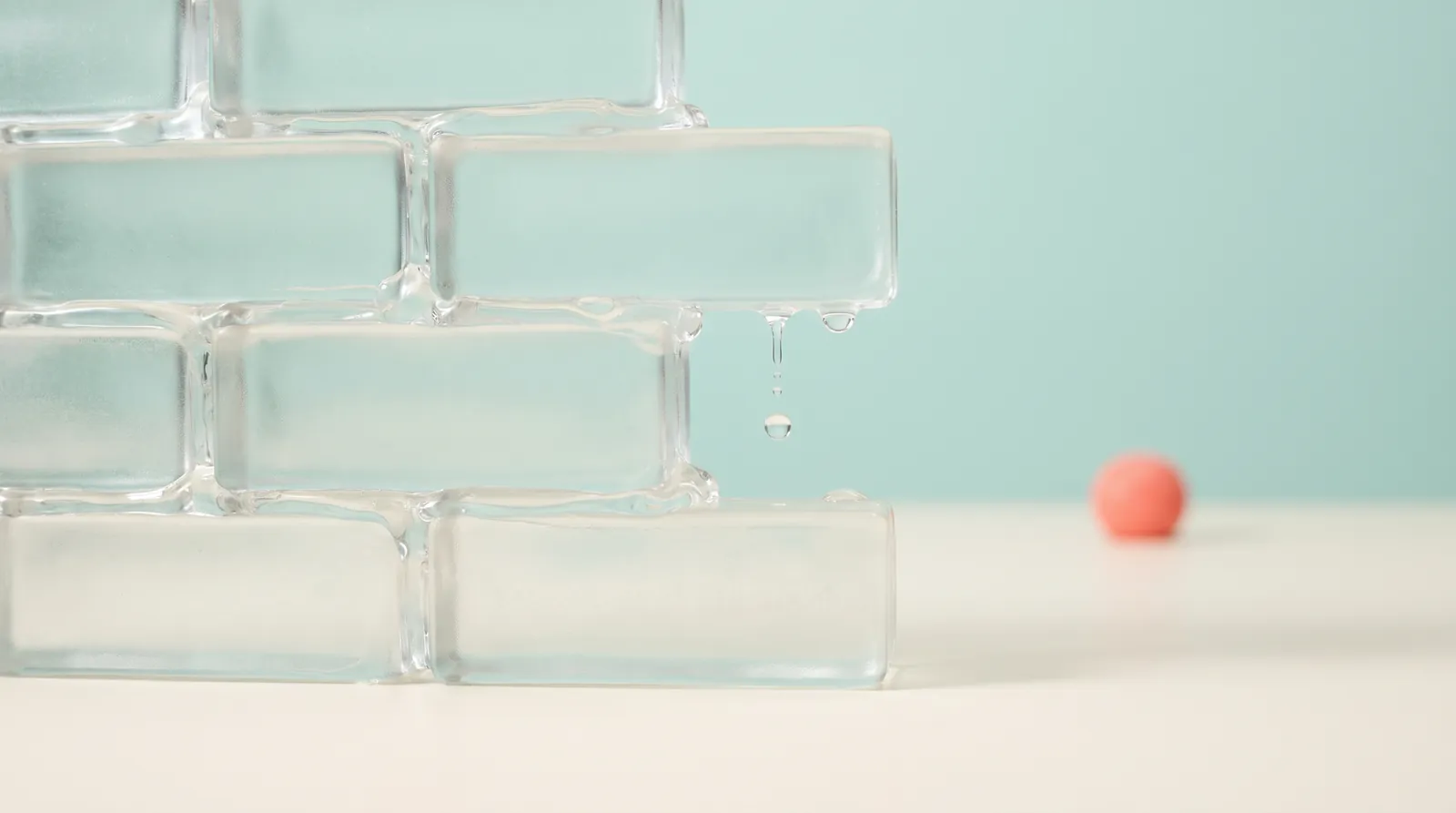
Bricks and mortar. The stratum corneum is a thin layer in which flattened dead cells (corneocytes) are held together by a fatty mortar. It is often compared to a brick wall: the cells are the bricks and the lipids between them are the mortar. According to Feingold's 2007 review, this mortar is made up of roughly 50% ceramide, 25% cholesterol and 15% free fatty acids by weight. According to Elias, the three are roughly equal by number of molecules (1:1:1), and the waterproof layers of the barrier need all three to be present together.
Moisture binders inside the bricks. Inside the corneocytes sit small water-binding molecules called natural moisturizing factor (NMF): amino acids and their derivatives, lactic acid, urea and salts. According to a 2011 study by Hoste and colleagues, a significant share of these components comes from the breakdown of a protein called filaggrin. In a 2018 study by Engebretsen and colleagues with 80 healthy adults, NMF levels in the cheeks were lower in winter than in summer.
The acid mantle. The surface of the skin is mildly acidic. In a study by Lambers and colleagues with 330 volunteers, the natural skin surface pH averaged 4.7; skin with a pH below 5 had better barrier, hydration and flaking measurements. In the study, even tap water with a pH of around 8 raised skin pH for up to 6 hours. The research was carried out in the laboratory of a consumer products company. We cover how water loss is measured and how moisturizers work in our guide to moisture loss and moisturizing.
You will find which cells build this structure, and the five layers of the epidermis, in our guide to the epidermis and the layers of the outer skin.
We explain how the acid mantle forms, what normal skin pH is and why soap upsets this balance in our guide to skin pH.
Damaged skin barrier symptoms: stinging, burning, tightness and flaking
The typical picture. According to Cleveland Clinic, a damaged barrier shows itself as dry, flaky or peeling skin, itching, rough patches, inflammation and irritation, sensitivity to touch and especially stinging when you apply products; acne and infection are on the list too. Many people first notice it as tightness that increases after washing the face.
Why does it sting and burn? The expert group of the International Forum for the Study of Itch defines sensitive skin as the appearance of uncomfortable sensations such as stinging, burning, pain, itching and tingling in response to stimuli that should not normally cause them (Misery et al., 2017). According to the definition, the skin may look normal or may be accompanied by redness; it can occur anywhere but especially affects the face. According to DermNet, irritants strip lipids and NMF from the top layer of the skin, so chemicals cross the barrier and trigger inflammation. This is why a cream that never caused trouble before can sting once the barrier weakens.
Redness can be hidden on dark skin. According to DermNet, irritation-related redness is harder to see on dark skin and dark marks are more likely to remain after healing; according to a dermatologist quoted by the AAD, retinoid irritation can also leave dark marks. If you cannot see the redness, go by stinging and tightness.
Is your barrier damaged? A six-question self-check
The questions below do not diagnose anything, but they help you find the right section.
- Have you added a new active in the last two to four weeks, or started using one more often?
- Does a plain moisturizer that used to be fine now sting?
- Do tightness and flaking increase after you wash your face?
- Did the symptoms begin one to three days after starting a new product, as an itchy rash with clear borders?
- Are there small blisters, oozing, or red bumps clustering around the mouth and nose?
- Does the redness come and go with hot drinks, alcohol, spicy food or heat?
If you answer yes to the first three and no to the last three, the most likely explanation is barrier damage from actives or cleansing. If you answer yes to any of the last three, look at the section "When it is not a barrier problem" first. According to the NHS, stinging with water or products is also among the first symptoms of rosacea; stinging alone is not distinctive.
What damages the skin barrier? Habits and conditions that weaken it
According to DermNet, irritant dermatitis develops when chemical or physical factors damage the skin faster than it can repair itself, and it often results from several small factors adding up. The following are the most common ones.
Over-exfoliation and stacked actives
The AAD notes that too much exfoliation can make the skin red and irritated. According to the Academy, some medicines and over-the-counter products can make skin more sensitive or peel it; exfoliating on top of them can increase dryness and even cause breakouts. Cleveland Clinic considers exfoliating once or twice a week enough for the face, advises using only one exfoliation method at a time and not following a chemical exfoliant with a mechanical one. According to a dermatologist at the same institution, microbead scrubs create tiny tears in the barrier; washcloth scrubbing, gritty scrubs and cleansing brushes also count as mechanical exfoliation. According to DermNet, retinoids and benzoyl peroxide can cause irritant dermatitis with long-term use; layering a retinoid, an acid toner and an exfoliating serum on the same evening adds to this load.
Harsh cleansers, long cleansing and hot water
Dr. Piliang, a dermatologist at Cleveland Clinic, compares hot water to water that melts butter on a knife: hot water takes away the skin's natural oils too. Soap also strips oils and beneficial bacteria; Piliang recommends a fragrance-free, soap-free cleanser suitable for sensitive skin. According to Piliang, massaging with a cleanser for a long time has no benefit. A short massage followed by rinsing is enough; a long massage can start to disrupt the barrier's oily layer.
Cold, dry air and heating
According to a 2016 review by Engebretsen and colleagues, low humidity and low temperature generally weaken barrier function and leave the skin more vulnerable to mechanical stress. A heated home combined with a period when you have been exfoliating more often adds the two loads together. We covered the flaking and itching that arrive with the change of season in our article on dry skin and flaking in autumn.
Some medicines
In a 2003 study by Kao and colleagues, when a strong steroid cream (0.05% clobetasol) was applied twice a day for just 3 days, barrier recovery slowed and the resilience of the stratum corneum decreased, with no visible change in the skin. According to the AAD, applying steroid medicines to the skin for a long time can also cause a rash around the mouth called perioral dermatitis. Dry skin is common during oral isotretinoin for acne and, according to the AAD, goes away when the medicine is stopped. Do not stop a prescription medicine on your own; discuss barrier symptoms with the doctor who prescribed it.
Eczema-prone skin
According to the NHS, atopic eczema is more likely in people whose mother or father has atopic eczema and in those with asthma or hay fever themselves or in the close family; soap, detergent, heat and temperature changes can make it worse. DermNet notes that people with atopic dermatitis are particularly prone to irritant dermatitis, and that people with eczema who have filaggrin deficiency also have a higher risk of allergic contact dermatitis. If you are in this group, barrier care is not a temporary rescue but a permanent habit.
How does the skin barrier heal? How long repair really takes
The barrier repairs itself; the time depends on the type and severity of the damage and on your age. Here is the picture from controlled studies:
| What was done | In whom | Result | Study |
|---|---|---|---|
| Tape stripping or acetone | Ages 20-30 | 50% recovery at 24 hours, 80% at 72 hours | Ghadially et al., 1995 |
| Same method | Over age 80 | 15% at 24 hours, with a delay over the following 6 days as well | Ghadially et al., 1995 |
| 0.5% sodium lauryl sulfate, 24 hours | 11 volunteers | Full repair at 17 days; skin hydration was the last to return to normal | Wilhelm et al., 1994 |
| 1% sodium lauryl sulfate, 24 hours | 18 volunteers, ages 30-51 | Measurements normal in 2-3 weeks; full recovery including sensitivity to irritation about 4 weeks | Lee et al., 1997 |
| Renewal of the stratum corneum | Younger and older adults | About 20 days in younger people; more than 10 days longer in older people | Grove and Kligman, 1983 |
Reading the table. Tape stripping removes the layer mechanically and recovers quickly. Chemical irritation, by contrast, comes with redness and inflammation and takes longer; the load from over-exfoliation and acids probably resembles this second model more. In Wilhelm's study, skin hydration fell to its lowest level 7 days after the irritation. So more flaking in the first days does not mean the new routine is not working.
The job is not done when the readings improve. In Lee's study, even after the instrument readings returned to normal, the previously irritated area reacted more strongly to a new irritation than healthy skin; the difference only disappeared in the fourth week. This is why we suggest a four-week window before returning to actives. Age also lengthens the time. Dr. Piliang of Cleveland Clinic, on the other hand, says that in skin that has been stressed for a long time, it usually takes three to four months to start seeing the benefit of care changes.
The barrier reset routine: how to strengthen your skin barrier in four weeks
- Day one: stop all actives. Retinoids including retinol, AHAs and BHAs, benzoyl peroxide, exfoliating toners, washcloth scrubbing, gritty scrubs and cleansing brushes all go on the shelf. If you use a prescription product, consult your doctor before pausing it.
- Cut cleansing to one step. In the evening, spread a fragrance-free, soap-free, gentle cleanser with your fingertips in lukewarm water for a short time and rinse. If your skin feels clean in the morning, lukewarm water alone may be enough. Pat dry without rubbing with the towel.
- Apply the cream on damp skin. Choose a fragrance-free cream that contains ceramide, cholesterol and fatty acid together with glycerin. According to a 2016 review by Sethi and colleagues, ingredients that stop water from evaporating show their strongest effect on slightly damp skin.
- Apply a thin layer of petrolatum to stinging and dry areas. Especially at night, over the cream. The AAD recommends a cool compress or petroleum jelly to soothe skin that reacts to a product.
- Use sunscreen every morning. Choose a broad-spectrum product. For sensitive skin, the AAD recommends sunscreens with mineral filters containing titanium dioxide or zinc oxide.
- Days 3-7: do not pick at flaking, do not switch products. Dryness may increase during this period; this is an expected course, consistent with the late dryness in Wilhelm's study.
- Week 2: note the stinging. If the plain cream has not stung at all for several days in a row, repair is on track. If stinging continues, review your makeup, fragranced products and sunscreen as well.
- Weeks 3-4: prepare for the return. Choose the first active you will bring back and start testing it on your inner forearm at the end of week four.
Choosing a barrier repair cream: ingredients with evidence
Ceramide works as a three-lipid mix, not alone. In a 1996 study by Man and colleagues, a mix containing ceramide, cholesterol and fatty acid in equal molar ratio gave normal repair; when the ratio of any one of the three was raised up to threefold, repair was faster still. According to Feingold's review, applying only one or two of these lipids, on the other hand, delayed repair in damaged skin. Most of these findings come from mice; in humans there are only preliminary data.
A small data point in eczema-prone skin. In a 2002 study by Chamlin and colleagues, the moisturizer of 24 children with persistent atopic dermatitis was replaced with a ceramide-dominant lipid mix, and 22 of them showed clear improvement within three weeks; the children were continuing their treatment and there was no control group. In his 2021 review, Elias suggests for eczema-prone skin a ceramide-dominant mix with at least 5% total lipid and a molar ratio of about 3:1:1. Because ingredient lists do not give ratios, the most realistic approach in practice is to look for a fragrance-free cream that contains all three lipids together.
Petrolatum. In a 1992 study by Ghadially and colleagues, petrolatum did not slow but sped up recovery of the barrier in human skin damaged with acetone; it settled between the cells in all layers of the stratum corneum. According to Sethi's review, petrolatum at a concentration of at least 5% reduces water loss by more than 98%.
Glycerin and hyaluronic acid. According to Sethi's review, glycerin is the most effective humectant. In two 1999 studies by Fluhr and colleagues, the barrier recovered faster on glycerin-treated sites, both after tape stripping and after repeated sodium lauryl sulfate washing. According to Sethi, humectants are usually used together with an occlusive ingredient, because in dry air they can draw water from the lower layers to the surface where it evaporates. Cleveland Clinic also lists hyaluronic acid among humectants such as glycerin and urea. The main active of Longos Moisturizing Serum is 8D Hyaluronic Acid Complex, and it is formulated for hydration and barrier support; do not add a new product while your barrier is damaged, and once stinging has passed, begin with a patch test and seal it with a cream on top. We explain why different molecule sizes are combined in our guide to 8D hyaluronic acid.
Niacinamide. In a 2000 study by Tanno and colleagues, niacinamide increased ceramide synthesis 4.1-5.5-fold in human keratinocyte cultures; applied to the skin, it reduced water loss in dry skin. The researchers worked at a cosmetics company. In a 2005 study by Draelos and colleagues, 50 women with rosacea used a moisturizer containing 2% niacinamide twice a day for 4 weeks; water loss in the treated forearm was significantly lower than in the untreated forearm. The product was a commercial moisturizer, and the facial measurements had no control group.
Panthenol. In a 2002 study by Proksch and Nissen, a cream containing dexpanthenol repaired the barrier faster than a cream without active ingredient (placebo) in skin irritated with sodium lauryl sulfate and reduced redness. It is a single small study; a cream with panthenol is a reasonable choice, but the evidence is limited.
You will find how ceramides are made, and what the label names Ceramide NP, AP and EOP mean, in our guide to ceramides.
What to pause: actives, fragrance and home devices
Actives and exfoliation. During repair, retinoids, AHAs and BHAs, benzoyl peroxide and every kind of mechanical exfoliation should wait. Dr. Chapas, a dermatologist quoted by the AAD, advises that anyone with marked redness or inflammation should avoid retinoids and discuss other options with their dermatologist for conditions such as rosacea.
Fragrance. DermNet lists fragrances among the common causes of allergic contact dermatitis. According to the AAD, even products labelled "unscented" or containing botanical ingredients can contain fragrance components.
Home skincare devices. The Longos Sense manual says the device should not be used on areas with open wounds, rashes or active lesions, or on skin with a broken surface, and that if irritation, burning or pain occurs during use you should stop and see a doctor. For this reason, while your barrier is damaged, do not use any of the device's six modes, light and cooling modes included. There is no study showing that the device repairs the barrier. Once stinging and redness have fully gone and you have tolerated the plain routine without problems for at least two weeks, start at the lowest intensity level as the manual recommends, do not hold RF and heat modes still on one spot, and do not use an active serum in the first sessions. The device is never used on the eyes or eyelids.
How to reintroduce actives
Test first, then the face. The AAD recommends applying a new product to an area the size of a coin on your inner forearm or the inside of your elbow twice a day for 7-10 days; if there is no redness, itching or swelling, you can move on to your face. According to the Academy, the irritation that retinol and glycolic acid cause in sensitive skin is normal and temporary. Stinging that increases as the days go by, however, is a sign to back off.
One active at a time. Use the first active alone for at least two weeks; if there is a reaction, this is the only way to find the cause.
Mildest formula for retinoids, every other night. Dr. Alster, a dermatologist quoted by the AAD, recommends starting with the mildest retinoid formula, using it every other night and increasing slowly; otherwise the skin becomes irritated. Use a retinoid in the evening only, and protect yourself from the sun during the day.
Acid once or twice a week. Cleveland Clinic considers exfoliating once or twice a week enough for the face. Do not put a retinoid and an acid on the same evening in the first weeks; the AAD reminds that exfoliating while using such products can increase dryness. Never exfoliate when you have sunburn, a cut or an open wound. We explain why and how to choose an acid for oily and acne-prone skin in our guide to using salicylic acid correctly.
If stinging returns, step back one level. Drop the frequency to the previous level that caused no problems. If it still stings after two step-backs, that formula is not right for you for now.
Common myths about the skin barrier
"If it stings, it is working." No. According to the definition of sensitive skin, stinging is a reaction to a stimulus that should not normally cause that sensation. The mild, brief irritation in the first days of a retinoid is not the same as stinging that increases with every application.
"The barrier heals in three days." Only partly true: in young skin, recovery 72 hours after tape stripping was 80%. After chemical irritation, full repair took between 17 days and 4 weeks; over age 80, recovery was much slower.
"Petroleum jelly suffocates the skin." In Ghadially's study, petrolatum did not slow repair but sped it up. In acne-prone skin, limiting the thick layer to dry and stinging areas is a cautious approach. If there are bumps around the mouth, avoid heavy creams.
"Oily skin has an intact barrier." Oiliness and barrier are different things. Cleveland Clinic lists adult acne among the conditions associated with a weak barrier and lists breakouts among the signs of barrier damage. You can find the causes of oiliness and how to balance it without drying the skin out in our guide to the causes and care of oily skin.
When it is not a barrier problem: contact dermatitis, rosacea, eczema and perioral dermatitis
Some conditions resemble barrier damage but need different care, and often treatment.
| Condition | Distinguishing clues | What to do |
|---|---|---|
| Irritant contact dermatitis | Limited to where the irritant touched; burning and pain stronger than itching; in severe cases swelling and blisters (DermNet) | Stop the trigger; see a dermatologist if there are blisters or oozing |
| Allergic contact dermatitis | Itchy, sharply bordered rash starting 24-72 hours after contact; fragrance and preservatives are common causes (DermNet) | Patch testing at a dermatologist |
| Rosacea | Redness that comes and goes on the nose, cheeks, forehead and chin; stinging with water and products; triggered by alcohol, spicy food, hot drinks and sun (NHS) | Doctor evaluation and treatment |
| Atopic eczema | Itchy, dry, cracked or thickened patches; eczema, asthma or hay fever in the family (NHS) | Doctor evaluation; a moisturizer alone may not be enough |
| Perioral dermatitis | Small acne-like bumps and burning around the mouth, nose and sometimes eyes; often after a steroid cream used on the face for a long time (AAD) | Stop the steroid cream (ask your doctor if it was prescribed), cut out heavy creams |
A petrolatum routine can backfire in perioral dermatitis. The Australasian College of Dermatologists lists heavy cosmetics, moisturizers and sunscreens among the factors that can trigger perioral dermatitis. According to the AAD, when a steroid cream is stopped, the rash may get worse for a while; applying it again gives only temporary relief. The AAD also notes that on dark skin the rash may look skin-colored rather than red. We have gathered other causes of redness and ways to calm sensitive skin in our guide to the causes of facial redness.
When should you see a dermatologist?
Most barrier damage heals once the trigger is removed. Do not wait in these situations:
- If there are blisters, oozing, crusting, pus-filled bumps, swelling or increased warmth, especially if you also have a fever; the NHS lists these as signs of infection in eczema-affected skin.
- If the redness comes with eye pain, blurred vision or light sensitivity; the NHS recommends urgent care for these symptoms in rosacea.
- If the reaction is severe and a cool compress or petroleum jelly does not relieve it (AAD).
- If you are using a steroid cream on your face, or the rash gets worse when you stop it.
- If you suspect an allergy to a product; patch testing may be needed.
- If there is no clear improvement within four weeks despite a plain routine. This is a practical threshold based on the recovery times in irritation studies, not a rule.
Where to start this week
This evening, cut your routine down to three products: a gentle cleanser, a fragrance-free barrier cream and sunscreen in the morning. Write down every product you set aside and the date; in four weeks you will bring them back one by one, with a 7-10 day test on the inner forearm.
If you want to track the change under the same conditions rather than by guesswork, run the AI skin analysis in the Longos app once this evening on clean skin with no products, and repeat it in the same light at the end of week four. Redness is one of the five appearance parameters the analysis scores from 0 to 100; this is appearance tracking, not a diagnosis. This article is a care guide and does not replace medical advice.
Frequently Asked Questions
What are the symptoms of a damaged skin barrier?
The most typical sign is a cream you used without trouble suddenly starting to sting. Cleveland Clinic lists dry, flaky or peeling skin, itching, rough patches, irritation, sensitivity to touch and especially stinging when you apply products among the signs of a damaged barrier; acne and infection are on the list too. Many people first notice it as tightness that gets worse after washing the face. Redness can be harder to see on darker skin, so stinging and tightness are the more reliable signs.
How does a damaged skin barrier heal, and how long does it take?
The barrier repairs itself once the trigger is removed, but the time depends on the type of damage and on age. In people aged 20-30, after tape stripping the barrier recovered about 50% in 24 hours and 80% in 72 hours; in people over 80 it was much slower. After irritation with sodium lauryl sulfate, full repair took 17 days in one study, and in another the hypersensitivity to irritation only disappeared in the fourth week. That is why waiting about four weeks before returning to actives makes sense.
What should you look for in a barrier repair cream?
Look for a fragrance-free cream that contains ceramide together with cholesterol and fatty acids and carries a humectant such as glycerin. In animal studies, applying only one or two of these three lipids delayed repair, while a balanced mix of all three gave normal or faster repair. Petrolatum sped up barrier recovery in human skin and can be applied thinly to dry areas at night. For niacinamide and panthenol there are promising but small studies. Because ingredient lists do not give the lipid ratio, a simple formula containing the three-lipid mix is the most realistic choice.
Why does skin feel sensitive and burn?
The International Forum for the Study of Itch defines sensitive skin as the appearance of stinging, burning, pain, itching and tingling in response to stimuli that should not normally cause these sensations. When the barrier is damaged, irritants strip lipids and natural moisturizing factor from the top layer of the skin and get in more easily. The most common causes are over-exfoliation, stacking retinoids and acids, harsh cleansers, hot water and dry air. Rosacea, contact dermatitis and eczema can cause a similar burning.
Can you use retinol and exfoliating acids with a damaged skin barrier?
No. While the barrier repairs, pause retinoids, AHAs and BHAs, benzoyl peroxide and mechanical exfoliation; if a product is prescribed, talk to your doctor first. After about four weeks, choose one active at a time and test it on your inner forearm twice a day for 7-10 days. Start a retinoid with the mildest formula every other day, limit acid to once or twice a week for the face, and do not put the two in the same evening in the first weeks. If stinging comes back, cut the frequency by one step.
When should you see a dermatologist for sensitive, red skin?
Do not wait if there are blisters, oozing, crusting, pus-filled bumps, swelling or fever; these can be signs of infection. If redness comes with eye pain, blurred vision or light sensitivity, seek care urgently. See a dermatologist if you are using a steroid cream on your face, if small bumps have appeared around the mouth, if you suspect an allergy to a product, or if there is no clear improvement in four weeks despite a plain routine. Redness that comes and goes with heat, alcohol or spicy food may be rosacea.
Clinical evidence

