
Sebum
What Is Sebum and What Does It Do? Sebaceous Glands, Sebum Composition and Sebum Balance
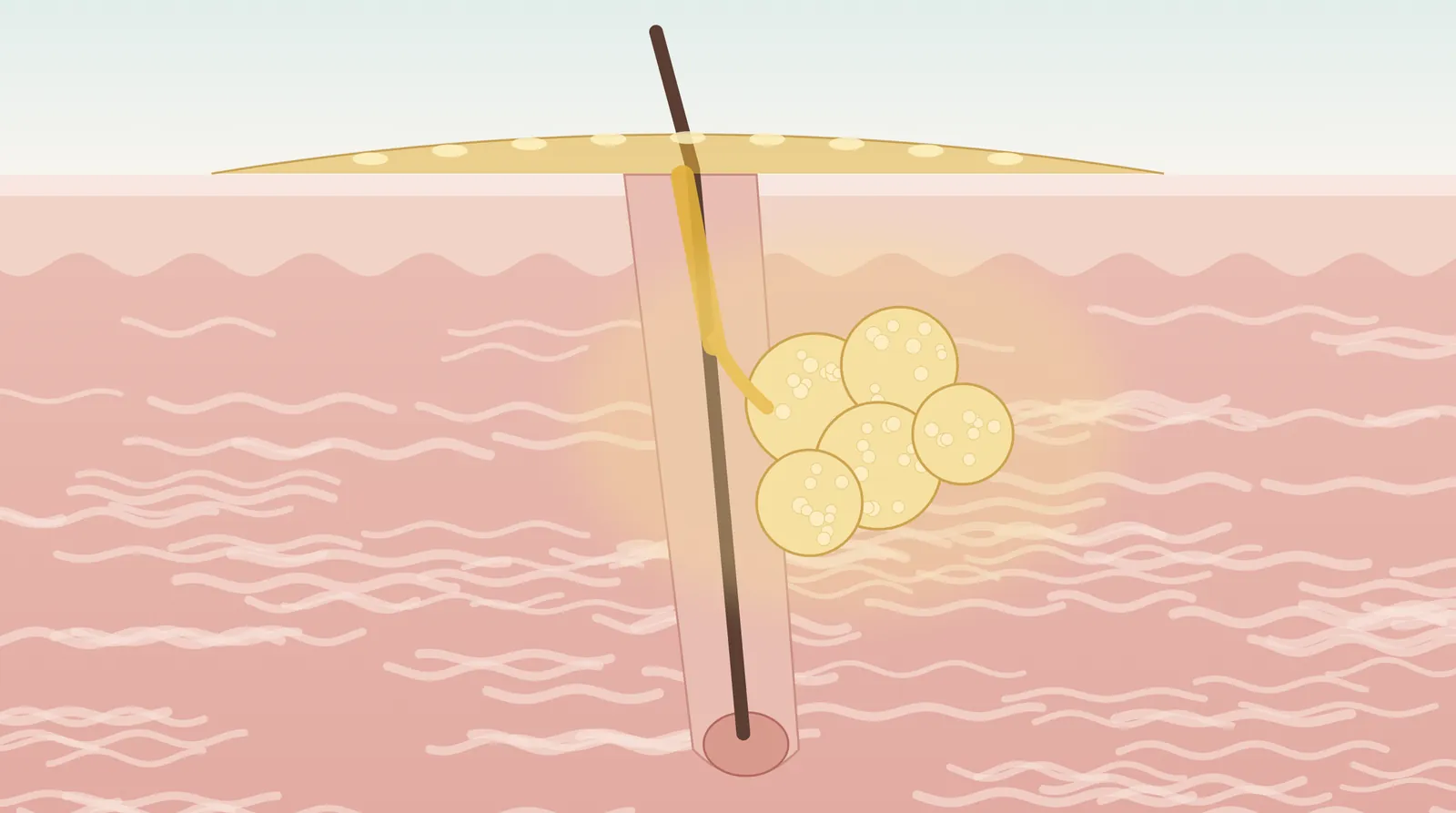
What is sebum? The short answer
Sebum is an oily mixture produced in the skin by the oil glands, known as sebaceous glands, that coats the surface of the skin and hair in a thin film. Its main components are triglycerides and free fatty acids, wax esters, squalene, cholesterol and cholesterol esters. According to NCBI StatPearls, the sebaceous glands supply 90% of the lipids on the skin surface; sebum lubricates the skin, limits moisture loss and contributes to the defense against environmental factors.
The sebaceous gland delivers its product by breaking down its own cells; this type of secretion is called holocrine secretion. Oily skin, on the other hand, is not a disease but glands secreting more sebum than average; its medical name is seborrhea.
In brief
- Location: sebaceous glands sit in the dermis, mostly attached to a hair follicle; there are none at all on the palms and soles.
- Secretion: the cell fills with lipids, breaks apart and releases its contents into the hair canal; the process takes about a week.
- Composition: triglycerides lead; squalene and wax esters are unique to sebum.
- Control: mainly androgens, especially dihydrotestosterone (DHT); age, temperature and season also change the amount.
- Care: products manage surface oil and appearance; the strongest suppressor of the gland's output is oral isotretinoin, monitored by a doctor.
Where are sebaceous glands found and how do they secrete sebum?
A gland beside the hair follicle. According to StatPearls, sebaceous glands sit in the mid-dermis and almost always develop together with a hair follicle; their ducts open into the hair canal. This pairing of hair follicle and sebaceous gland is called the pilosebaceous unit. You can read more about the layer the gland sits in in our guide to the layers of the dermis and the structures inside it.
Where they are densest. According to a 2008 review by Smith and Thiboutot, sebaceous glands are found all over the body except the palms and soles, and on facial skin they can reach 400-900 per square centimeter. According to a 2017 review by Endly and Miller, they are densest behind the ears, on the face, the upper chest and the back; this distribution matches the areas where acne appears.
Glands not attached to hair. According to Endly and Miller, some sebaceous glands open directly onto the skin or a mucosal surface: Fordyce granules on the red part of the lips, meibomian glands in the eyelids, Montgomery tubercles on the areola and Tyson glands in the genital area. According to StatPearls, meibomian glands improve the lubricating quality of tears.
Holocrine secretion step by step. The process described by StatPearls and by Smith and Thiboutot can be summarized in four stages:
- At the outer edge of the gland, small, flat young cells that contain no lipids (sebocytes) multiply.
- As the cells move toward the center, they mature; the lipid-producing smooth endoplasmic reticulum expands and the cytoplasm fills with lipid droplets.
- At the center, mature cells undergo programmed death and break apart.
- The cell debris and lipids combine to form sebum, which empties into the hair canal.
According to StatPearls, the time from lipid production to release is about a week, and sebum mostly reaches the surface from the hair canal along the hair shaft through a wicking effect. The gland becomes distinct in the fetus at weeks 13-15; sebum is the first glandular secretion the body produces. The number of glands stays roughly constant throughout life, while their size increases, especially at puberty.
What is sebum made of? Triglycerides, wax esters and squalene

Sebum is made of nonpolar lipids that do not mix with water. The proportions vary slightly from one publication to another because the timing of the sample matters: according to DermNet, the triglycerides produced in the gland are broken down into free fatty acids by lipase enzymes from bacteria in the hair canal. The later a sample is collected, the less triglyceride and the more free fatty acid it contains.
| Lipid class | Picardo et al., 2009 | Pappas, 2009: mean (range) |
|---|---|---|
| Triglycerides and free fatty acids | 57.5% | 45% (20-60%) and 10% (5-40%) |
| Wax esters | 26% | 25% (23-29%) |
| Squalene | 12% | 12% (10-14%) |
| Cholesterol and cholesterol esters | 4.5% | 4% (1-5%) |
| Diglycerides | Not given separately | 2% (1-2%) |
Picardo's proportions are based on a measurement from 1970; Pappas compiles frequently cited values and writes from the skin research center of a consumer products company.
Two components unique to sebum. According to a 2009 review by Picardo and colleagues, squalene and wax esters are found nowhere else in the body, and not in surface lipids of epidermal origin either. Squalene is normally an intermediate step in cholesterol synthesis, and other tissues quickly convert it to cholesterol; in the sebaceous gland this conversion stops and squalene accumulates. According to Pappas, cholesterol makes up less than 2% of sebaceous gland lipids but 30-35% of epidermal lipids.
Sapienic acid. According to Picardo, the enzyme delta-6 desaturase in the gland converts palmitic acid into sapienic acid (16:1, Δ6). This fatty acid is unique to human sebum, makes up about 25% of total fatty acids and, according to Smith and Thiboutot, is absent from the sebum of other hairy mammals.
The surface lipid film. In areas rich in sebaceous glands, most of the surface oil is sebum: according to Pappas, 150-300 micrograms of sebum per square centimeter can be collected from the forehead, compared with 5-10 micrograms of lipid of epidermal origin. The mortar between the cells of the epidermis is a completely different mixture: ceramides, cholesterol and free fatty acids.
Sebum is not the same as the mortar between the cells of the stratum corneum; we describe the main lipid of that mortar in our guide to ceramides.
What does sebum do? Water loss, microbes and vitamin E
Smith and Thiboutot write that the exact role of sebum in humans is still not fully understood. Even so, three functions stand out.
It limits water loss and keeps skin soft
According to DermNet, sebum reduces water loss from the skin surface. According to Pappas, wax esters are more resistant to oxidation and heat than triglycerides and, like waxes in nature, preserve the moisture of the tissue.
In mouse studies cited by Smith and Thiboutot, the stratum corneum of mice without developed sebaceous glands (asebia mice) was markedly drier. Applying sebum-like lipids did not correct this, but applying glycerol did; glycerol is released when triglycerides are broken down in the gland's duct.
Fatty acids against microbes
According to DermNet, sebum protects the skin against bacteria and fungi. In a 2003 laboratory study by Wille and Kydonieus, lipids obtained from human sebum reduced the growth of gram-positive bacteria, including Staphylococcus aureus, by 10,000 to 100,000 times, but had no effect on most gram-negative bacteria. The most effective single component was sapienic acid: in pure form it stopped gram-positive bacteria at 10-20 micrograms per milliliter.
These data come from culture dishes, not from living skin. We cover the acidic nature of the skin surface and its relationship with bacteria in our guide to skin pH and the acid mantle.
It delivers vitamin E to the skin
In a 1999 study by Thiele and colleagues, the level of alpha-tocopherol (vitamin E) in the upper layers of the stratum corneum on the cheeks of eight volunteers was 20 times that on the upper arm. Vitamin E was secreted continuously together with sebum, and its level closely tracked squalene. According to the authors, this route may help protect surface lipids and the stratum corneum from oxidation.
What controls sebum production? Androgens, DHT and the androgen receptor
Androgens are the master switch. According to Smith and Thiboutot, most circulating androgens come from the ovaries or testes and the adrenal glands; some are also made locally inside the sebaceous gland. Free testosterone that enters the cell is converted to DHT by the enzyme 5-alpha-reductase. DHT acts on the androgen receptor about 5-10 times more potently than testosterone; once bound to the receptor, it moves into the nucleus and switches on genes that increase cell proliferation and lipid production.
Clinical evidence. According to the same review, people whose androgen receptor does not work, meaning they are completely insensitive to androgens, produce no sebum. According to StatPearls, type 1 5-alpha-reductase, which converts testosterone to DHT, is particularly abundant in the sebaceous glands of the face and scalp.
Gland sensitivity. According to Smith and Thiboutot, the activity of the enzymes that process androgens is higher in glands on the face, chest and back than in areas not prone to acne, even after adjusting for gland size. We explain the role of this sensitivity in adult acne in our guide to the causes and care of hormonal acne.
Estrogen, progesterone and genes. According to Smith and Thiboutot, estrogens suppress sebum. According to DermNet, the role of progesterone is unclear: women produce more sebum in the premenstrual week, when progesterone is high, yet progesterone also inhibits 5-alpha-reductase. In a study of 40 pairs of adolescent twins with acne, cited by Picardo, sebum secretion rates were very close in identical twins but differed in non-identical twins.
Sebum by age: from newborns to puberty and menopause

Sebum rises twice over a lifetime and declines in later years. Sources differ on some age boundaries.
| Stage | What does sebum do? | Source |
|---|---|---|
| First week after birth | Increases a few hours after birth and peaks in the first week | StatPearls |
| Infancy and childhood | Falls; for the first 3-6 months its composition resembles that of adults, then until age 8 it contains fewer wax esters and less squalene | StatPearls, DermNet |
| Adrenarche and puberty | Rises again at about age 9 and keeps increasing until age 18; in males it can rise up to fivefold | StatPearls, DermNet |
| Adulthood | Does not change markedly until later life; men produce slightly more than women | Pochi et al., 1979; DermNet |
| Women after menopause | Gradually declines and changes little after age 70 | Pochi et al., 1979 |
| Men in later life | According to Pochi, changes little until age 80; according to Endly and Miller, the decline begins in the 60s and 70s | Pochi et al., 1979; Endly and Miller, 2017 |
Why do glands grow with age? According to Pochi and colleagues, while surface oil decreases with age, the glands paradoxically grow larger because cell turnover slows down. The most likely explanation for the decline is the body's falling androgen production. According to StatPearls, the benign condition formed by glands that enlarge with age is called sebaceous hyperplasia.
Too little sebum. According to Endly and Miller, average sebum production in adults is about 1 milligram per 10 square centimeters every three hours; below 0.5 milligrams, skin dryness (xerosis) appears, and above 1.5 milligrams, excessive oiliness. The fall in sebum after menopause can bring the skin closer to this lower limit.
How much do temperature, season and diet change sebum?
Temperature. In a 1970 study by Cunliffe and colleagues, the forehead skin of nine people was heated and cooled; the sebum secretion rate changed by about 10% for every 1°C change. The authors note that this may come less from production in the gland than from heat changing the fluidity of sebum and how easily it passes onto the collection paper. Looking shinier on a hot day may not mean your glands have suddenly sped up.
Season. In 2005, Youn and colleagues measured sebum at five points on the faces of 46 Korean women aged 21-37 in every season over one year. Sebum on the forehead, nose and chin (the T-zone) was significantly higher than on the cheeks. Summer was the only season in which sebum was significantly higher than in the other seasons; in summer, 71.7% of participants fell into the combination skin category. Combination skin is therefore not a fixed type but a state that changes with the season.
Diet: the data are small. In a 2012 randomized study by Kwon and colleagues of 32 people with mild to moderate acne, those who switched to a low glycemic load diet had fewer pimples after 10 weeks; in skin samples, the sebaceous glands shrank and SREBP-1, a protein that controls lipid production, decreased. The same paper also notes that another study lasting 8 weeks found no significant change in acne severity. According to DermNet, prolonged fasting reduces sebum; according to Picardo, however, the link between diet and acne is still debated.
Excess sebum and acne: C. acnes, squalene oxidation and seborrheic dermatitis
No sebum, no acne. According to Smith and Thiboutot, acne is the combination of four processes: sebum production by the sebaceous gland, colonization of the hair follicle by the bacterium Cutibacterium acnes (formerly Propionibacterium acnes), excessive keratinization in the upper part of the hair canal and the release of inflammatory substances. According to the review, sebum is this bacterium's food source and acne cannot develop without sebum. According to Picardo, people with acne secrete more sebum on average, and the secretion rate is in line with acne severity.
Squalene breaks down in light. According to Picardo, about 60% of squalene is broken down in human skin exposed to UV radiation. Oxidized squalene (squalene peroxide) produced comedones, that is, pore plugs, in rabbit ear experiments and increased the release of inflammatory substances from keratinocytes in the laboratory. More squalene peroxide and less vitamin E were measured in the sebum of people with acne. Whether sebum oxidizes matters as much as how much of it there is.
Not every dot is a plug. According to Cleveland Clinic, sebaceous filaments, which are especially visible on the nose, are fine structures that carry sebum to the surface; they contain no plug and are a normal part of the skin. We explain how to tell them apart from open comedones in our guide to the causes of blackheads and the risks of squeezing them.
Seborrheic dermatitis. According to the American Academy of Dermatology (AAD), seborrheic dermatitis is a common skin condition that causes a scaly rash on oily areas such as the scalp and face. It can also appear on the eyebrows, the ears, the beard area and around the sides of the nose. According to Smith and Thiboutot, excessive oiliness can set the stage for seborrheic dermatitis. Diagnosis and treatment are a dermatologist's job.
You can read how squalene oxidises, and about the free radicals that start this chain reaction, in our guide to free radicals.
How is sebum measured? Photometric strips, blotting paper and oil-sensitive film
According to the EEMCO group's 2000 guidance, surface sebum can be collected by washing with solvents, cigarette paper pads, photometric measurement, bentonite clay and oil-sensitive tapes. Two of the measures the guidance defines are the amount of oil on the surface of untouched skin (the casual level) and the oil that builds up on a cleansed area over a set time (the secretion rate).
Photometric measurement. According to a 2011 review by Wójcik and colleagues, one common method presses a thin film onto the skin and measures the oil collected on it photometrically, that is, with light. In Youn's study, the plastic strip was held with 10 newtons of pressure for 30 seconds, and participants did not wash their faces for 2 hours before the measurement.
Oil-sensitive film. According to Wójcik, these films turn transparent at the spots where they absorb oil. In a 1991 study by Serup of 24 acne-prone volunteers, an adhesive film that absorbs oil agreed with photometric measurement, but in some people it showed more sebum than was actually there and its reproducibility was lower.
The invisible reservoir. In a 1982 study by Downing and colleagues, sebum was collected from the foreheads of three people every three hours for 24 hours; the amount fell over the first 12 hours and then leveled off. The sebum stored in the stratum corneum and the hair canals averaged 213 micrograms per square centimeter, while the gland's ongoing secretion rate was 25 micrograms per hour. According to EEMCO, skin temperature, humidity and surface roughness also affect the result. Blotting paper at home gives you an idea of shine; it does not tell you how fast your glands work.
How much can skincare change sebum? Cleansing, niacinamide, salicylic acid, retinoids and zinc
According to Smith and Thiboutot, apart from oral isotretinoin and systemic antiandrogens, few medicines effectively suppress sebum production; products applied to the skin mostly manage surface oil and the appearance of pores. You can find a step-by-step morning and evening routine in our guide to the causes of an oily face and the care that works.
Cleansing without drying. For oily skin, the AAD recommends washing your face no more than twice a day and after sweating, with a gentle, foaming cleanser and without scrubbing; harsh cleansers can irritate the skin and trigger more oiliness. In a small randomized 2006 study by Choi and colleagues, men with acne washed their faces once, twice or four times a day for six weeks; there was no significant difference between the groups, but inflamed lesions increased in those who washed once a day.
Niacinamide. In the first of two studies published by Draelos and colleagues in 2006, 100 people in Japan used a moisturizer with 2% niacinamide or one without the active ingredient for four weeks; in the niacinamide group, the sebum secretion rate fell significantly at weeks two and four. In a split-face study of 30 people in the US, surface oil decreased after six weeks, while the secretion rate did not change.
Salicylic acid. In a 2019 laboratory study by Lu and colleagues, salicylic acid reduced lipid production in a human sebocyte cell line by suppressing the AMPK/SREBP-1 pathway, and it eased inflammation. This is not a study that measured sebum in humans. The AAD states that salicylic, glycolic and lactic acid can reduce oiliness, and that you should use them less often if irritation occurs. You can read how this oil-soluble acid works inside the pore in our guide to what salicylic acid does and how to use it correctly.
Retinoids. According to Endly and Miller, retinoids markedly reduce sebocyte proliferation and sebum production in the laboratory; however, there is no direct evidence that topical retinoids reduce sebum in living skin. In one cited study, pores became smaller in 42% of people using tazarotene over 24 weeks; in the placebo group, the rate was 20%.
Zinc. According to a 2020 meta-analysis by Yee and colleagues, zinc treatment significantly reduced the number of inflamed papules. These studies measured acne, not sebum.
Choosing a serum. Longos Pore Minimizer Serum is formulated with Epilobium and plant extracts for pore appearance and oil balance; apply it in a thin layer after cleansing and before moisturizer.
Blue light and isotretinoin: options that target the bacteria and the gland itself
Blue light targets the bacteria. According to a 2008 review by Gold, as C. acnes multiplies in the hair follicle, it produces light-sensitive porphyrins, especially coproporphyrin III and protoporphyrin IX. The main absorption peak of these porphyrins is at 415 nm (the Soret band); porphyrin that absorbs the light generates singlet oxygen inside the bacterium. In a 2003 laboratory study by Ashkenazi and colleagues, blue light at 407-420 nm reduced the viability of C. acnes cultures 10,000-fold over two applications 24 hours apart.
The level of evidence in humans. A 2016 Cochrane review by Barbaric and colleagues examined 71 randomized studies with a total of 4,211 participants. Most of the studies were small (a median of 31 people); the authors noted that larger, well-designed studies of light therapies are needed. Blue light targets not the sebaceous gland itself but the bacteria in the hair follicle; it is therefore an approach aimed at the appearance of acne-prone skin, not at the amount of sebum.
The blue 415 nm mode according to the manual. The Quantum Dot Light technology in Longos Sense delivers blue light at 415 nm; the device's user manual (version 1.2) defines this mode as a cosmetic use "to improve the appearance of acne-prone skin". According to the manual, the mode is used on cleansed skin, only on the face and neck, no more than three times a day and for 5-10 minutes per area; it is not used over the eyes or eyelids. The device is not used if there are active lesions, open wounds or a rash in the application area, during pregnancy and breastfeeding, or under the age of 18; if you take a medicine that causes light sensitivity, consult your doctor first.
Isotretinoin shrinks the gland. In a 1982 study by Goldstein and colleagues, seven men with severe acne were given 1 mg of oral isotretinoin per kilogram of body weight per day for 16 weeks; sebum production fell by 88.4%, biopsies showed markedly smaller sebaceous glands, and gland activity partly returned by week 32. According to Endly and Miller, common side effects are dry skin, chapped lips and dry eyes; because the drug carries a risk of severe harm to an unborn baby, contraception is mandatory. Isotretinoin, like the birth control pills and spironolactone that can reduce sebum in women, is started only after a doctor's assessment.
Common myths about sebum
"Oily skin doesn't need moisturizer." The oil on the surface and the water content of the stratum corneum are not the same thing. According to the AAD, using a moisturizer is important to keep oily skin hydrated too; it recommends products labeled oil-free and non-comedogenic (they do not clog pores). In asebia mice, too, what hydrated the skin was not the oil itself but the glycerol released from triglycerides.
"The more often I wash, the less oily I get." Washing removes surface oil; it does not stop the gland's output. Downing's measurements show that sebum amounting to many times the hourly secretion builds up in the hair canals; the cleansed surface becomes oily again from this reservoir.
"Washing hair often makes it greasy faster." In a 2021 study by Punyani and colleagues, 60 people first did not wash their hair at all for one week and then washed it every day for four weeks. With daily washing, there were fewer surface lipids on the scalp and less sebum on the hair strands, and no measurable damage to the hair was seen. The participants were Asian with straight hair; a consumer products company funded the study, and some of the authors were employees of that company.
"The right diet clears oily skin completely." According to the AAD, the findings on a low glycemic diet come from small studies, and the data on milk relate to acne, not sebum. In a US study of 47,355 women, those who drank two or more glasses of skim milk a day were 44% more likely to have acne; yogurt and cheese were not shown to increase breakouts.
When should you see a dermatologist?
The AAD recommends working with a dermatologist if you are worried about how much oil your skin produces or are struggling to manage blackheads and breakouts. Do not wait in these situations:
- Oiliness comes with inflamed, painful, deep pimples or lesions that leave marks.
- You have scaly, itchy patches on your eyebrows, around the sides of your nose, on your scalp or in the beard area; the AAD recommends treating seborrheic dermatitis as early as possible.
- Oiliness and breakouts started suddenly in adulthood and come with other hormonal signs. Endly and Miller list conditions that cause androgen excess among the causes of excessive oiliness.
- A new, growing bump has appeared on your facial skin. According to StatPearls, benign sebaceous hyperplasia can resemble basal cell carcinoma.
- You have a swelling on your eyelid that does not go away or keeps growing. According to Smith and Thiboutot, the more common type of the very rare sebaceous carcinoma appears around the eyes.
Where to start this week
This week, track your oiliness under the same conditions instead of guessing: wash your face with a gentle cleanser in the morning, wait two hours without applying any products, and compare your T-zone and cheeks in the same light. Stop washing more than twice a day, use an oil-free moisturizer, choose a single active and assess after four to six weeks; the changes in the Draelos studies were also measured over these periods.
If you would like to track it with a score, run the AI skin analysis in the Longos app once this evening on clean, product-free skin; pore appearance and breakouts/spots are among the appearance parameters the app scores. The score is not a diagnosis but a way to track your cosmetic appearance; repeat it in the same light a few weeks later. This is a skincare guide, not medical advice.
Frequently Asked Questions
What is sebum and what does it do?
Sebum is an oily mixture made by the sebaceous glands of the skin, most of which are attached to hair follicles. Its main components are triglycerides and free fatty acids, wax esters, squalene and small amounts of cholesterol and its esters; squalene and wax esters are unique to sebum. The gland releases sebum by breaking down its own cells, which is called holocrine secretion. Sebum reduces water loss from the skin surface, contributes to the defense against some bacteria through fatty acids such as sapienic acid, and delivers vitamin E to the skin. According to NCBI StatPearls, 90% of the lipids on the skin surface come from the sebaceous glands.
Why is too much sebum produced?
Sebum production is controlled mainly by androgen hormones. In the sebaceous gland, testosterone is converted by the enzyme 5-alpha-reductase into the more potent dihydrotestosterone (DHT); DHT binds to the androgen receptor and increases both the multiplication of gland cells and lipid production. This is why sebum rises markedly at puberty. Genetic predisposition, the gland's sensitivity to hormones, hot weather and the summer season also increase surface oil. If oiliness and breakouts start suddenly in adulthood and come with other hormonal signs, you should see a dermatologist.
What is sebum balance and how do you maintain it?
Sebum balance is an everyday expression for skin producing enough oil to avoid both dryness and excessive shine. According to one review, average production in adults is about 1 milligram per 10 square centimeters every three hours; below 0.5 milligrams counts as dryness and above 1.5 milligrams as excessive oiliness. To maintain the balance, it is recommended to wash your face no more than twice a day with a gentle cleanser, use an oil-free moisturizer and avoid drying your skin out with harsh products. Medicines that strongly reduce the gland's output are used only after a doctor's assessment.
Why does sebum build up in hair, and why does hair get greasy so quickly?
The scalp is one of the areas densest in sebaceous glands, and the glands there are rich in the enzyme that converts testosterone into DHT. Sebum empties into the hair follicle and spreads along the hair shaft, coating the strands. In a 2021 study funded by a consumer products company, washing the hair every day reduced sebum on the scalp and on the hair strands compared with not washing it at all for a week, and caused no measurable damage to the hair. If your scalp is itchy, flaky and red, see a dermatologist to check for seborrheic dermatitis.
Should oily skin use a moisturizer?
Yes. The oil on the surface and the amount of water in the skin's outer layer are not the same thing. The American Academy of Dermatology states that using a moisturizer is important to keep oily skin hydrated too, and recommends products labeled oil-free and non-comedogenic (they do not clog pores); for daytime, a broad-spectrum moisturizer with SPF 30 or higher is a practical option. Mouse studies showed that what keeps the skin hydrated is not the oil itself but glycerol, which is released when the triglycerides in sebum are broken down.
Does washing your face often reduce sebum?
No. Washing removes surface oil but does not stop the gland's output; sebum amounting to many times the hourly secretion accumulates in the hair follicles and the skin's outer layer, and the cleansed surface becomes oily again. In a small randomized study of men with acne, washing four times a day gave no better results than washing twice a day; in those who washed once a day, inflamed pimples increased. The American Academy of Dermatology recommends washing your face no more than twice a day and after sweating, with a gentle cleanser and without scrubbing.
Clinical evidence

