collagen
What Is Elastin and What Does It Do? Elastic Fibres, the Difference From Collagen and How to Protect Skin Elasticity
What is elastin? The short answer
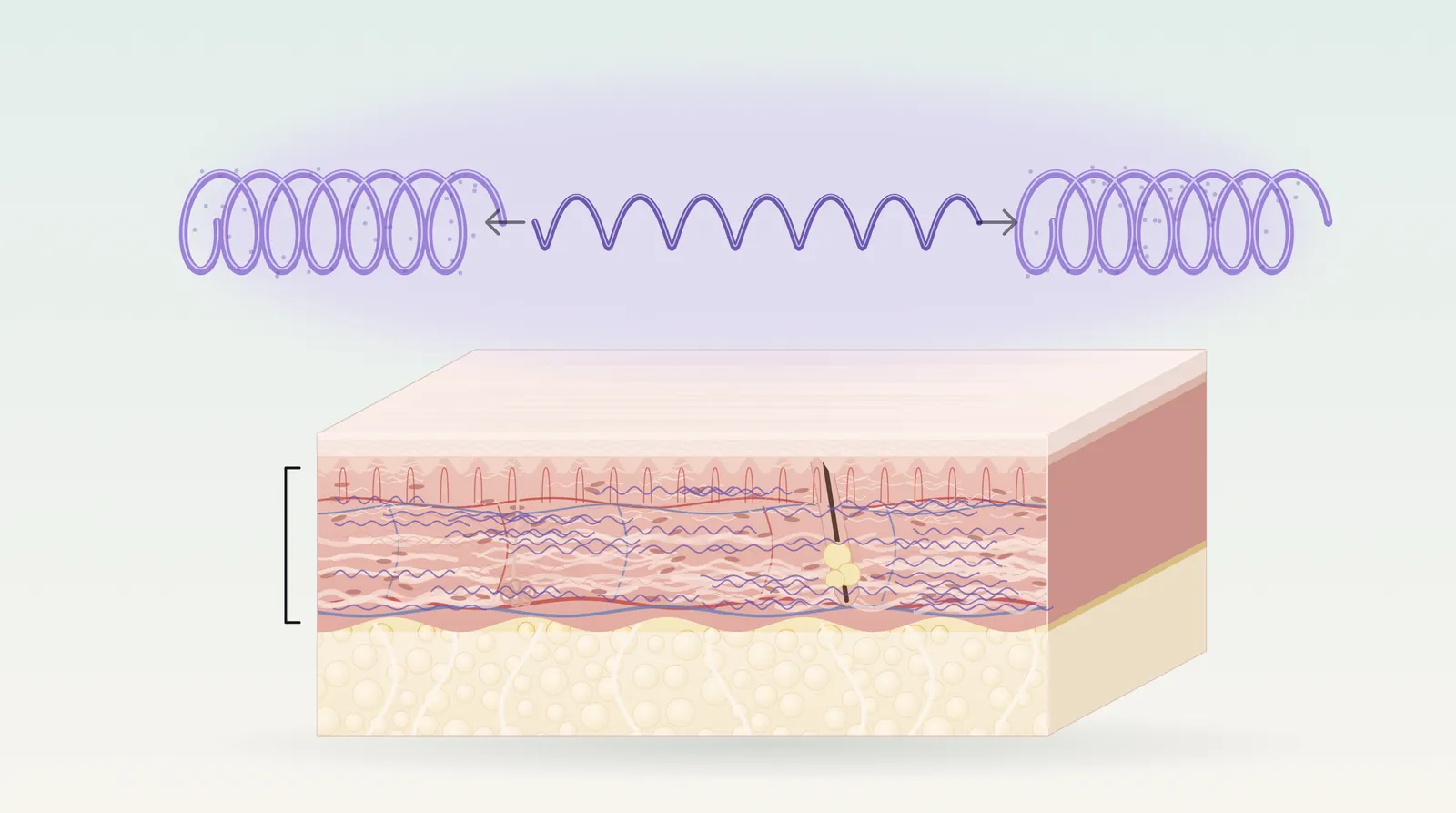
Elastin is a structural protein that gives skin, the lungs and large arteries the ability to stretch and return to their original shape. It forms the core of the structures known as elastic fibres: according to a 2021 review by Ozsvar and colleagues, about 90% of an elastic fibre is elastin, and the rest is mostly glycoproteins called fibrillins. In everyday and medical English alike, the protein is simply called elastin, and its fibres are called elastic fibres.
In skin, elastin sits in the dermis, the connective tissue layer beneath the epidermis; we cover this layer in our guide to the sublayers of the dermis and the structures inside it. According to NCBI StatPearls, what sets elastin apart from collagen is that its fibres can slide, lengthen and gather back together. These are the fibres that return stretched skin to its original shape.
In brief
- Elastin forms when a soluble precursor called tropoelastin is cross-linked by the enzyme lysyl oxidase; these elastin-specific cross-links are called desmosine and isodesmosine.
- The dermis has three families of elastic fibres: oxytalan near the surface, elaunin in the middle and mature elastic fibres deeper down.
- Elastin is mostly produced around birth and in childhood; its estimated half-life is about 70 years.
- The sun disrupts the elastic network and leaves a non-functional mass in its place: solar elastosis.
- Sunscreen slows this damage; hydrolysed elastin in a cream, by contrast, adds no elastin to the skin and holds moisture at the surface.
How is elastin made? Tropoelastin, lysyl oxidase and desmosine
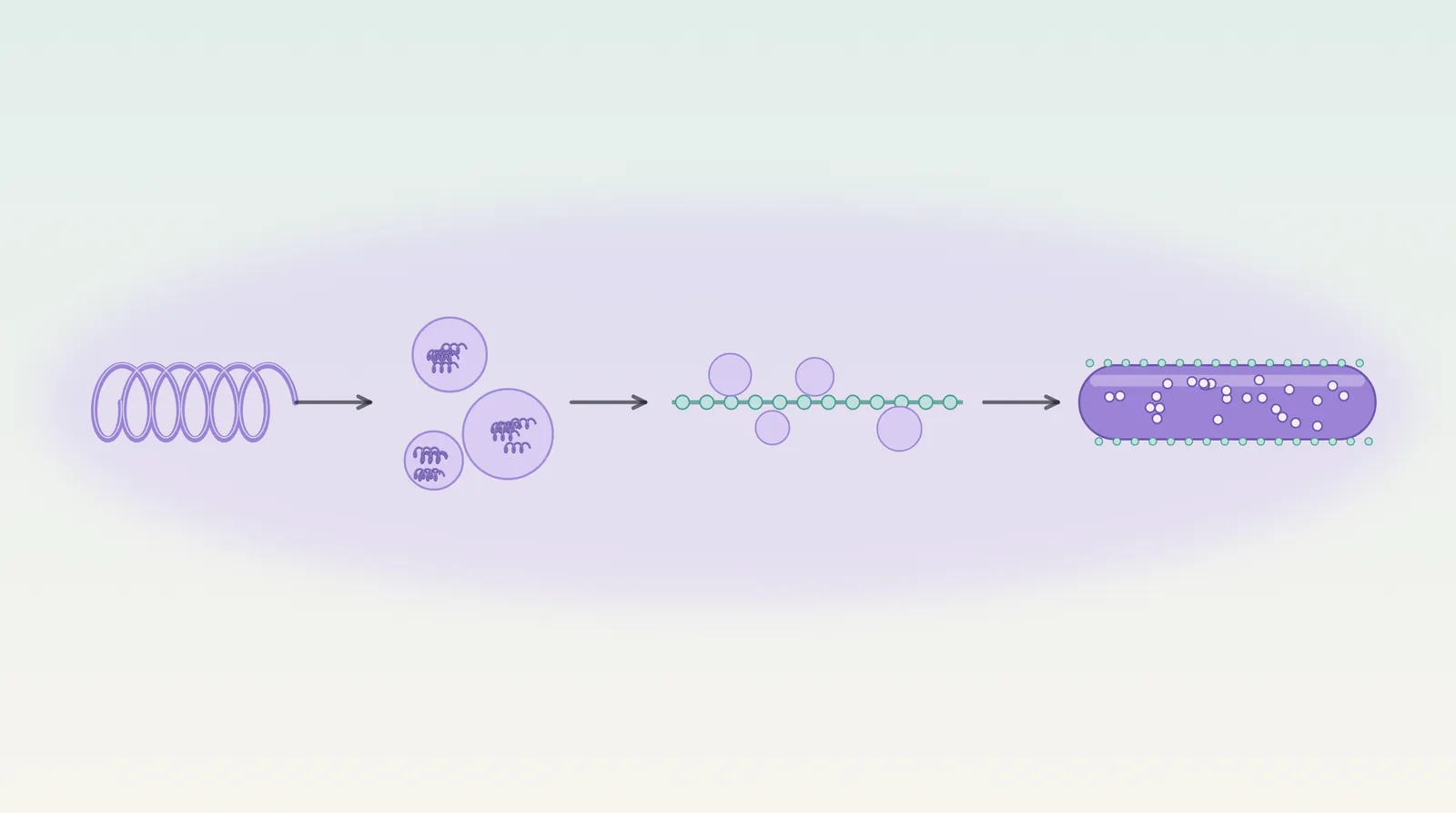
The precursor molecule: tropoelastin. The building block of elastin is tropoelastin. According to Ozsvar's review, it is a water-soluble protein of about 60-70 kilodaltons, encoded in humans by the ELN gene on the long arm of chromosome 7 (7q11.2). The molecule behaves like a spring: before cross-linking, a single tropoelastin can stretch to eight times its resting length.
Two kinds of domains take turns. According to a 1998 review by Vrhovski and Weiss, tropoelastin mostly alternates between water-repelling (hydrophobic) domains rich in glycine, valine, proline and alanine, and cross-linking domains rich in lysine and alanine. The hydrophobic domains provide elasticity and self-assembly. The lysines are the anchor points for the bonds that will form later.
Self-assembly. Once released outside the cell, tropoelastin molecules come together at body temperature and form small spheres; this process is called coacervation. According to Ozsvar, the spheres then settle onto the microfibril scaffold and merge into a fibre.
Cross-links. Copper-containing lysyl oxidase (LOX) and the related LOXL enzymes convert the side chain of lysine into a reactive aldehyde called allysine. The reactions that follow proceed spontaneously, without enzymes. According to Vrhovski and Weiss, the desmosine and isodesmosine cross-links, which form when three allysines join one lysine, are unique to elastin; when the enzyme is inhibited, cross-linking falls sharply. According to Ozsvar, about 90% of the lysines in tropoelastin take part in this conversion or in the cross-links; mature elastin's insolubility in water and its resistance to breakdown come from this dense network.
The scaffold: fibrillin microfibrils. According to a 2010 review by Langton and colleagues, tropoelastin is laid down on pre-formed fibrillin-rich microfibrils, and this scaffold sets the direction in which the fibre grows. In adult skin, the main protein of the scaffold is fibrillin-1, a protein of about 340 kilodaltons made by the FBN1 gene on chromosome 15.
What happens when it goes wrong? According to the same review, fibrillin-1 mutations cause Marfan syndrome, while mutations in the elastin gene cause Williams syndrome, supravalvular aortic stenosis and cutis laxa (loose skin disease).
Three families of elastic fibres in the dermis: oxytalan, elaunin and mature fibres
In 1976, Cotta-Pereira and colleagues described three fibre types in human skin. All three are made of the same two materials; the difference is how much elastin fills the microfibril bundle.
| Fibre family | Structure | Location in the dermis | Arrangement |
|---|---|---|---|
| Oxytalan fibres | Elastin-free bundles of microfibrils, 10-12 nm in diameter | Upper papillary dermis, just below the dermal-epidermal junction | Perpendicular to the skin surface; bundles resembling the arms of a candelabra |
| Elaunin fibres | A small amount of elastin inside the microfibril bundles | Border of the papillary and reticular dermis | Form a network (plexus); StatPearls notes that they run horizontally |
| Mature elastic fibres | An abundant, dense elastin core with a sheath of microfibrils | Reticular dermis | Thick fibres parallel to the skin surface |
Sources for the table: Cotta-Pereira et al. (1976), the dermis histology section of StatPearls and Langton et al. (2010).
One network, three levels. According to Langton, oxytalan fibres descend from the junction and join the elaunin network, which in turn joins the thick fibres deeper down; an unbroken chain of elasticity runs from beneath the epidermis to the deep dermis. That is why the loss of the fine oxytalan fibres near the surface is, as you will see below, one of the first signs of sun damage.
Which cells make elastin, and why is it mostly produced in childhood?
The producing cells. According to StatPearls, the elastic fibres in skin are made by fibroblasts, the main cells of the dermis, while elastin in the vessel wall comes from smooth muscle cells. According to Langton, fibrillin-1 in skin is made both by fibroblasts and by keratinocytes of the epidermis.
Timing: around birth and in childhood. According to Ozsvar's review, most tropoelastin production takes place around birth. Elastin is mostly laid down before birth and in childhood and is rarely made in adulthood. According to Langton, dermal fibroblasts keep the ability to secrete elastin, but in most adult tissues production is suppressed at the stage after the gene is read; according to Ozsvar, tissue injury can switch it on again.
Why does it last so long? In 1991, Shapiro and colleagues examined lung elastin from 14 people who had died between the ages of 6 and 78. D-aspartate, which builds up in the protein over time, rose linearly with age. Based on the radiocarbon trace left by nuclear weapons tests, the mean residence time of the carbon in elastin in the tissue came out at 74 years (95% confidence interval 40-174 years). The measurement was made in the lung; Langton's review of skin ageing gives the half-life of elastin as about 70 years and states that the protein remains for a person's whole life.
What it means in practice. The network built in childhood is carried for life, and the damage it takes adds up.
Collagen vs elastin: function, stretch and turnover
Both are fibrous proteins of the dermis, but one provides strength and the other recoil. According to the connective tissue section of StatPearls, collagen fibres do not stretch and strongly resist pulling, while elastic fibres can stretch to about 150% of their resting length and recoil.
| Property | Collagen | Elastin |
|---|---|---|
| Main role | Tensile strength, firmness | Returning to shape after stretching |
| Stretch | Does not stretch | Lengthens to about 150% of resting length |
| Share in skin | About 75% of the skin's dry weight | 2-5% of dry weight; 2-4% of dermal volume |
| Arrangement in the dermis | Bundles that thicken with depth; 80-90% type I | Fine perpendicular fibres near the surface, thick fibres parallel to the surface deeper down |
| Turnover | Half-life of skin collagen about 15 years | Estimated half-life about 70 years |
| Cross-links | Bonds initiated by lysyl oxidase | Initiated by lysyl oxidase; the elastin-specific desmosine and isodesmosine |
Sources for the table: StatPearls, Shin et al. (2019), Langton et al. (2010), Bernstein et al. (1994), Verzijl et al. (2000), Vrhovski and Weiss (1998).
Why does turnover matter? In 2000, Verzijl and colleagues calculated the half-life of skin collagen at 14.8 years in samples taken from the buttock skin of 27 people. Collagen is renewed, if slowly; elastin hardly at all. That is why protection matters more than repair for the elastic network.
You will find collagen's triple helix and its types in the skin in our guide to collagen, and the cell that makes both fibres in our article on the fibroblast.
How do elastic fibres change with age? Intrinsic ageing and skin that recoils slowly
A measurable loss. In 2019, Langton and colleagues measured the skin of 20 young (mean age 24.5) and 20 older (mean age 75.7) fair-skinned volunteers with a device that draws the skin up by suction and releases it (a cutometer). Even on sun-protected buttock skin, the older group's skin was less elastic and returned to its starting position less readily after stretching. In biopsies, this loss went hand in hand with disorganised elastic fibres in the papillary dermis.
On sun-exposed skin, the gap widens. In the same study, forearm skin did much worse than buttock skin in both age groups. On the forearms of the older volunteers, repeated suction stretched the skin a little further each time; this effect, which the researchers call viscous creep, was not seen in the young group.
What is happening inside? According to Shin's review, intrinsic ageing selectively breaks down the fibrillin-rich microfibrils of the papillary dermis and reduces the amount of elastic fibre. According to Langton's 2010 review, as the microfibril sheath around the fibres is stripped away, the elastin core is left open to enzymes: MMP-2 can break down elastin, and neutrophil elastase and mast cell tryptase, released by inflammatory cells, can digest fibrillin-1. You can find the overall picture of intrinsic and extrinsic ageing in our article on why skin ages and the scientific causes of wrinkles.
How does the sun damage elastin? Solar elastosis and elastase enzymes
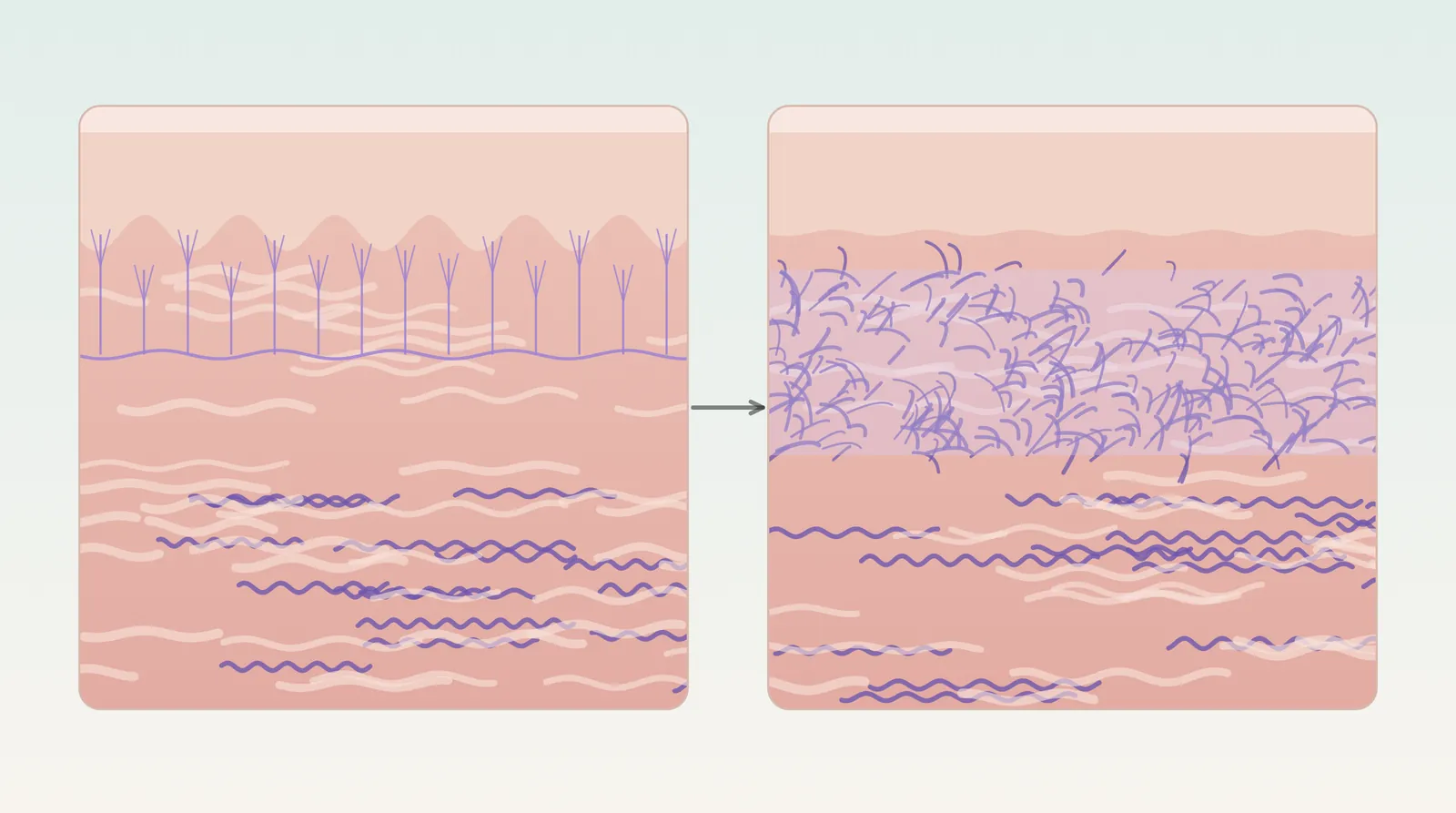
First too much, then the wrong kind. According to Langton's review, the first response of elastic fibres to sun damage is proliferation, and the size of this response depends on sun exposure. In 1994, Bernstein and colleagues compared the leathery neck skin of 16 men aged 49-66 with their own buttock skin. In the sun-exposed skin, the message of the elastin gene (mRNA) was up to 2.6 times higher in the tissue, and elastin staining in the upper dermis was about eight times denser.
A mass is not a fibre. According to Bernstein, the rise in production is not enough to explain the amount of material that builds up; the authors concluded that most of this material is not normal, cross-linked, elastic fibre. According to Langton, this shapeless material containing both tropoelastin and fibrillin-1, which accumulates in chronically sun-exposed dermis, is called solar elastosis. According to DermNet, as it progresses the fibres become coarse, disorganised and tangled.
The first to go: oxytalan fibres. According to Langton, the separate microfibril bundles beneath the junction are rarely seen in sun-damaged skin; even in skin with little sun exposure these microfibrils are reduced. The authors therefore regard fibrillin-1 as an early marker of photoageing.
Elastases: the enzymes that cut the fibre. In a 2005 study by Rijken and colleagues, the sun-protected buttock skin of fair-skinned volunteers was irradiated with solar-simulated light. Neutrophil elastase and MMPs appeared only at doses that redden the skin (at least one minimal erythema dose), and their main source was neutrophils migrating into the skin. In 1999, Saarialho-Kere and colleagues found macrophage metalloelastase (MMP-12) inside the fragmented and thickened fibres of the upper dermis in all 18 solar elastosis samples they examined. These findings suggest that sun, especially sun that reddens the skin, draws the enzymes that cut the elastic network into the tissue.
Smoking targets the same network. According to DermNet, tobacco smoke increases the production of MMPs and tropoelastin, which leads to disordered deposits of elastin.
What does elastin loss look like on the skin? Sagging, crepey texture and slow recoil
Crepey texture. According to Cleveland Clinic, when skin thins and wrinkles like crepe paper it is called crepey skin; it appears most often under the eyes and on the arms. According to a dermatologist quoted by the clinic, the cause is usually the sun: UV breaks down elastin, which lets skin return to its original position. Crepey texture usually appears in the forties; frequent tanning bed use or large weight changes can bring it forward to the twenties. Long-term cortisone use is also among the causes.
Yellow, thick, deeply lined skin. According to DermNet, in marked solar elastosis the skin on sun-exposed areas such as the face, ears, neck, forearms and backs of the hands looks dry, thick and yellowish, and wrinkles deepen. The look is compared to lemon peel, and it does not usually appear before the thirties.
Slow recoil and sagging. As the elastic network weakens, stretched skin returns to place more slowly; Langton's cutometer measurements show this in numbers. Sagging, however, cannot be explained by elastin alone. According to a 2021 review by Swift and colleagues, with age the facial bones recede, fat pads shift, supporting ligaments weaken, and the skin settles over this changing foundation. We explain in detail what happens in each of these layers in our guide to the causes of facial sagging and what works at home.
What protects elastic fibres? Sunscreen, not smoking and retinoids
The evidence for sunscreen. In a randomised trial published in 2013 by Hughes and colleagues, 903 adults under 55 in Nambour, Australia, used a broad-spectrum sunscreen either every day or as they usually would. After four and a half years, silicone casts taken from the backs of the hands showed no detectable increase in ageing among daily users; ageing was 24% lower than among occasional users. The product was SPF 15+, and the study was funded by Australia's National Health and Medical Research Council.
Retinoids may bring microfibrils back. In a 2001 study by Watson and colleagues, 0.025% tretinoin (all-trans retinoic acid) was applied under occlusion for four days to the forearms of 8 volunteers aged 64-82 with advanced sun damage. Fibrillin-1 rose significantly at both the protein and the gene level. In biopsies from 5 people who had applied 0.05% tretinoin cream to the face every day for 192 weeks, microfibrils near the junction had also increased markedly. The samples are small; Langton's review nevertheless regards topical retinoids as the gold standard in the treatment of photoageing. The laboratory that wrote the review received research funding from a cosmetics retail company.
A retinoid in your night routine. The key active of Longos Midnight Repair Serum is hydroxypinacolone retinoate, a gentle retinoid ester, and the serum is formulated for night-time care. Watson's biopsies were done with tretinoin; hydroxypinacolone retinoate is a gentler member of the same family. According to the Cleveland Clinic dermatologist, when you start retinol there may be a period when your skin temporarily looks drier and flakier. Talk to your doctor before using a retinoid during pregnancy or breastfeeding.
A daily routine to protect the elastic network:
- Every morning, apply a broad-spectrum sunscreen of SPF 30 or higher to your face, neck and the backs of your hands; the American Academy of Dermatology (AAD) recommends this for all skin not covered by clothing.
- Stay away from tanning beds; according to the AAD, every tan, whether from the sun or a tanning bed, ages the skin prematurely.
- If you smoke, quit; according to a study cited by Langton, people who smoke more than a pack a week are 4.7 times more likely to have facial wrinkles than non-smokers.
- In the evening, apply your retinoid product to cleansed skin, followed by your moisturiser; Cleveland Clinic notes that well-moisturised skin is better protected against the damage that makes crepiness worse.
Whether you need SPF in winter too is covered in our article on using sunscreen in winter and choosing the right SPF.
What is hydrolysed elastin? What it really does in creams and supplements
Definition. According to a safety report published in 2022 by the independent Cosmetic Ingredient Review (CIR) panel in the US, hydrolysed elastin is obtained by breaking down elastin with acid, enzymes or another method. The manufacturer data in the report list cod skin, bovine neck tendons and various animal ligaments or skins as sources; the molecular weight is between 1,000 and 4,000 daltons.
Why does it not go deep? According to a 2000 paper by Bos and Meinardi, a molecule must have a molecular weight below 500 daltons to be absorbed through the skin; larger ones cannot cross the stratum corneum. Hydrolysed elastin is 2 to 8 times this limit. It cannot be expected to reach the dermis, join an elastic fibre or be cross-linked by lysyl oxidase.
What does it do at the surface? The CIR report describes hydrolysed elastin as a skin-conditioning and softening (emollient) ingredient. In other words, it stays on the skin's surface and makes skin feel soft and smooth; this is an effect on feel and appearance, not a repair of the elastic network.
Is it safe? The CIR panel found hydrolysed elastin safe in its current uses; in a repeated patch test on 52 people, a 25% solution caused no irritation or allergy. For fish-derived ingredients, the panel recommended labelling that informs people with a fish allergy.
Elastin supplements. According to Seong and colleagues, few clinical studies have evaluated oral elastin peptides. In their own 2024 study, 100 Korean adults took 100 mg of skipjack tuna elastin peptide or a placebo daily for 12 weeks; 84 people were included in the analysis. Device-measured wrinkle values and hydration fared better than with placebo. The expert score for crow's feet, however, did not fall significantly in the supplement group; the difference came from the placebo group getting worse over the winter. Skin elasticity and elastin content were not measured, and the test product was prepared by a company where one of the authors works.
What can radiofrequency and red light do for elastic fibres?
Two energy sources have been studied for their effect on elastic fibres: radiofrequency heat and red light. The studies come first, followed by the framework set out in the Longos Sense manual.
Radiofrequency: heat may reorganise damaged elastin
In a 2011 study by El-Domyati and colleagues, 6 women aged 47-62 with sun-damaged skin received 6 sessions, two weeks apart, with a single-pole (monopolar) radiofrequency device in a clinic. In biopsies, type I and III collagen and newly formed collagen increased. Total elastin, however, decreased: the area of dermis occupied by elastin was 53.7% at baseline and 42.2% three months later. According to the authors, this decrease came with the solar elastosis mass moving away from the epidermis and normal-looking elastic fibres returning in the papillary and upper reticular dermis.
The finding suggests that in photoaged skin the goal is not to increase elastin but to restore its order; still, there was no control group and the sample was very small. We cover the differences between home devices and clinical RF in our article on what an at-home radiofrequency device does and who should not use one.
Red light: biopsy and cell data
In a 2007 randomised, double-blind study by Lee and colleagues, 76 people with facial wrinkles received 633 nm, 830 nm, both together or sham light on the right half of the face twice a week for four weeks. Collagen and elastic fibres increased markedly in skin samples from the three groups that received light. The increase in elasticity of up to 19%, however, was reported as a change from baseline, not as a difference from the sham group.
In a 2021 laboratory study by Li and colleagues, human dermal fibroblasts and human skin samples were exposed every day to 640 nm red and 830 nm near-infrared light at 0.5 mW/cm² for 10 minutes (0.3 J/cm²). The elastin gene (ELN) and the LOXL1 gene, which cross-links elastic fibres, increased, and elastic fibre formation rose in the skin samples. The study was carried out at the research centre of a consumer health company, in cell cultures and skin samples, not in living people.
Red light and RF at home: the framework set by the manual
Longos Sense's Quantum Dot Light technology delivers red light at 630 nm; the user manual (version 1.2) defines this mode as a cosmetic use "to improve the appearance of the skin; visible reduction of wrinkles and fine lines". The same device's bipolar, 1 MHz Radiofrequency mode, according to the manual, is for "temporarily warming the skin tissue to improve skin appearance".
The manual's limits are clear: clean, dry skin, face and neck only, never over the eyes or eyelids. In the light modes, apply no more than three times a day and 5-10 minutes per area. RF is used 3-4 times a week for 5-10 minutes per session, and the device is moved slowly and continuously, never held on one spot. Do not use the device if there is an active lesion or open wound in the area, during pregnancy and breastfeeding, or with active cancer or a history of skin cancer; if you take a medication that causes light sensitivity, talk to your doctor first.
Common myths about elastin
"Elastin in a cream renews the skin's elastin." Hydrolysed elastin is far above the 500-dalton limit; it stays on the surface and softens the skin, without joining the network in the dermis.
"The more elastin, the younger the skin." In Bernstein's study, elastin staining in the sun-damaged upper dermis was about eight times denser, but most of the accumulated material was not functional fibre. What counts is order, not quantity.
"A lost elastic network responds to nothing." In Watson's study, tretinoin increased fibrillin-1 deposits within just four days; in El-Domyati's biopsies, normal-looking fibres returned after radiofrequency. The network changes slowly, but it is not fixed.
"Elastin supplements go straight to the skin." Seong's study did not measure elastin or elasticity in the skin, and the product came from a company linked to the study; a firm verdict needs independent and longer studies.
"Sagging is just a lack of elastin." According to Swift's review, bone, fat pads, supporting ligaments and skin change together. A product that targets a single protein cannot change this picture on its own.
When should sagging and laxity be taken to a dermatologist?
According to the AAD, dermatologists use prescription topical retinoids, fillers, tightening ultrasound and non-invasive radiofrequency treatments, and lasers for loose skin, often in combination. Home care does not replace these procedures.
See a dermatologist if:
- Dry, scaly, rough patches have appeared on sun-exposed areas. According to the AAD, actinic keratosis is a skin growth that can turn into cancer. DermNet also notes that people with solar elastosis have a higher risk of skin cancer; every new or changing lesion needs an examination.
- You notice rapidly spreading laxity that you cannot explain by age, weight or sun. Rare elastic tissue disorders such as cutis laxa can be inherited or can develop later in life.
- Marked excess skin remains after major weight loss. According to Cleveland Clinic, creams have their limits, and in this case the excess skin often has to be removed by a plastic surgeon.
- You notice your skin thinning during long-term cortisone use. Do not stop the medication on your own; talk to the doctor who prescribed it.
We cover the options for crepey texture and bands on the neck separately in our guide to neck wrinkles, bands and sagging.
Where should you start this week?
Most of your elastic network was built in childhood, and you will carry it for life; the most effective favour you can do it is a broad-spectrum sunscreen every morning. In Hughes's study, daily users showed no detectable increase in ageing over four and a half years.
This evening, run the Longos app's AI analysis once on cleansed, product-free skin and note your wrinkles and fine lines score. This score is not a diagnosis but a way to track cosmetic appearance; repeat it in the same light eight weeks later and judge the change by two measurements, not by guesswork. This is a skincare guide, not medical advice.
Frequently Asked Questions
What is elastin and what does it do?
Elastin is a structural protein that gives skin, the lungs and large arteries the ability to stretch and return to their original shape. It makes up about 90% of elastic fibres; the rest is fibrillin microfibrils. In skin, elastic fibres sit in the dermis and return stretched skin to its original shape. According to StatPearls, elastic fibres can stretch to about 150% of their resting length and recoil. When the elastic network is damaged by age or by the sun, skin recoils more slowly and can take on a crepey look.
What is the difference between collagen and elastin?
Both are fibrous proteins of the dermis, but they do different jobs. Collagen provides tensile strength and firmness, makes up about 75% of the skin's dry weight and does not stretch. Elastin pulls stretched skin back and accounts for only 2-5% of the dry weight. Their turnover differs too: the half-life of skin collagen has been calculated at about 15 years, while that of elastin is estimated at about 70 years. That is why, for the elastic network, protection matters more than repair.
What are elastic fibres, and how many types are there?
Elastic fibres are made of an elastin core and the fibrillin microfibrils that surround it and act as a scaffold. Three families are described in the dermis. Oxytalan fibres are bundles of microfibrils without elastin and run perpendicular to the surface just below the epidermis. Elaunin fibres contain a little elastin and form a network at the border of the papillary and reticular dermis. Mature elastic fibres are thick fibres rich in elastin and run parallel to the skin surface in the reticular dermis.
What is hydrolysed elastin, and what does it do in a cream?
Hydrolysed elastin is a cosmetic ingredient obtained by breaking down animal elastin with acid or enzymes. According to the Cosmetic Ingredient Review (CIR) report, its molecular weight is 1,000-4,000 daltons, far above the 500-dalton limit accepted for absorption through the skin. So it does not reach the dermis and join the skin's own elastic fibres. It stays on the skin's surface; according to the CIR, as a skin-conditioning agent and emollient it makes skin feel soft and smooth. The CIR panel found it safe in its current uses.
Can elastin be produced again?
Elastin is mostly produced around birth and in childhood; in adulthood production is largely suppressed, and its estimated half-life is about 70 years. Still, the elastic network is not completely fixed. In a study of eight people, tretinoin applied to the skin increased fibrillin-1, the scaffold of elastic fibres, in sun-damaged skin within four days. In a clinical radiofrequency study of six people, damaged elastic material decreased and normal-looking fibres returned. The most reliable step, though, is a broad-spectrum sunscreen every day.
What does the word elastin mean, and how is it defined in medicine?
In everyday and medical English alike, the protein is simply called elastin, and its fibres are called elastic fibres. In biochemistry, elastin is defined as a water-insoluble structural protein formed when a soluble precursor protein called tropoelastin is cross-linked by the enzyme lysyl oxidase. The cross-links called desmosine and isodesmosine are unique to elastin. The elastin gene is on chromosome 7; mutations in this gene lead to conditions such as Williams syndrome and cutis laxa, while fibrillin-1 mutations cause Marfan syndrome.
Clinical evidence