Photoaging
What Is Collagen and What Does It Do? Collagen Types, Synthesis and What Supports Collagen in the Skin
What is collagen? The short answer
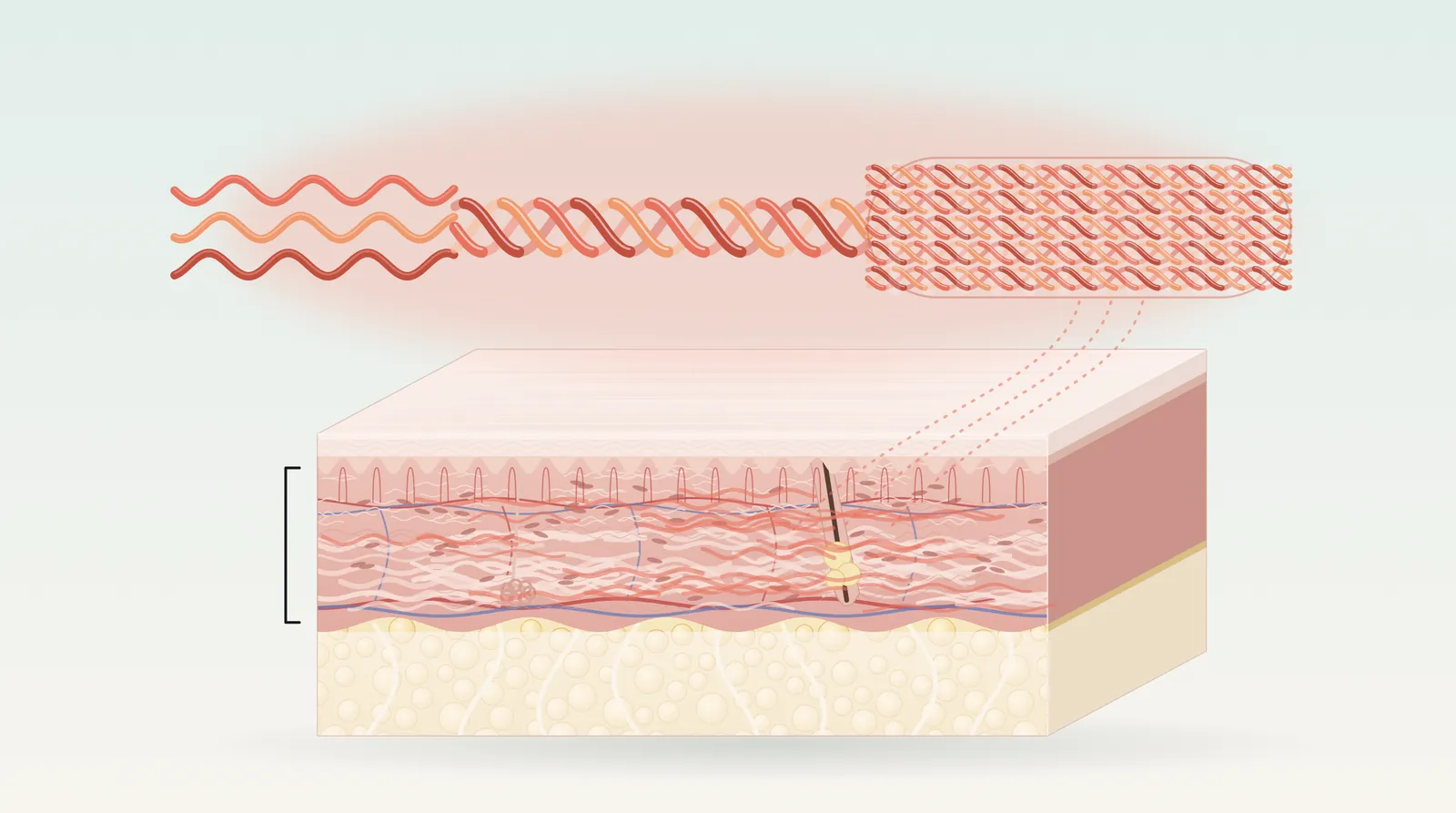
Collagen is a fibrous structural protein that gives connective tissue its tensile strength and is formed by three chains wound around one another. It is the most abundant protein in mammals: according to Ricard-Blum's 2011 review, it makes up about 30% of total protein mass. According to the 2009 review by Shoulders and Raines, three quarters of the skin's dry weight is collagen.
In the skin, most collagen sits in the dermis below the epidermis, where it is made by cells called fibroblasts. Collagen gives the skin its resistance to stretching; elastin fibers do the work of stretching and springing back.
In short
- Structure: three chains in which every third amino acid is glycine build a right-handed triple helix.
- Production: converting proline into hydroxyproline requires vitamin C; in vitamin C deficiency (scurvy), collagen cannot form a stable helix.
- Types: 28 collagen types have been described; 80-90% of the collagen in the skin is type I.
- Decline: age, UV radiation, glycation and smoking reduce collagen production or speed up its breakdown.
- Support: the strongest evidence is for daily sunscreen and retinoids; collagen in a cream holds moisture on the surface, and the evidence for supplements is debated.
The structure of collagen: the Gly-X-Y sequence and the triple helix
Every third amino acid is glycine. A collagen chain is made of repeating triplets in the form Gly-X-Y. According to Shoulders and Raines, 28% of the amino acids in the X position are proline and 38% of those in the Y position are hydroxyproline; the most common triplet is Pro-Hyp-Gly (10.5%). Glycine is the smallest amino acid. Because its side chain is just a single hydrogen atom, it allows the three chains to pack tightly in the center of the helix.
Left-handed chains, a right-handed helix. On its own, each chain is a left-handed helix of the polyproline II type. The three chains wind around one another, each offset by one amino acid, and form the right-handed triple helix. According to Alberts' cell biology textbook, one chain is about 1,000 amino acids long. In type I collagen the chains are not identical: according to Ricard-Blum, the molecule is a heterotrimer made of two α1(I) chains and one α2(I) chain.
Long, thin and heavy. According to the 2024 review by Jadach and colleagues, a single collagen molecule is about 280 nanometers long and 1.5 nanometers thick, with a molecular weight of about 300,000 daltons. This size also explains why the collagen in a cream cannot reach the dermis.
Why is the position of glycine critical? According to StatPearls, in osteogenesis imperfecta, where bones break easily, mutations put a bulkier amino acid in place of glycine and the triple helix is disrupted.
How is collagen made? Hydroxyproline, vitamin C and procollagen
The collagen synthesis chapter of NCBI StatPearls divides the process into intracellular and extracellular steps. Inside and outside the fibroblast, the following happens in order:
- Transcription and translation: In the nucleus, the genes for the pro-α1 and pro-α2 chains are transcribed into mRNA; on the ribosomes, the mRNA is translated into a chain.
- Hydroxylation: In the endoplasmic reticulum, hydroxyl groups are added to proline and lysine residues. The hydroxylase enzymes that do this use vitamin C as a cofactor.
- Sugars and the helix: Galactose and glucose attach to some hydroxylysines; the three chains close like a zipper and form procollagen.
- Secretion: Procollagen is packaged in the Golgi apparatus and released outside the cell.
- Cleaving the ends: Outside the cell, enzymes cut off the propeptides at both ends of the molecule; the molecule is now tropocollagen.
- Crosslinking: The copper-dependent enzyme lysyl oxidase forms covalent bonds between neighboring molecules, and a fibril forms.
Why do propeptides exist? According to Alberts, because the ends are cut off outside the cell, giant fibrils do not form inside the cell; molecules whose ends have been cleaved lose their solubility and assemble on their own.
From fibril to fiber. According to the same source, fibrils are 10-300 nanometers in diameter, show bands that repeat every 67 nanometers under the electron microscope and gather into bundles several micrometers thick, that is, into collagen fibers. In the skin these fibers are woven like wickerwork, so the skin resists stretching from many directions.
Why is vitamin C essential? According to Alberts, in vitamin C deficiency, that is, in scurvy, chains that have not been hydroxylated cannot form a stable helix and are broken down inside the cell right away. According to StatPearls, the first signs of scurvy appear in the skin: bleeding around hair follicles, corkscrew-like coiled hairs and slow-healing wounds. Cleveland Clinic notes that, alongside vitamin C, zinc, copper and manganese are also needed to build the triple helix.
Collagen types and their roles: which type sits where in the skin?
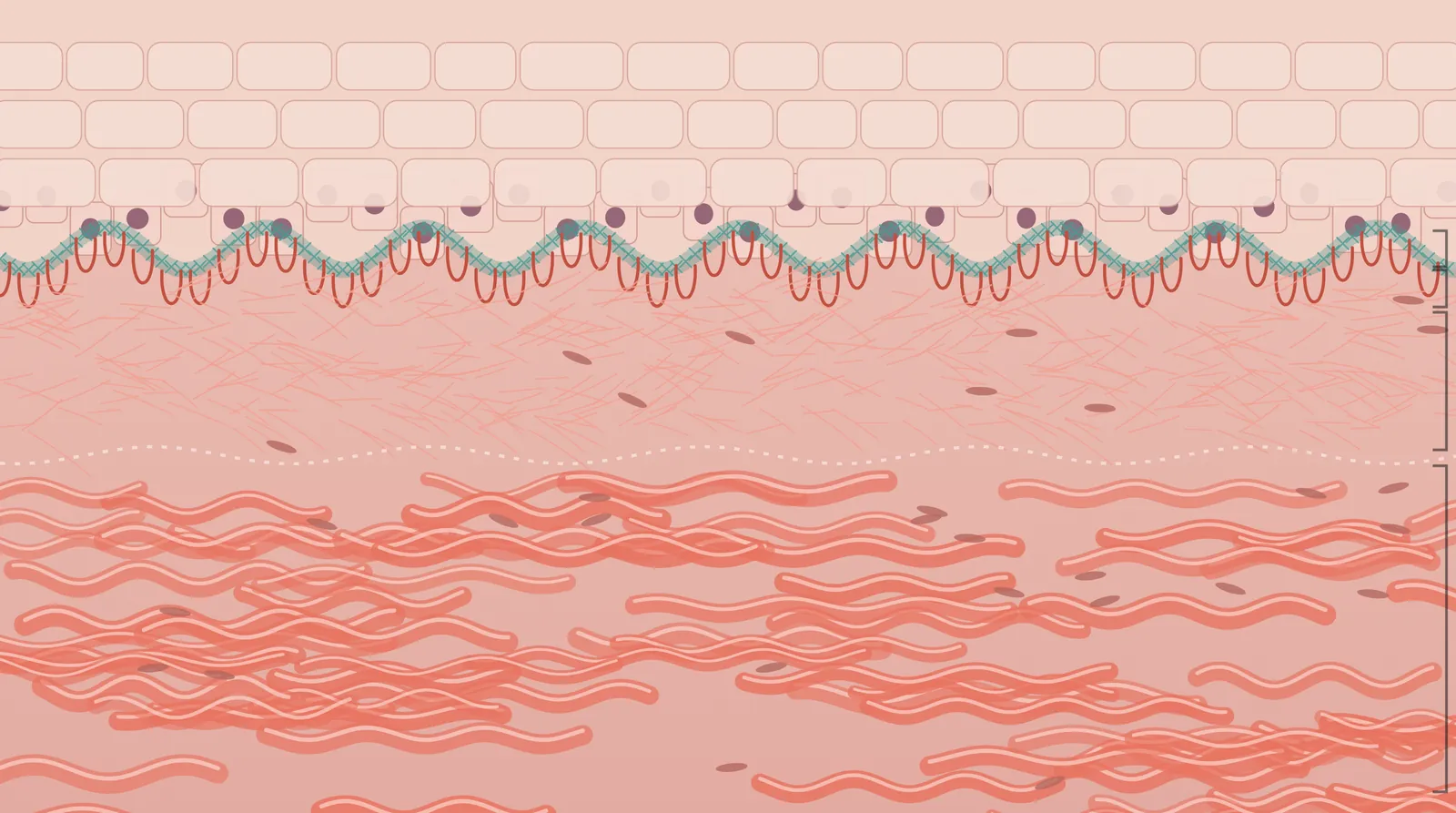
How many types are there? According to StatPearls and Ricard-Blum's review, 28 collagen types have been described in vertebrates, numbered with Roman numerals (I-XXVIII). What they share is at least one triple-helical region; this region makes up 96% of the molecule in type I and less than 10% in type XII.
| Type | Where in the skin? | What does it do? |
|---|---|---|
| Type I | Throughout the dermis; the bundles get thicker deeper down | 80-90% of the collagen in the skin; builds the thick fibrils that provide tensile strength |
| Type III | In the dermis, together with type I | 8-12% of the collagen in the skin; thinner than type I, the temporary collagen made first in wound healing |
| Type V | In the dermis, together with the fibril-forming collagens | Less than 5% of the collagen in the skin; belongs to the fibril-forming collagen family |
| Type IV | In the basement membrane between the epidermis and dermis | Weaves a felt-like network that forms the scaffold of the basement membrane |
| Type VII | Just below the basement membrane, in the upper papillary dermis | Forms anchoring fibrils and fixes the epidermis to the dermis |
| Type XVII | In the hemidesmosomes of basal cells | A transmembrane collagen; anchors the cell to the basement membrane |
Sources for the table: proportions from the 2019 review by Shin and colleagues; locations and roles from Alberts' textbook, the StatPearls chapters on wound healing and the review of type VII by Chung and Uitto.
Roles become obvious when they fail. According to Alberts, mutations affecting type III collagen cause Ehlers-Danlos syndrome, in which the skin and blood vessels become fragile and the joints hypermobile. According to StatPearls, mutations in the type VII collagen gene (COL7A1) cause a disease called dystrophic epidermolysis bullosa; the fragility arises below the lamina densa, and the skin blisters again and again and heals with scarring.
Which cells make collagen? Fibroblasts in the dermis
The main producer: the fibroblast. According to the StatPearls chapter on dermis histology, fibroblasts are the main cells of the dermis; they produce collagen, elastic fibers and the other components of the extracellular matrix. According to Shin and colleagues, they differentiate from mesenchymal cells and both build and break down the matrix. You can find the layers of the dermis and the structures inside it in our guide to the dermis and the deeper skin layers.
Not the only producer. According to Chung and Uitto, type VII collagen, which builds the anchoring fibrils, is made both by dermal fibroblasts and by keratinocytes in the epidermis.
The fibroblast works under tension. According to Alberts, fibroblasts crawl over the collagen they produce, pull on it and compact it into bundles. The relationship runs both ways: in the 2006 study by Varani and colleagues, 78% of the fibroblast surface was attached to collagen fibers in young skin, while over the age of 80 this share fell to 58%. According to the authors, a cell that cannot hold on to intact fibers does not receive enough mechanical stimulation and makes less collagen.
The type changes as a wound heals. According to the StatPearls chapter on wound healing, fibroblasts first build a temporary matrix of type III collagen; in the remodeling phase, the stronger type I takes its place. This phase starts on day 21 and can last up to a year. Even after three months, a scar reaches only about 80% of the strength of normal skin.
You will find this cell in full in our guide to the fibroblast and its role in wound healing, and collagen's elastic partner in our article on elastin and elastic fibres.
Why does collagen decline in the skin? Age, sun, sugar and smoking
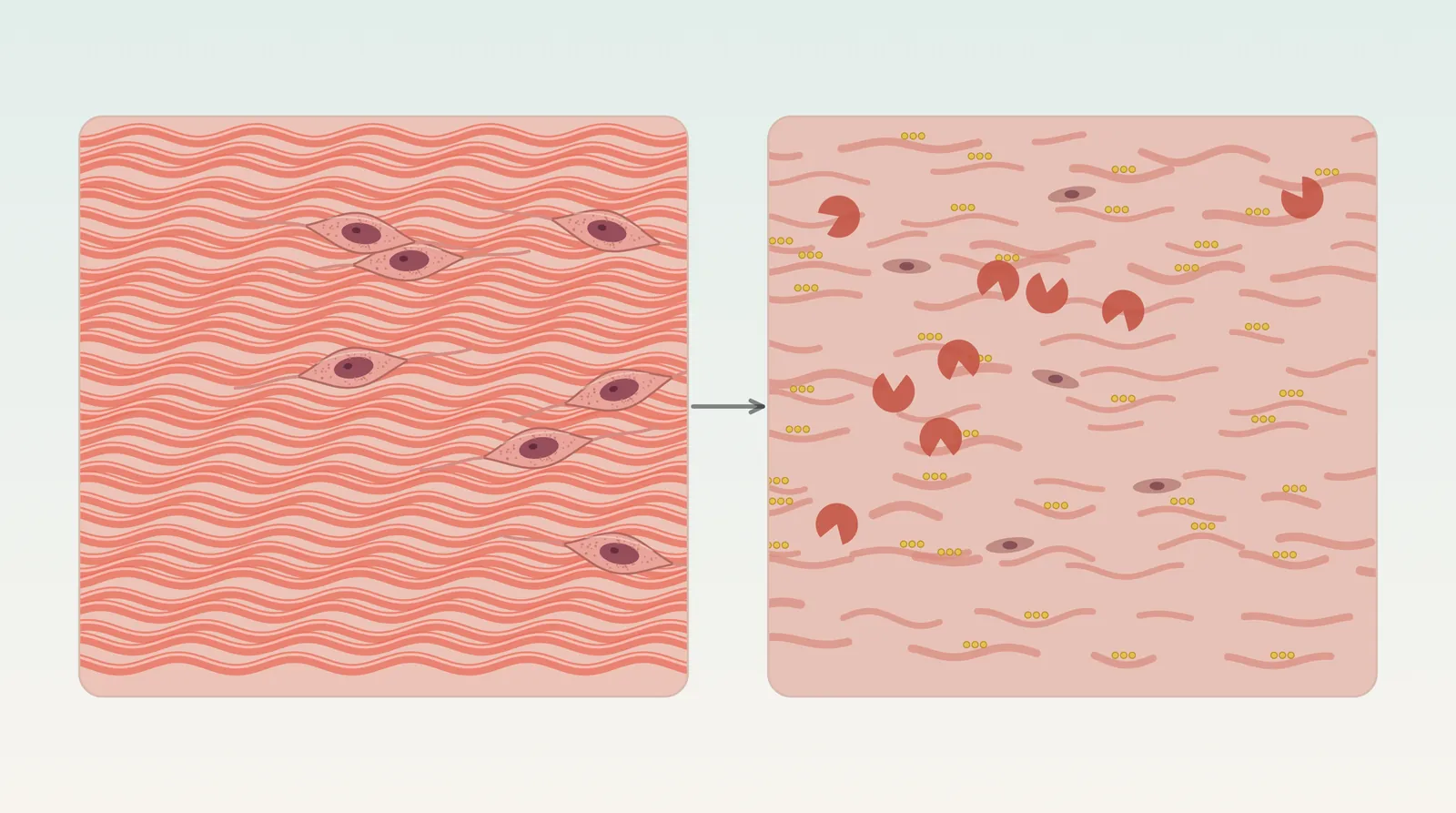
According to Shin and colleagues, in aged skin collagen is both made less and broken down more; the result is a net collagen deficit. Four factors widen this deficit. You can read at what ages the loss becomes noticeable in our article on when collagen loss in the skin begins.
Intrinsic aging: the tired fibroblast
In a 2020 article, Shuster summarizes that collagen per unit of skin surface declines by about 1% a year in both women and men, that female skin contains less collagen at every age and that this loss is independent of the sun. In Varani's study, fibroblasts taken from the 18-29 age group produced 82 nanograms of type I procollagen per milliliter in the lab, while those from people over 80 reached only 56 nanograms. According to Shin, fragmented collagen makes the fibroblast shrink; the shrunken cell produces more reactive oxygen species and more collagen-cutting enzymes.
Sun: enzymes rise, production stops
According to the 2015 review by Rittié and Fisher, UV radiation activates a transcription factor in the skin called AP-1; AP-1 switches on the genes for MMP-1, MMP-3 and MMP-9, which break down collagen, and suppresses the type I and III procollagen genes. In fair skin, these enzyme genes rise within 8 hours of irradiation and return to normal at 96 hours. According to the 2009 study by Quan and colleagues, MMP-1 is the main enzyme that can initiate the cleavage of fibril-forming collagen.
A single exposure is temporary, but over the years fragmented collagen accumulates. In 1993, Griffiths and colleagues found that type I collagen formation in the papillary dermis of sun-exposed forearm skin was 56% lower than in sun-protected skin. The decline was linked more to the severity of sun damage than to calendar age.
Glycation: sugar stiffens collagen
According to the 2012 review by Gkogkolou and Böhm, type I and IV collagen are long-lived proteins renewed about every 10 years; this makes them prone to forming bonds with sugar spontaneously, that is, to glycation. Glycated collagen starts to appear at age 20, increases by about 3.7% a year and is 30-50% higher at age 80. These crosslinks stiffen the fibers and make it harder for MMPs to break them down; damaged collagen cannot make way for new collagen.
Smoking: production slows, breakdown speeds up
The 2002 study by Knuutinen and colleagues compared the sun-protected arm skin of 47 smokers and 51 people who had never smoked. In the smokers, the synthesis rate of type I collagen was 18% lower and that of type III 22% lower, while the level of the collagen-degrading MMP-8 was twice as high.
You will find how sunlight and pollution create free radicals in the skin, and the skin's own antioxidant network, in our guide to free radicals.
Care that really supports collagen: sunscreen, retinoids and vitamin C
Daily sunscreen: the strongest evidence. In the 2013 randomized trial by Hughes and colleagues, 903 adults under 55 in Australia were assigned to use sunscreen either every day or whenever they chose. After 4.5 years, skin casts taken from the back of the hand showed 24% less aging change in the daily group, and no measurable increase in aging was seen in this group. The study was funded by Australia's National Health and Medical Research Council. Cleveland Clinic recommends SPF 30 or higher every day; you can find the right amount in our guide to sunscreen in winter and how much to apply.
Retinoids: an effect measured in the dermis. In Griffiths' study, type I collagen formation in the papillary dermis rose by 80% in 15 people who applied 0.1% tretinoin to their sun-damaged forearm every day for 10-12 months; in 14 people who applied a cream without the active ingredient, it fell by 14%. In the 2007 double-blind study by Kafi and colleagues, 36 people with a mean age of 87 applied 0.4% retinol to one arm and a lotion without the active ingredient to the other for 24 weeks. Fine wrinkles decreased on the retinol side; in a subgroup of 4 people who had biopsies, procollagen I increased.
According to the American Academy of Dermatology (AAD), retinoids increase collagen; it recommends starting with the mildest formula every other day, using the product at night and protecting the skin from the sun during the day. According to the AAD, retinoids should not be used during pregnancy. Among the Longos serums, Midnight Repair Serum comes closest to this mechanism: its main active is hydroxypinacolone retinoate, a gentle retinoid ester, and it is formulated for night-time care.
Vitamin C: a cofactor, but hard to get through the skin. According to the 2017 review by Pullar and colleagues, vitamin C is a water-soluble, charged molecule, so the skin barrier repels it; only some passes through below pH 4, in the form of ascorbic acid. In people whose blood levels are already saturated, applying it to the skin does not raise vitamin C in the skin. In the 2003 double-blind study by Humbert and colleagues, 20 women applied a 5% vitamin C cream to one side and a cream without the active ingredient to the other for six months. Skin microrelief improved on the vitamin C side, but in the 10 people who had biopsies, no clear change was seen in the collagen network; the cream was a cosmetics manufacturer's product.
Diet and habits. The Harvard T.H. Chan School of Public Health lists fish, chicken, eggs, dairy products and legumes for glycine and proline, and citrus fruits, peppers and tomatoes for vitamin C. The same source also names enough sleep and avoiding smoking among the habits that protect collagen.
What do red light at 630-633 nm and radiofrequency do to collagen?
This section covers two energy-based approaches: red light first, then radiofrequency.
Red light: from cell culture to people
In the lab. In the 2021 study by Li and colleagues, human dermal fibroblasts and skin samples were exposed every day to 640 nm red and 830 nm near-infrared light at 0.5 mW/cm² for 10 minutes (0.3 J/cm²); type I and III collagen genes and type I procollagen protein increased. The study was carried out at a consumer health company's skin research center, in cell culture and skin samples, not in living people. The dose can change the direction of the effect: in the 2016 study by Mamalis and colleagues, fibroblasts were given 633 nm light at very high doses such as 320 and 640 J/cm², and collagen fell by 16.8% and 45.9% at 48 hours. The authors were investigating this effect for excessive scarring.
In people. In the 2007 double-blind study by Lee and colleagues, 76 people with facial wrinkles were randomly assigned to 633 nm, 830 nm, both combined or sham light and received two sessions a week for four weeks. In the light groups, wrinkles fell by up to 36% from baseline, elasticity rose by up to 19%, and collagen and elastic fibers increased in skin samples. In the 2014 study by Wunsch and Matuschka, collagen density measured by ultrasound rose in the groups that received 30 sessions of 611-650 nm light compared with a control group of 23 people. Because the samples were small and the devices differed, the results do not transfer directly from one study to another.
The equivalent in the device. The Quantum Dot Light technology of Longos Sense delivers red light at 630 nm; the user manual defines this mode as being for "improving the appearance of the skin; visibly reducing wrinkles and fine lines". According to the manual, the LED is applied to cleansed skin, only on the face and neck, at most three times a day and for 5-10 minutes per area; it is not applied over the eyes or eyelids. Known light sensitivity, use of photosensitizing medication, epilepsy, pregnancy and breastfeeding are among the situations in which the manual says it should not be used. We explained the difference between the three colors in our guide to red light therapy and quantum dot LED.
Radiofrequency: targeting collagen with heat
Radiofrequency (RF) affects tissue not with light but with heat created by a high-frequency alternating current. According to the 2015 review by Araújo and colleagues, non-ablative RF works in the 0.3-10 MHz range; the goal is to stimulate new collagen production in deeper layers through controlled thermal injury. Of the 31 studies the review examined, 96% had no control group, and the level of evidence was judged low. These studies used clinical devices; it would not be right to equate a home-use device with these results. We covered the limits of home RF in our article on what an at-home radiofrequency device does.
What do collagen creams do? A large molecule and a moisture film on the surface
The molecule does not get through the door. According to the 2020 review by Aguirre-Cruz and colleagues, native collagen, with a molecular weight of about 300 kilodaltons, cannot pass the stratum corneum, the outermost layer of the skin. The same review lists being under 500 daltons among the suggested criteria for molecules that pass well through the skin; collagen is about 600 times this limit. Hydrolyzed collagen consists of fragments of 1-10 kilodaltons, but according to the review, peptides longer than six or seven amino acids are unlikely to reach the deeper layers.
So what does a cream do? According to the 2025 review by Sen and colleagues, collagen is a water-attracting (hygroscopic) molecule. When applied to the skin, it forms a moisture-holding film, plumps the skin and temporarily reduces fine lines; high-molecular-weight collagen can also stay on the surface and give an optical smoothness. A collagen cream can be a good moisturizer, but it does not replace the collagen in the dermis. According to Harvard, collagen fibers are too large to pass through the outer layers, and research does not support the idea that peptides do this any better.
Do collagen supplements work? What randomized trials found
Absorption and positive meta-analyses. As reported in the 2023 meta-analysis by Pu and colleagues, small hydroxyproline-containing peptides are detected in the blood one hour after hydrolyzed collagen is ingested. The 2021 meta-analysis by de Miranda and colleagues pooled 19 randomized, double-blind trials comparing oral hydrolyzed collagen with placebo: 1,125 participants aged 20-70, 95% of them women. The collagen group showed better results than placebo for hydration, elasticity and wrinkles; the authors concluded that 90 days of use was effective. Pu's analysis, covering 26 randomized trials and 1,721 people, also found improvements in hydration and elasticity, but identified various biases in the trials.
Split by funding, the picture changed. The 2025 meta-analysis by Myung and Park examined 23 randomized trials and 1,474 participants. When all trials were assessed together, collagen significantly improved hydration, elasticity and wrinkles. When the trials without funding from pharmaceutical companies were examined separately, however, no effect was seen on any of the three outcomes; there was no significant effect in the high-quality trials either. The authors concluded that there is no clinical evidence supporting the claim that supplements prevent or treat skin aging.
What is being measured? The outcomes in de Miranda's analysis were wrinkles, hydration, elasticity and firmness; that is, properties of the skin measured at the surface, not the amount of collagen in the dermis. According to Harvard, most, perhaps all, of the research in this area is partly or fully funded by industries with an interest in a positive result. If you try a supplement, add it alongside sunscreen, not in its place.
Does collagen have downsides? Side effects, allergy and product quality
Side effects are generally mild. According to Harvard, current research has shown no adverse side effects in people given collagen supplements. Martini's 2019 review, however, lists diarrhea, indigestion, a bad taste in the mouth, headache, dizziness, insomnia and rash among the reported side effects; abnormal liver values have also rarely been reported.
Allergy depends on the source. The collagen in supplements is of animal origin: Martini lists fish scales and pig and chicken skin as sources, and Wang lists cattle and marine animals. According to Wang's 2021 review, someone with a shellfish allergy may experience anaphylaxis with a marine collagen supplement; it has also been suggested that severe allergic reactions to some vaccines may stem from the bovine gelatin in the vaccine. Martini writes that people allergic to certain animal sources (for example fish) or to sulfites should not use products containing these ingredients, and that use during pregnancy and breastfeeding is not recommended because evidence is scarce.
Quality and content. According to Harvard, exactly what a supplement contains and whether it lives up to the claim on its label can be unclear; there are also concerns that some contain heavy metals. The same source notes that in the US, the FDA does not review supplements for safety and effectiveness before they go on sale. Choose products that clearly state their source and contents. Because collagen is an animal protein, it is not suitable for a vegetarian or vegan diet.
Common myths about collagen
"Collagen cream adds collagen to the skin." Native collagen is about 300 kilodaltons and cannot pass the outermost layer of the skin. The cream forms a moisture-holding film on the surface; it does not renew the fibers in the dermis.
"The collagen you eat goes straight to your skin." According to Cleveland Clinic, the body does not absorb collagen whole; it breaks it down into amino acids. According to Harvard as well, research showing that eating collagen directly benefits the skin is insufficient.
"Plant collagen exists." According to Harvard, in food, collagen occurs naturally only in animal meat that contains connective tissue and in fish. Plant products do not contain collagen, but they may contain the amino acids the body uses to make collagen and helpers such as vitamin C.
"Bone broth is a collagen store." According to Harvard, the amount of amino acids in bone broth varies widely with the bone, the cooking time and the processing.
"Collagen loss happens only with age." In Griffiths' data, the collagen deficit in sun-exposed skin was linked more to the severity of sun damage than to calendar age. You can find the difference between static and dynamic lines in our guide to wrinkle types and methods you can use at home.
"With red light, the longer the session, the more collagen." In Mamalis' cell study, very high doses of 633 nm light reduced collagen production by fibroblasts. More is not better; do not exceed the time in the manual.
When should you see a dermatologist?
Some signs point not to cosmetic collagen loss but to a connective tissue problem and need a doctor's assessment:
- Skin that blisters with light friction: according to StatPearls, type VII collagen deficiency comes with skin fragility, blistering and healing with scars.
- Skin that tears easily and hypermobile joints: according to Alberts, type III collagen mutations cause Ehlers-Danlos syndrome, in which the skin and blood vessels become fragile.
- Suspected autoimmune connective tissue disease: according to Cleveland Clinic, diseases such as scleroderma, lupus and dermatomyositis can damage collagen; this picture is assessed with a doctor, not with skincare products.
- Redness and inflammation that do not go away: the AAD recommends that people with marked redness or inflammation of the skin discuss options for conditions such as rosacea with a dermatologist instead of using a retinoid.
- Rash, swelling or shortness of breath after a supplement: stop the supplement and seek medical help immediately.
Where to start for your collagen this week
The order of what you can do for collagen matches the strength of the evidence. Apply a broad-spectrum sunscreen every morning; in the study by Hughes, what made the difference was regular use, not occasional use. If you are not pregnant, then add a retinoid with the mildest formula to your night routine every other day, and increase the frequency as your skin gets used to it.
Before you start, run the AI analysis in the Longos app once this evening on cleansed, product-free skin and note your wrinkles and fine lines score. This score is not a diagnosis but a way to track cosmetic appearance; repeat it in the same light after three months and judge the change by two measurements, not by guesswork. This is a skincare guide, not medical advice.
Frequently Asked Questions
What is collagen and what does it do?
Collagen is a fibrous structural protein formed by three protein chains wound around one another. It is the most abundant protein in mammals; according to Ricard-Blum's review, it makes up about 30% of total protein mass. In skin, bone, tendon and cartilage it gives tissue its tensile strength. Three quarters of the skin's dry weight is collagen; most of it sits in the dermis, where cells called fibroblasts make it. Collagen lets the skin withstand stretching, while elastin fibers do the work of stretching and springing back.
What types of collagen are there, and which are found in the skin?
According to StatPearls and Ricard-Blum, 28 collagen types have been described. Of the collagen in the skin, 80-90% is type I, 8-12% is type III and less than 5% is type V; these are the fiber-forming collagens of the dermis. Type III is the collagen made first in wound healing and is thinner than type I. Type IV weaves a network in the basement membrane between the epidermis and dermis. Type VII builds anchoring fibrils just below this membrane and fixes the epidermis to the dermis; its deficiency causes dystrophic epidermolysis bullosa, a disease that makes the skin blister.
How can you increase collagen production?
The strongest evidence is for sun protection and retinoids. In a randomized trial of 903 people, skin aging progressed 24% less over 4.5 years in those who used sunscreen every day. In Griffiths' study, 0.1% tretinoin increased type I collagen formation in sun-damaged skin by 80%; in a small study, retinol also increased procollagen. Vitamin C is a cofactor of collagen synthesis, but when applied to the skin, it passes through only to a limited extent. Avoiding smoking and getting enough sleep also protect collagen. Retinoids should not be used during pregnancy.
Are collagen supplements good for the skin?
The evidence is mixed. De Miranda's 2021 meta-analysis, which pooled 19 randomized trials and 1,125 people, found that hydrolyzed collagen gave better results than placebo for hydration, elasticity and wrinkles. In Myung and Park's 2025 meta-analysis of 23 studies, however, no effect was seen in studies without funding from pharmaceutical companies or in high-quality studies. According to Harvard, most research in this area is funded by industry. A supplement does not replace daily sunscreen.
What are the downsides of collagen?
Collagen supplements are generally well tolerated; according to Harvard, no adverse side effects were seen in studies. Martini's review, however, notes that diarrhea, indigestion, a bad taste in the mouth, headache, dizziness, insomnia and rash have been reported. Collagen comes from animal sources; according to Wang's review, someone with a shellfish allergy may have a severe allergic reaction to marine collagen. Harvard notes concerns about product content and heavy metals. Because evidence is scarce, use during pregnancy and breastfeeding is not recommended.
How should you use collagen: cream or supplement?
Collagen cream does not add collagen to the skin: native collagen is about 300 kilodaltons and cannot pass the outermost layer of the skin. The collagen in a cream draws in water, forms a moisture-holding film on the surface and temporarily smooths fine lines; in other words, it works as a moisturizer. Supplements are broken down during digestion into amino acids and small peptides. De Miranda's meta-analysis found 90 days of use effective, but independent studies show weaker results. Whichever you choose, daily sunscreen is the foundation of protecting the collagen in your dermis.
Clinical evidence