sphingolipids
What Are Ceramides and What Do They Do? Structure, Types, Label Names and Food Sources
What are ceramides? The short answer
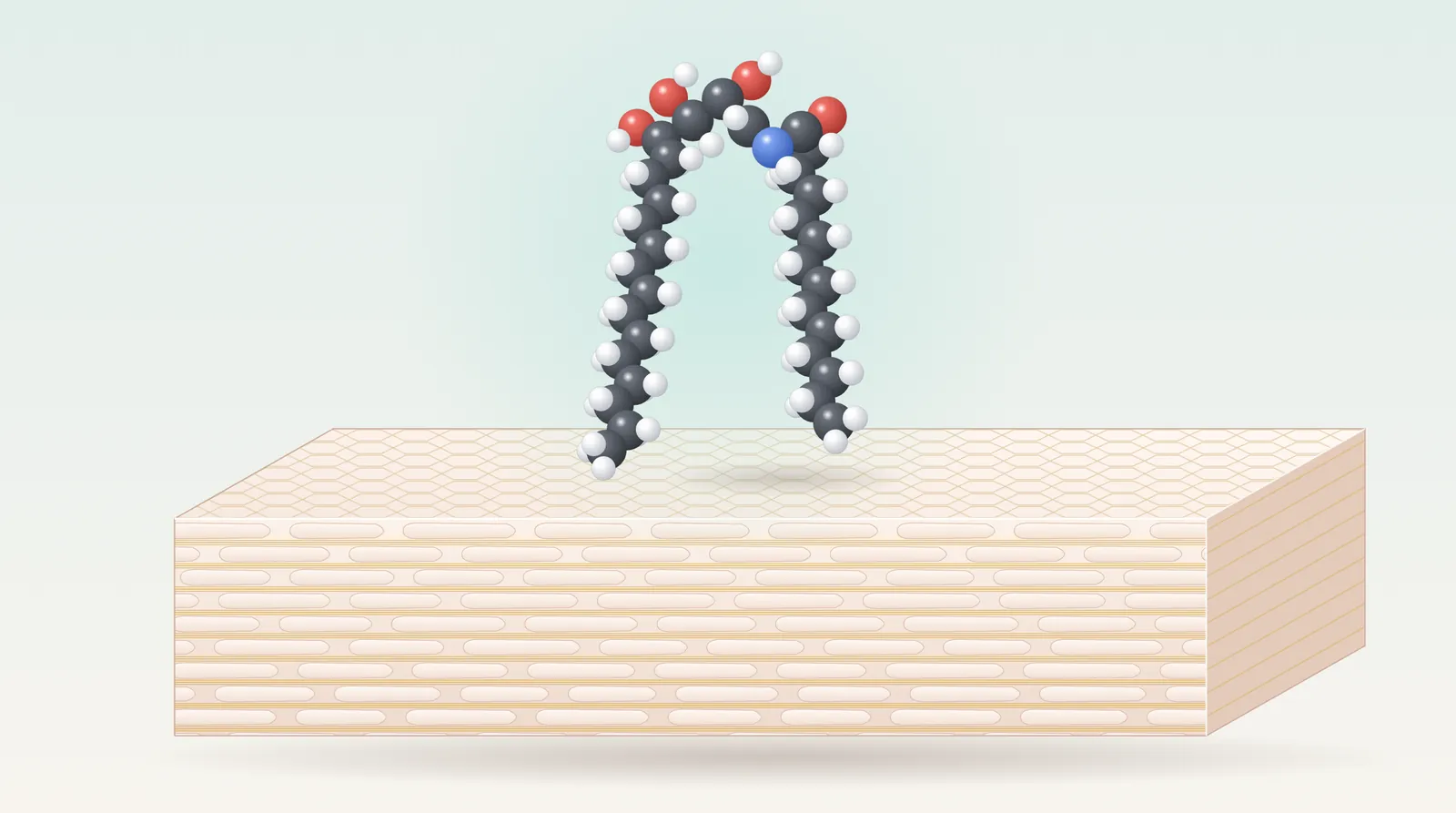
A ceramide is a lipid made of a sphingoid base and a fatty acid attached to it by an amide bond. A sphingoid base is a long-chain amino alcohol such as sphingosine. That places ceramide in the same family as sphingomyelin and glucosylceramide, the sphingolipids, and ceramide forms their backbone. According to a 2022 study by Suzuki and colleagues, in most tissues ceramide is an intermediate that appears only briefly while sphingolipids are being built and broken down. The outermost layer of the skin, the stratum corneum, is the exception to this rule: there, ceramides are both abundant and highly diverse.
Their job in the skin is to build the mortar that keeps water in and external irritants out. According to a 2024 review by Feingold and Elias, the lipid matrix between the cells of the stratum corneum is roughly 50% ceramides, 25% cholesterol and 15% free fatty acids by weight.
In brief
- Structure: a sphingoid base with a fatty acid attached by an amide bond; a small water-loving head and two long fatty tails.
- Location: the intercellular mortar of the stratum corneum; roughly half of the barrier lipids by weight.
- Production: packaged as precursors in the granular layer and converted into ceramides outside the cell by two enzymes that work in an acidic environment.
- Label: the letters in names such as Ceramide NP, AP and EOP tell you the type of fatty acid and base.
- Care: topical ceramides make sense together with cholesterol and fatty acids.
Ceramide structure: a sphingoid base, an amide bond and two fatty tails
In biochemistry classes, ceramide is summed up as "sphingoid base plus fatty acid". Behind that formula lies a production line with several steps.
The base starts from serine. According to a 2024 review by Schild and colleagues, ceramide synthesis from scratch begins in the endoplasmic reticulum. The amino acid serine combines with palmitoyl-CoA through the enzyme serine palmitoyltransferase; this first step sets the pace of the whole pathway. The resulting intermediate is reduced to dihydrosphingosine (sphinganine).
Six enzymes attach the fatty acid. Ceramide synthases (CerS1-6) add a second fatty acid to dihydrosphingosine through an amide bond; each synthase prefers fatty acids of a different length. When a desaturase adds a double bond, the molecule becomes ceramide. If a sugar or phosphocholine head is added to ceramide in the Golgi apparatus, glucosylceramide or sphingomyelin is formed.
Why do the two tails matter? According to Schild, the hydroxyl groups on the base and the amide bond form the molecule's water-loving head, while the two carbon chains form its fat-loving tails. This two-faced structure lets ceramides build stacked layers. In the human stratum corneum, the fatty acid chain of ceramides is mostly 24-28 carbons long. According to Feingold and Elias, mutations in ceramide synthase 3 (CerS3), which prefers chains of 26 and 28 carbons, cause ichthyosis in humans, a scaling disorder that disrupts the barrier.
From a medical perspective. According to a 1999 review by Vesper and colleagues, ceramide and sphingoid bases are molecules that cells use to regulate growth, differentiation and programmed cell death. Their importance in skincare, however, comes from the barrier.
Where and how are ceramides made? Lamellar bodies and two enzymes
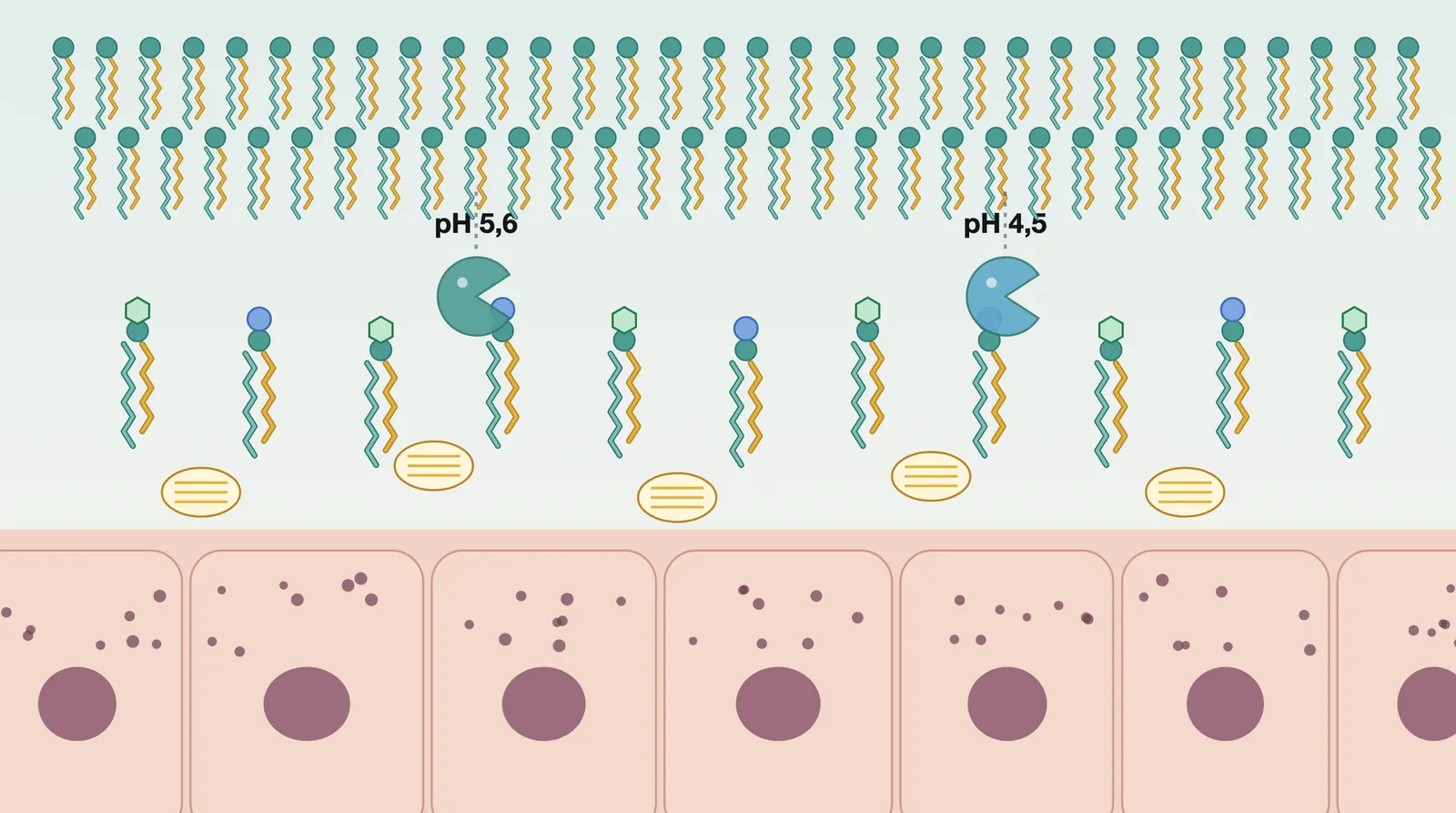
Packaging happens in the granular layer. As keratinocytes mature on their way to the surface, they load ceramide precursors into vesicles called lamellar bodies. According to a 2007 review by Feingold, these bodies are secretory organelles about 0.2 × 0.3 micrometers in size that exist only in the epidermis; they are absent from the basal layer, appear in the upper spinous layer and multiply in the granular layer. You can find the order of these layers in the epidermis in our guide to the layers and cells of the epidermis.
They carry precursors, not ceramides. According to Feingold, lamellar bodies carry glucosylceramide, sphingomyelin, phospholipids, cholesterol and the enzymes that will process them. The uppermost cells of the granular layer empty this cargo into the spaces between cells. There, beta-glucocerebrosidase converts glucosylceramide into ceramide, and acid sphingomyelinase does the same with sphingomyelin.
The enzymes need acid. According to a 2013 review by Ali and Yosipovitch, beta-glucocerebrosidase works best at pH 5.6 and acid sphingomyelinase at pH 4.5. At pH 7.4, the activity of beta-glucocerebrosidase is 10 times lower than at pH 5.5.
Two inherited diseases confirm this. According to Feingold, in Gaucher disease, which involves a beta-glucocerebrosidase deficiency, and in Niemann-Pick disease, which involves an acid sphingomyelinase deficiency, the precursors cannot be adequately converted into ceramide; the intercellular lipid layers become disordered and the barrier weakens. According to the same review, when the barrier is disrupted, the granular layer empties 50-80% of its existing lamellar bodies within a few minutes and produces new ones.
The mortar of the stratum corneum: ceramides, cholesterol and free fatty acids
The ratio. According to Feingold and Elias, the intercellular lipid matrix contains almost no phospholipids, and the three lipids are roughly equal in molar terms (1:1:1). A 2023 review by Bouwstra and colleagues considers the 1:1:1 ratio a reasonable approximation but notes that measured cholesterol and fatty acid levels can come out somewhat higher. According to Feingold's 2007 review, the most abundant free fatty acids have 22 and 24 carbons.
An order built layer by layer. According to Bouwstra, these lipids arrange themselves in two repeating patterns: a short periodicity phase of about 6 nanometers and a long periodicity phase of about 13 nanometers. In the human stratum corneum, the molecules pack side by side very tightly, in an arrangement called orthorhombic.
Each of the three lipids has its own job. According to Schild, in laboratory models the long periodicity phase needs cholesterol and special ceramides called acylceramides in order to form, while tight orthorhombic packing depends on free fatty acids with at least 24 carbons. That is the biochemical reason creams name ceramides together with cholesterol and fatty acids rather than on their own. We describe the stinging, tightness and flaking that appear when the mortar weakens in detail in our guide to the symptoms of a damaged skin barrier and how long recovery takes.
This mortar is different from the sebum that sebaceous glands release onto the surface; you can read what sebum is made of in our guide to sebum and the sebaceous glands.
Ceramide classes and label names: what do Ceramide NP, AP and EOP mean?

A ceramide's name is made of two groups of letters: first the type of fatty acid, then the type of sphingoid base. In this system, proposed by Motta and used by Bouwstra, N stands for a non-hydroxy fatty acid, A for alpha-hydroxy, O for omega-hydroxy and EO for an omega-hydroxy fatty acid whose end is esterified to another fatty acid. The base letters are S for sphingosine, dS for dihydrosphingosine, P for phytosphingosine, H for 6-hydroxysphingosine and SD for 4,14-sphingadiene.
How many classes are there? Suzuki and colleagues identified 20 free ceramide classes and 5 classes bound to the corneocyte surface in the human stratum corneum, and measured 1,327 free and 254 protein-bound ceramide species. Bouwstra's review puts the number at around 25; the difference comes from how the classes are grouped.
INCI names follow the same logic. According to a 2020 report by the expert panel of the Cosmetic Ingredient Review (CIR) in the United States, the old numbered names were retired in 2014 and replaced with letter names. The panel found the ceramides it reviewed safe under the conditions of use.
| Label name (INCI) | What the letters mean | Old INCI name | Average share of total ceramides |
|---|---|---|---|
| Ceramide NP | Non-hydroxy fatty acid + phytosphingosine | Ceramide 3 | About 23%, the most abundant class |
| Ceramide AP | Alpha-hydroxy fatty acid + phytosphingosine | Ceramide 6 II | About 12% |
| Ceramide NS | Non-hydroxy fatty acid + sphingosine | Ceramide 2 (in part) | About 6% |
| Ceramide NG | Non-hydroxy fatty acid + sphinganine | Ceramide 2 (in part) | About 6% (NdS) |
| Ceramide AS | Alpha-hydroxy fatty acid + sphingosine | Ceramide 4 and 5 | About 5% |
| Ceramide EOS | Esterified omega-hydroxy fatty acid + sphingosine | No match | About 5% |
| Ceramide EOP | Esterified omega-hydroxy fatty acid + phytosphingosine | Ceramide 1 and 1A | About 1.4% |
The name matches come from the CIR report, and the shares from a table in which Schild and colleagues averaged several lipidomic studies; most of that review's authors work for a chemical company. According to Schild, classes such as NP and NH vary greatly by body site, while EOS and EOP are fairly constant.
The old numbers cause confusion. In research papers from the 1990s, "ceramide 1" referred to the linoleic acid-bearing acylceramide in human skin; Schild renders the "ceramide 1 linoleate" in Rogers's 1996 study as CER EOS. On labels, however, according to the CIR, the retired name "Ceramide 1" passed to the phytosphingosine-based Ceramide EOP.
Acylceramides and the corneocyte lipid envelope: the scaffold of the barrier
What is an acylceramide? According to Bouwstra, ceramides with the letters EO (EOS, EOP, EOH, EOdS) are molecules in which an 18-carbon fatty acid, usually linoleic acid, is attached to the end of a very long omega-hydroxy fatty acid, and they are found only in the epidermis. According to Schild, they make up about 10% of free ceramides by mass, yet they are essential for building and stabilizing the long periodicity phase.
Making them depends on a chain of enzymes. According to a 2024 review by Berdyshev, ELOVL4 produces ultra-long-chain fatty acids with at least 26 carbons, CYP4F22 adds a hydroxyl group to the end of the chain, CerS3 attaches this fatty acid to the base and PNPLA1 adds linoleic acid, taken from triglycerides, to the end. According to the same review, loss of ELOVL4 function leads to death in newborns.
Why is linoleic acid essential? According to Feingold, in essential fatty acid deficiency, oleic acid takes the place of linoleic acid in acylceramides; the intercellular lipid layers become disordered and barrier function weakens. Linoleic acid is a fatty acid that has to come from food.
The corneocyte lipid envelope. According to Schild, once lipoxygenase enzymes have processed their linoleic acid end, some acylceramides are covalently bound to the corneocyte's protein envelope, for example to involucrin. According to Suzuki, these protein-bound ceramides form a layer resembling a cell membrane around each corneocyte and act as a scaffold for the intercellular layers. Schild adds that this envelope may also work like a semipermeable membrane that lets water through while keeping natural moisturizing factor inside the cell. According to Suzuki, a mutation in any of the genes in this pathway causes congenital ichthyosis.
Why do ceramides decline? Age, season, atopic dermatitis and cleansing
Ceramide levels are not fixed. The four factors below are the most studied, and the evidence for them comes from different types of studies.
Age and sun
In a 1991 study by Imokawa and colleagues, total ceramide on the forearms of 65 healthy people decreased significantly with age. In 1996, Rogers and colleagues took tape-strip samples from the face, hands and legs of 49 women aged 21-60; all major lipid classes, and ceramides most of all, decreased with age. The first author of both studies worked in the research laboratory of a cosmetics or consumer products company. According to Schild, UV radiation also appears to reduce the production of the enzymes that bind acylceramides to corneocytes in mouse and human skin.
Winter
In the seasonal arm of the Rogers study, 26 women were sampled in summer, spring and winter. Stratum corneum lipids fell markedly in winter at all sites; linoleic acid in acylceramides was about 20% lower in winter than in summer. We cover the extra flaking that comes with the change of season in our article on the causes of dry skin in autumn.
Atopic dermatitis
In Imokawa's study, ceramide on the forearms of 32-35 people with atopic dermatitis was markedly lower than in healthy people of the same age; a similar decrease was present even in skin without lesions, and the class that fell most was the one then called ceramide 1. According to Bouwstra, ceramide chains get shorter in atopic skin, CER EOS is the class that declines most, and these changes often go hand in hand with increased water loss. Feingold and Elias describe a cycle: a disrupted barrier triggers inflammation, interferon gamma suppresses the production of long-chain ceramides in human keratinocyte cultures, and the barrier weakens further.
Harsh cleansing and high pH
The effect of cleansers is subtler than people assume. According to a 2013 review by Ananthapadmanabhan and colleagues, when stratum corneum was soaked in a 2% sodium lauryl sulfate solution for 20 minutes in the laboratory, up to 7% of the total lipid dissolved; 8% of the free fatty acids came out, while ceramide did not come out at detectable levels. In washing experiments on living skin, too, the fatty acids were the fastest to go. The review's interpretation is that harsh washing upsets the ratio of the mortar more than it directly removes ceramide. We describe how this looks on frequently washed hands in our guide to dry, cracked hands and how to care for them.
The effect of pH is more direct. According to Ali and Yosipovitch, soap-based cleansers are generally around pH 10. In a 2005 mouse study by Hachem and colleagues, when the stratum corneum was kept at neutral pH for five days, beta-glucocerebrosidase and acid sphingomyelinase were broken down by proteases; when the skin was acidified again, their activity did not return. You can read how the acid mantle is protected in our guide to skin pH.
What topical ceramides can and cannot do
Ratio matters more than amount. In a 1996 study by Man and colleagues, applying only one or two of the three lipids to mouse skin with a disrupted barrier delayed repair; an equimolar mixture allowed normal repair. When the proportion of any one of them was raised up to threefold, that is, in a ratio such as 3:1:1, repair was even faster. In human skin, only preliminary results were reported.
Penetration is limited. According to the CIR panel, ceramides in cosmetics are not readily absorbed through the skin. According to Schild, dissolving ceramide in a formula requires heating above 80°C; ceramide left undissolved had the opposite effect on repair in laboratory barrier models. Seeing ceramide on the label does not, on its own, show that the formula carries it in the right form.
Human studies. In a 2021 randomized, double-blind study by Spada and colleagues, 100 adults with moderate eczema used either a ceramide-dominant cream and cleanser or their counterparts without active ingredients for 28 days. The eczema severity score fell to a similar degree in both groups; water loss and skin hydration improved only in the ceramide group. Six of the authors were employees of the manufacturer that sponsored the study. In a 2023 meta-analysis by Nugroho and colleagues, three studies (45 vs 45 people) showed no significant difference in water loss; in two studies (53 vs 53 people), the improvement in the severity score was about one point greater in the ceramide group.
A practical reading. A ceramide cream is a sensible moisturizer that mimics the barrier lipids; it is not a treatment for atopic dermatitis. The clear improvement seen with the cream without active ingredients in the Spada study suggests that regular use accounts for a large share of the benefit. For eczema, the NHS recommends using moisturizer at least twice a day and continuing even when the skin improves.
Plant ceramides and oral phytoceramide supplements
Plant ceramide is not the same molecule. According to Vesper, plant sphingolipids are mostly cerebrosides such as glucosylceramide. According to a 2017 study by Fujii and colleagues, the sphingoid bases of plant glucosylceramides differ from those in mammals; 4,8-sphingadienine in maize is one example.
Absorption is low. According to a 2021 review by Yamashita and colleagues, dietary sphingolipids are broken down in the gut as far as sphingoid bases and are absorbed much less than other fats. In Fujii's rat study, plant sphingadienine passed into the lymph less than sphingosine did, because the P-glycoprotein pump in intestinal cells pushed it back out. The authors propose explaining any skin effect not by ingested ceramide being carried to the skin, but by it stimulating ceramide production in the skin; this is still a hypothesis.
Clinical data: a small effect. A 2022 meta-analysis by Sun and colleagues reviewed 11 randomized trials (601 people) in healthy adults; the daily dose was 0.4-30 mg and the duration 6-20 weeks. In seven studies (426 people), single-ingredient supplements raised skin hydration compared with placebo and also reduced water loss. Results varied widely between studies; two were rated at high risk of bias because of possible conflicts of interest or missing measurement information. In a 2008 study by Uchiyama and colleagues, 100 people who drank a beverage containing konjac-derived glucosylceramide for 12 weeks had lower water loss on the cheek than with placebo, while on the forearm there was no difference.
The verdict. These studies were done in healthy volunteers; there is no evidence that supplements replace treatment for eczema. If you are considering a supplement, talk to your doctor first, especially if you are pregnant, breastfeeding or take medication regularly.
Which foods contain ceramides?
Foods contain little free ceramide; mostly they contain sphingolipids that the gut breaks down into ceramides and sphingoid bases: sphingomyelin predominates in animal foods and glucosylceramide in plants. In 1999, Vesper and colleagues brought together the measurements available up to that point.
| Food | Total sphingolipids (micromol/kg, approximate) |
|---|---|
| Soybeans | 2,410 |
| Eggs | 2,250 |
| Cheese | 1,326 |
| Wheat flour | 576 |
| Chicken | 530 |
| Whole milk | 160 |
| Apples | 69 |
| Tomatoes | 42 |
Reading the table. According to Vesper, most of these values were measured by indirect methods, and the effect of cooking is unknown. By the review's estimate, intake in the US is 0.3-0.4 grams per person a day, and there is no known dietary requirement for sphingolipids. The clinical data on skin come not from foods but from supplement studies at defined doses.
How to read ceramides on a label and how to use a ceramide cream
The label is the quickest way to separate marketing claims from ingredients. The steps below help both when you choose a product and when you use it.
- Look for the INCI names. Ceramide NP, AP, EOP, NS, NG, AS or EOS; on older labels, Ceramide 1, 3 or 6 II. The CIR's list of ceramides also includes names such as Hydroxypalmitoyl Sphinganine and Caprooyl Phytosphingosine.
- Look for cholesterol and fatty acids too. Cholesterol together with fatty acids such as Linoleic Acid, Stearic Acid or Palmitic Acid is how the three-lipid mix appears on a label. The ratio is not printed on the label.
- Do not read too much into the order. According to the labeling guidance of the US Food and Drug Administration (FDA), ingredients are listed in descending order of amount, but those at 1% or less can be listed in any order after that group.
- Choose a fragrance-free cream. The American Academy of Dermatology (AAD) recommends fragrance-free products for dry skin, and a cream or ointment instead of a lotion; among the moisturizing ingredients dermatologists choose, it lists ceramides, urea, lactic acid and glycerin.
- Apply to damp skin. According to a dermatologist at Cleveland Clinic, moisturizer is absorbed best when it goes onto damp skin within three minutes of washing; according to the same source, ceramides work well with humectants such as glycerin and hyaluronic acid.
- Keep the order simple. Thin textures first, then cream. If you want to strengthen the hydration side, the 8D hyaluronic acid complex, the main active in Longos Moisturizing Serum, is formulated for moisture and barrier support; seal the serum with a cream containing ceramides, cholesterol and fatty acids. If your skin stings, do not add new products.
- Wait four weeks. The Spada study lasted 28 days; do not decide after a trial of a few days.
Common myths about ceramides
"Ceramides make up half of your skin." According to Feingold and Elias, ceramides are roughly half, by weight, of the intercellular lipids of the stratum corneum; not half of the skin or of the epidermis.
"The more ceramides, the better." In Man's study, a lipid applied on its own delayed repair; acylceramide alone also slowed repair, while mixed with cholesterol in certain ratios it sped repair up. What decides the outcome is the ratio and the formula.
"Cleansers wash ceramides away." In the laboratory, detergent struggled to dissolve the two-tailed ceramide and removed fatty acids more easily. The practical step is to use less cleanser: the AAD recommends enough product to remove dirt and oil, but not so much that it foams heavily.
"Ceramide creams treat eczema." In the Spada study, eczema severity fell to the same degree with the ceramide cream and the cream without active ingredients. If there is inflammation, you need the treatment a doctor recommends.
"Eating plant ceramides sends them straight to the skin." Plant sphingoid bases are poorly absorbed in the gut and differ from those in human skin.
When should you see a dermatologist?
Low ceramide levels are not a diagnosis but a finding shared by many conditions. See a doctor instead of switching products if:
- Dryness persists even though you follow the AAD's advice for dry skin. According to the AAD, atopic dermatitis, psoriasis or kidney disease may lie behind it.
- A product you apply, including a moisturizer, burns or stings; the AAD asks you to tell your dermatologist.
- Itchy, dry, cracked or thickened patches persist despite treatment (NHS).
- Skin with eczema develops blisters, crusts, oozing, pus-filled bumps, pain, swelling, warmth, sudden worsening or fever. The NHS treats these as signs of infection or of a serious condition called eczema herpeticum and advises you to see a doctor urgently.
- You have had widespread scaling since birth; according to Suzuki, genetic defects in acylceramide production cause congenital ichthyosis.
To tell whether your skin is dry, dehydrated or has a damaged barrier, see our guide to the signs of dehydrated skin.
Where to start this week
Change two things this week: swap your cleanser for a gentle, low-foaming, fragrance-free product, and apply a cream that contains ceramides, cholesterol and fatty acids together twice a day, within three minutes of washing. If you see Ceramide NP, AP or EOP on the label alongside Cholesterol and a fatty acid such as Linoleic Acid, the trio you are looking for is on that list. Do not add any new actives for four weeks.
If you want to track the change under the same conditions, run the AI skin analysis in the Longos app once this evening on clean, product-free skin and repeat it at the end of the fourth week in the same light. The redness score tracks appearance; it is not a diagnosis. This is a skincare guide, not medical advice.
Frequently Asked Questions
What are ceramides and what do they do?
A ceramide is a lipid made of a sphingoid base and a fatty acid attached to it by an amide bond, and it forms the backbone of the sphingolipid family. In skin, ceramides sit mainly in the stratum corneum, in the lipid mortar between corneocytes. According to Feingold and Elias, this mortar is roughly 50% ceramides, 25% cholesterol and 15% free fatty acids by weight. Ceramides arrange the mortar into ordered layers that slow water evaporation and make it harder for external irritants to get in, so they are one of the main building blocks of the skin barrier.
What is Ceramide NP, and how does it differ from AP and EOP?
The letters on the label describe the two parts of the molecule: the first letter names the type of fatty acid, the last letter the type of sphingoid base. Ceramide NP is made of a non-hydroxy fatty acid and phytosphingosine; its old INCI name is Ceramide 3. In Ceramide AP the fatty acid is alpha-hydroxy (old name Ceramide 6 II). Ceramide EOP carries a very long omega-hydroxy fatty acid whose end is esterified to another fatty acid, which makes it an acylceramide (old name Ceramide 1). Averaged across lipidomic studies, NP is the most abundant ceramide class in the human stratum corneum.
Which foods contain ceramides?
Foods contain little free ceramide; mostly they contain sphingolipids that the gut breaks down into ceramides and sphingoid bases. According to a 1999 review by Vesper and colleagues, the richest sources are soybeans (about 2,410 micromol/kg), eggs (2,250) and dairy products such as cheese; wheat flour and chicken are in the middle, and fruit contains very little. There is no known dietary requirement for sphingolipids. Plant sphingoid bases are poorly absorbed in the gut, and the clinical skin data come not from foods but from supplement studies at defined doses.
Do oral phytoceramide supplements work?
A 2022 meta-analysis by Sun and colleagues reviewed 11 randomized trials (601 people) in healthy adults who took 0.4-30 mg of plant ceramides a day for 6-20 weeks. Single-ingredient supplements raised skin hydration slightly compared with placebo and reduced water loss, but results varied widely between studies and some had incomplete reporting. Because plant sphingoid bases are poorly absorbed in the gut, any effect is thought to come from stimulating ceramide production in the skin. There is no evidence that they replace treatment for eczema; if you are pregnant, breastfeeding or taking medication, talk to your doctor first.
How do you use a ceramide cream?
Wash your face with a gentle, low-foaming cleanser, pat it dry with a towel and apply the cream while the skin is still damp, within three minutes of washing. Ceramide NP, AP or EOP listed alongside cholesterol and a fatty acid such as linoleic acid is a good sign, because the three lipids work together. Apply the thin-textured serum first, then the cream. Use it twice a day and judge the result after at least four weeks. If it stings or burns, stop using it and see a dermatologist.
Can ceramides treat atopic dermatitis?
No. In atopic skin, ceramides decrease and their chains get shorter, so ceramide moisturizers are a sensible care step. But in a 2021 study by Spada and colleagues in 100 adults, eczema severity fell to a similar degree over 28 days with a ceramide cream and with a cream without active ingredients; water loss and skin hydration improved only in the ceramide group. In a 2023 meta-analysis, the extra improvement in the severity score was about one point. The NHS recommends using moisturizer at least twice a day; inflammation and itch need the treatment a doctor recommends.
Clinical evidence