
Skin tone bias
AI Skin Analysis: What It Measures, What It Can't, and How to Build Personalised Care
What is AI skin analysis? The short answer
AI skin analysis means showing a face photo taken with your phone to an image model that has learned from many photos graded in advance by experts. The model compares how wrinkles, spots, pores and blemishes look in your photo with those examples and produces a score for each. What it measures is how your skin looks in the photo. It does not measure the moisture or collagen inside the skin, or a disease.
Validation studies published in peer-reviewed journals show that a well-built system agrees strongly with dermatologists on clear signs such as wrinkles and sagging, but stays weaker on spots and pores. Light, camera and skin tone can change the result. That is why the most honest use of a score is as a tracking tool, repeated under the same conditions for weeks.
Practical rule: Don't interpret a single analysis on its own. Repeat it on the same day, at the same time and in the same light for at least four weeks, and look at the direction of the scores. For a spot that is growing, changing colour or bleeding, choose a dermatologist, not an app.
How does a phone photo become a score?
First, the photo itself is checked. A good app looks, before the shot, at whether your face is in the right place in the frame, at the right distance and in enough light. At the top of the Longos app face scan screen there is guidance for these three conditions: position (Position), distance (Distance) and light (Light). The device's user manual also advises that if an analysis fails, you check for adequate lighting, hold the phone steady, and make sure the full face is in view without glasses or a hat.
Then the face is split into regions. Wrinkles look different on the forehead, pores on the cheek and spots over the cheekbone. For this reason systems examine the face region by region, and QOL's app page also describes its app as examining the face region by region and giving each indicator its own score.
The real work is learning from graded examples. In one example described in detail in the peer-reviewed literature, the software introduced by Jiang and colleagues in 2019 was based on an image model called a convolutional neural network (CNN), and took its training data from reference skin ageing atlases. These atlases are photo scales on which each sign is graded from mild to severe. The model learns by shrinking the gap between the grade an expert gives a face and its own prediction, like a student learning from corrected exam papers.
In the last step, the prediction becomes a score. The model's prediction is converted into a scale that is readable on screen, for example a score from 0 to 100. This score is not a laboratory value. It is the model's answer to the question "which grade does this photo resemble among the examples I learned from?" Because the skin's moisture level or collagen amount is not visible in a photo, a camera image does not measure these values directly.
How closely do AI scores agree with expert grading?
What does correlation mean? In these studies, agreement is usually measured with a correlation coefficient (r). As r approaches 1, the model's and the experts' scores rise and fall together; as it approaches 0, the relationship between them disappears. The authors of the study below describe 0.75 and above as strong, 0.63 as moderate and 0.40 as weak agreement.
The largest study is from the US. In the 2022 study by Flament and colleagues, 1,041 women aged 18-80 took selfies at home with their own phones. The photos were graded both by the AI system and by 50 dermatologists, against the same reference atlas. Agreement was strong on five of seven signs (forehead lines, lines around the eyes, the nasolabial fold, lower-face sagging and diffuse redness). Cheek pores stayed at a moderate level; agreement on spot intensity was weak, and was lower still, and more clearly so, on the darkest skin tones.
Experts don't give the same score either. In the same study, dermatologists differed among themselves by 0.3-0.5 grades, and on four signs the system's mean error was lower than the dermatologist panel's. So a single expert score is not absolute truth either. The model, in effect, learns to approach the average of many expert eyes.
| Sign | Agreement with experts in the US study | What makes the result harder |
|---|---|---|
| Forehead and eye-area lines | Strong (r ≥ 0.75) | Facial expression and the angle of the light |
| Nasolabial fold, lower-face sagging | Strong (r ≥ 0.75) | Head angle and shadow |
| Diffuse redness | Strong (r ≥ 0.75) | Contrast with skin colour; in the European study, agreement was lower for vascular signs |
| Cheek pores | Moderate (r = 0.63) | Resolution differences between phone cameras |
| Spot intensity | Weak (r = 0.40) | Lighting conditions, low contrast on dark skin, and different spots such as moles and melasma being mixed up |
Who ran it, and who paid for it? A cosmetics company funded the US study, and most of the authors were employees of that company. The validations in Europe with 157 women and in South Africa with 281 men are likewise studies in which the same research group tested the same system. All the validations we reviewed for this article come from the teams that developed the system; we found no independent comparison. The results belong to that system and do not carry over to another app by themselves.
We summarise the validation studies published in 2026, and what AI really does in at-home skincare devices, in our guide to beauty technology trends in 2026.
Light, camera and skin tone: the known limits
Light changes how a spot looks. In the US study, the time of the shot and the light were left to the participant. The authors write that the assessment of spots and tone evenness may have been affected by these lighting conditions. In Jiang's study the system was found relatively robust to light and facial expression, but for photos taken under different conditions the coefficient of variation for most signs was still 10-13%. The score of the same face can move simply because the shooting condition changed.
The camera matters too. In the European validation, photos taken with the higher-resolution rear camera agreed slightly better with expert scores. In the same team's first study, cameras under 3 megapixels gave less repeatable results. The authors of the US study also put the low agreement on pores down to resolution differences between phones. The practical conclusion: always do your tracking with the same phone.
Skin tone and gaps in the dataset. A model is only as good as the examples it has seen. The 2022 systematic review by Wen and colleagues examined 106,950 images in 21 open datasets used to develop skin cancer AI; only about 2% of the images had skin type information. According to Oxford University's account, among the images with a skin type stated, only 10 belonged to brown skin and 1 to dark brown or black skin.
Diverse data can close the gap. In the 2022 study by Daneshjou and colleagues, three dermatology models that did well on their own test data fell back clearly on a new, biopsy-confirmed image set covering different skin tones. Performance was lower on dark skin than on light skin. When two of the models were given extra training on these diverse images, the gap closed. So asking whether an app has been tested on faces that resemble your skin tone is a fair question.
Analysis or diagnosis? The line cosmetic apps draw
Cosmetic analysis scores appearance. Section 7.2 of the Longos Sense user manual defines the AI skin analysis in the app as a cosmetic appearance tracking tool: it does not diagnose, treat or detect any skin disease or medical condition. QOL's app page also says the analysis gives no medical result and does not replace an examination by a dermatologist. A blemish score in an app is not an acne diagnosis; it is a score for how blemishes look in the photo.
Skin cancer AI is a medical device question. Software that assesses whether a lesion is malignant is outside the territory of a cosmetic app. The US Food and Drug Administration (FDA) granted marketing authorisation in January 2024 to a device using AI in this area. The device was cleared to help physicians who are not dermatologists assess lesions already suspected in patients aged 40 and over and decide whether to refer the patient to a dermatologist. According to the FDA, the device is not a screening tool, should not be used alone as a diagnostic criterion, and the manufacturer must run an additional validation study in demographic groups representative of the US population.
The evidence for mole-checking apps is weak. The 2020 systematic review by Freeman and colleagues, published in the BMJ, gathered nine studies examining six smartphone apps that assess skin cancer risk. The studies were small and methodologically weak. The authors concluded that current apps cannot be relied on to catch all melanomas or other skin cancers. Don't entrust your moles to a beauty app; show a changing mole to a dermatologist.
How to take a photo you can repeat
The 2017 guideline by Finnane and colleagues, which brings the standards of the International Skin Imaging Collaboration (ISIC) into clinical practice, defines a good skin photo by lighting, background colour, field of view, image orientation, focus, resolution and colour calibration. At home you can't control all of these, but you can keep them the same every week. The aim is not a professional photo but a comparable one.
- Same day, same time. QOL's app page recommends doing the analysis on the same day and at the same time each week, because if the light or makeup changes, the result changes too.
- Daylight from the front. Face a window. A window behind you or a single lamp shining from above leaves shadows on your face; don't use yellow and white lamps at the same time.
- Clean, makeup-free, product-free face. Wash and dry your face and shoot before applying cream or serum. A shiny layer of cream changes how the surface reflects light.
- Phone at face height, straight and steady. A frame taken from below or above shows the lower face and under-eyes differently; the manual also advises holding the phone steady.
- Hair tied back, no glasses or hat. Keep your forehead and cheeks uncovered and get the full face in the image.
- Neutral facial expression. In validation studies, participants were asked to shoot with a neutral expression. Smiling deepens the lines around the eyes.
- Same phone, clean lens, filters off. Changing cameras changes resolution; beauty filters smooth the texture the model sees.
If you want to understand your skin type without AI, using a mirror, the tissue test and touch, see our guide to the steps of skin analysis at home. The two methods complement each other: one tracks your skin type, the other tracks changes in appearance.
What should personalised skincare actually mean?
The phrase "personalised" can be printed on any product box. You can tell real personalisation apart with four questions.
Does it start from a measurement? Real personalisation starts with data taken from your skin and a goal that you set. According to the manual, QOL's app also prepares its routine recommendation from the appearance scores and the cosmetic preference you choose.
What does it leave out first? What is never added to the programme matters as much as what is added. Pregnancy, a pacemaker, a photosensitising medicine or a history of epilepsy don't show up in a photo. They are taken into account only when you say so or when you read the contraindications.
Does it say how much and how often? "This serum suits you" is not enough. It should also say how many drops, on which day, in which device mode and for how many minutes.
Does it re-measure and adjust? If the programme doesn't change according to your skin's response in later analyses, it is not a routine made for you, only one assigned to you.
| Question | Weak personalisation | Strong personalisation |
|---|---|---|
| Starting point | Only age or a short survey | Photo analysis and your goal |
| Safety | The same recommendation for everyone | Unsuitable treatments are removed from the start, contraindications are asked |
| Dose | "Use regularly" | Drops, duration, frequency and device mode are stated |
| Follow-up | One-off recommendation | Re-analysis under the same conditions, routine updated |
| Limit | Claims to know everything | Says what it cannot know and when to see a dermatologist |
The system YTU and Quantum Orbit Labs describe: app, device and serums

The university's own announcement. In a video and LinkedIn post published on 27 October 2026, Yildiz Technical University announced that Prof. Dr. Ömer Tahir Günkara, a faculty member in its Department of Chemistry, described the personalised skincare system developed with Quantum Orbit Labs. According to the post, the work is an academia-industry collaboration run within Yildiz TTO A.S. Yildiz TTO is the technology transfer office operating within Yildiz Technopark, which carries academic research to industry through patents, licensing and university-industry projects.
The four parts of the system. YTU's post describes the system as a combination of AI-supported skin analysis, a mobile app, a care device and specially formulated serums. According to the post, the system determines which product to use, how much, and which treatments to prefer, keeps unsuitable procedures out of the care programme before they enter it, and combines light, radiofrequency and hot-cold treatments in one device. In the video published on YTU's official YouTube channel, Prof. Günkara describes it like this: "Thanks to artificial intelligence you can identify the flaws in your skin, and a personalised application instruction for these flaws is prepared for you."
Personalisation starts with elimination. In the same video he highlights a safety step as the system's distinguishing feature: "If a treatment is not suitable for your skin, it removes it from your therapy programme before you even begin." This is an answer to the second of the four questions above. The programme first sorts out what is unsuitable, then chooses among the remaining treatments.
An interdisciplinary effort. Prof. Günkara works in organic chemistry in the Department of Chemistry of the YTU Faculty of Science and Literature. The Günkara Research Group (Gunkara Research Group, GRG), which he founded, works on the synthesis of active pharmaceutical ingredients, as well as extraction technologies and the isolation of bioactive compounds from natural sources. In video interviews filmed for Quantum Orbit Labs, he sums up how the device was developed like this: "Here, sciences such as organic chemistry, electrics, electronics, software and biophysics were used together."
Let us state the relationship openly. Prof. Dr. Ömer Tahir Günkara works with Quantum Orbit Labs: he leads the formulation work on the Longos serums and sits on QOL's science board. The article you are reading is also published on Quantum Orbit Labs' own blog. The serums were developed in the laboratories of Yildiz Technical University under the direction of Prof. Günkara and his team. You can find the science board and the laboratory measurements of the serums, made with and without the device, on our page on the scientific foundation of the device and serums; these measurements were made on the serum in the laboratory, not on skin.
You can read about his academic path in our profile of Prof. Dr. Ömer Tahir Günkara and about the chemistry of the plant compounds in the serums in our guide to secondary metabolites.
From analysis to routine in the Longos app: what you see on screen
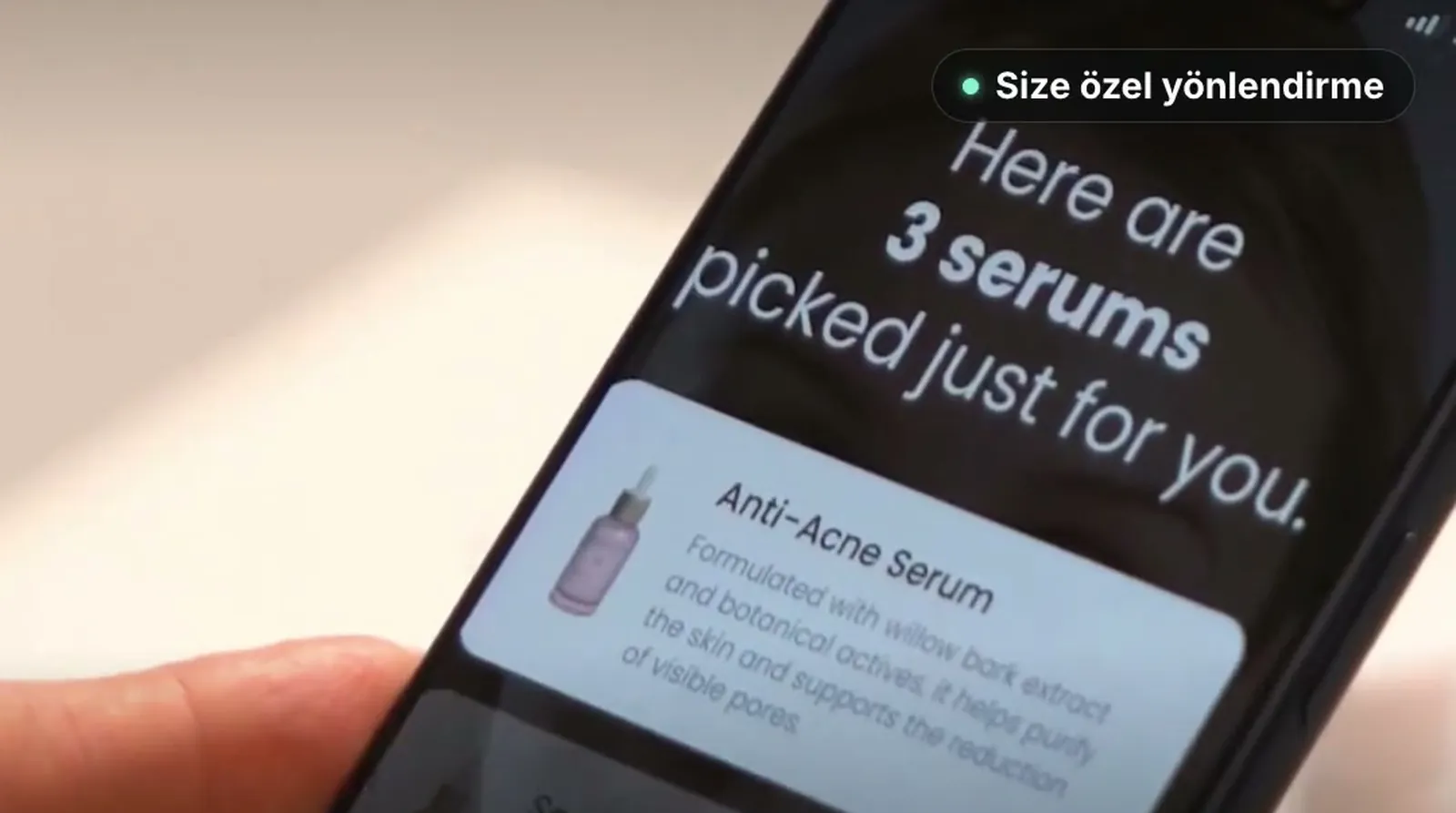
The analysis screen. In this system the analysis is done not by the device but by the app, which works with the phone's front camera; the device applies the care modes. According to QOL's app page, when the analysis ends you see your face map, your Longos Skin Score from 0 to 100, your skin type and an estimated skin age calculated from your appearance, all on one screen. On the face map, acne and blackheads are marked region by region. The page lists the indicators examined as acne, pores, wrinkles, dark circles, blackheads and uneven skin tone. The analysis is done once a week, and each result is stored with its date in the History tab.
From score to routine. Based on the result you are recommended a serum, and a seven-day morning-and-evening plan is prepared for you; you do the sessions with the device. For example, on acne-prone skin the recommendations may include the Anti-Acne Serum. The main active of this serum is natural salicylates from purple willow (Salix Purpurea) bark, and it is aimed at the appearance of acne-prone skin. Outside the weekly routine, you can also choose your own need and get a serum and device mode suggestion.
The decision stays with you. According to the manual, the serum and routine the analysis suggests are personalised advice, not a firm medical commitment. Analysis results are read-only, and the device is always started and controlled manually by you. The device is used only on the face and neck, never on the eyes or eyelids. Pregnancy and breastfeeding, an active electronic implant, active infection or an open wound in the treatment area, epilepsy, and use of photosensitising medicines are among the manual's contraindications.
Where do the device modes come from? The modes the app selects come from the six technologies of Longos Sense: Quantum Dot Light technology, Radiofrequency (RF), Ultrasonic Wave, Thermal Therapy, Cryo Therapy and Mechanical Vibration. You can find what red, blue and near-infrared light are used for in our home LED light therapy guide, how RF works and who should not use it in our home radiofrequency device guide, and how ultrasound is used together with a serum in our article on what an ultrasonic skincare device does. You can look at the set that brings the device, serums and app together on the Longos Sense Kit page.
How to read your score: a trend, not a single number
One number describes one frame. A score belongs to a single photo taken on that day in that light. A sleepless night, cheeks flushed by cold weather or hormonal fluctuations can easily move a single analysis. Think of the weekly analysis as a notebook: its value appears when the pages sit side by side.
Look at a four-week trend. At least four analyses taken under the same conditions say far more than a single measurement. If a score moves in the same direction for several weeks in a row, that is a trend. If it rises one week and falls the next, most likely what has changed is not your skin but the shooting condition.
Change is slow. Change in skin appearance builds up over weeks and months. In video interviews filmed for Quantum Orbit Labs, Prof. Günkara sums up this expectation like this: "We cannot stop ageing, but we can slow down the effects of ageing." The aim of score tracking is likewise not to look for a quick jump but to see the direction.
Don't mix scores up. Different apps use different scales and different training data. A 70 in one app and a 70 in another do not mean the same thing; make comparisons only against the same app's own history.
Your face photo is personal data: what to check under Turkey's KVKK
A photo is personal data. Turkey's personal data protection law (KVKK, Law No. 6698) treats any information relating to an identified or identifiable natural person as personal data; a clear photo of your face falls under this definition. Article 6 of the law counts biometric data among special categories of personal data. According to the biometric data guide of the Personal Data Protection Authority, a face image becomes biometric data when it goes through a specific technical process that serves to uniquely recognise or verify a person.
Read before you upload. A free AI skin analysis app and a paid one should answer the same questions. Before you start, open the privacy policy and the privacy notice and look for the following:
- Who is the data controller, and where do you send your request?
- Is the photo processed on the phone, sent to a server, or transferred abroad?
- How long are photos kept, and what happens when you delete your account?
- Are your photos also used to improve the model, and is your separate consent asked for this?
Your rights. Under Article 11 of the KVKK, you can learn whether your data is being processed, ask for it to be corrected if incomplete or wrong, ask for it to be deleted if the reason for processing no longer exists, and object to an outcome against you that results solely from analysis by automated systems. The last right is especially meaningful for AI analyses.
What does QOL's policy say? The privacy policy published on the Quantum Orbit Labs website is prepared under the KVKK for website visitors and cookies. The text lists the rights in Article 11 of the KVKK one by one, names the data controller and its address, and says that properly submitted requests will be concluded within thirty days at the latest, free of charge unless a separate cost is required. How face photos uploaded to the app are processed is not described separately in this text. For this reason we recommend that you also read the app's own privacy text and put your question to the data controller in writing.
When to see a dermatologist instead of using the app
A cosmetic analysis tracks appearance; it cannot tell you why something changed. In the situations below, set the score aside and see a dermatologist.
A changing mole or spot. The American Academy of Dermatology (AAD) recommends that moles and spots fitting the ABCDE rule be shown to a dermatologist right away: two halves that don't match, an irregular or blurred border, colour that varies from one area to another, a diameter often larger than 6 millimetres (though it can be smaller), and spots that change in size, shape or colour. According to the AAD, spots that are new, look different from the others, itch or bleed also call for an appointment.
Painful, deep or scarring blemishes. Cystic acne, redness that won't go away or suspected rosacea begin not with a serum but with a diagnosis. In such a case, a cosmetic serum can complement the treatment a dermatologist recommends, but it does not replace it.
Everything a photo can't see. If you are pregnant, take regular medication, have recently had a dermatological procedure or have a known skin condition, talk to your doctor before starting a care programme. The manual also advises seeing a dermatologist if irritation continues after use.
If the score worsens quickly under the same conditions. If within a few weeks your redness or blemish score rises clearly and is accompanied by itching, burning or flaking, ask a specialist for the cause instead of changing the routine. We explain the types of spots and which ones need a dermatologist in detail in our guide on how to get rid of dark spots on the face.
Where to start this week
This week, set a fixed day and time for the analysis in your calendar, pick a corner facing a window and take the first photo with a clean, makeup-free face. Before uploading, check in the app's privacy text where your photos are stored and for how long. After four weeks, look not only at the latest score but at the direction of all four; if you see a changing mole or spot, go to a dermatologist without waiting for the app.
If you use Longos Sense, run the app's AI skin analysis once this evening under the same conditions, and review the manual's contraindications before adding the recommended serum to your routine. The analysis does not diagnose; this article is a care guide, not medical advice.
Frequently Asked Questions
What is AI skin analysis?
AI skin analysis means an image model evaluates a face photo taken with your phone. The model has learned from many photos graded by experts. It compares the look of wrinkles, spots, pores and blemishes with those examples and produces a score for each. What it measures is how your skin looks in the photo; it does not measure moisture or collagen inside the skin, or a disease. That makes it a cosmetic tracking tool, not a diagnosis. Its most useful role is showing the direction of results when the analysis is repeated for weeks in the same light with the same phone.
Is AI skin analysis accurate?
Peer-reviewed studies give a useful but limited picture. In a 2022 study of 1,041 women, funded by a cosmetics company, the system agreed strongly with 50 dermatologists on five signs, including forehead lines and sagging. Agreement was moderate for pores, weak for spot intensity, and lower still on the darkest skin tones. Lighting and phone camera resolution can change the result. These findings belong to the system tested and do not carry over to other apps by themselves. Trust the direction of scores repeated under the same conditions, not a single score.
How do you do a skin analysis?
With an AI-based app, take the photo under the same conditions every week. Pick the same day and time and face a window so daylight reaches your face from the front. Wash and dry your face, with no makeup or cream. Hold the phone straight and steady at face height, tie your hair back, remove glasses and hats, and keep a neutral expression. Always use the same phone and switch off beauty filters. To understand your skin type without AI, observing in a mirror and the tissue test also work.
Are free AI skin analysis apps reliable?
Whether an app is free or paid does not by itself show how reliable it is. Look at three things. First, has the system been checked against expert grading in a validation study that includes different skin tones? Second, does the privacy policy say clearly where your face photo is stored, for how long, and whether it is used to train models? Under Turkey's KVKK law, a face photo is personal data. Third, does the app say plainly that it does not diagnose? Be especially careful with apps that claim to assess moles and spots.
Can AI skin analysis detect skin cancer?
A cosmetic skin analysis app does not detect skin cancer; it scores appearance. AI that assesses lesions is a medical device question. In January 2024 the US FDA authorised a device using AI in this area. It was cleared not as a screening tool but to help non-dermatologist physicians decide on referral for lesions already suspected in patients aged 40 and over. A 2020 review in the BMJ concluded that current mole-checking apps cannot be relied on to catch all skin cancers. Show any mole that is new, growing, changing colour or bleeding to a dermatologist.
What is personalised skincare?
Personalised skincare means building care from data taken from your skin and from your own goal, instead of giving everyone the same routine. Real personalisation does four things: it starts with a measurement, removes treatments that don't suit you before they enter the programme, tells you which product to use, how much and how often, and updates the routine after later measurements. Pregnancy, medicines or implants don't show up in a photo, so tell the app yourself and read the product's contraindications. See a dermatologist for problems that persist or change.
Clinical evidence

